







Qutuz’s Response to Hulagu and the Decisive Battle of `Ain Jalut
Written by: At-Tayeb Adeeb
The Islamic world passed through extremely
difficult times during the seventh century AH (the thirteenth century CE), due
to the weakness and humiliation that afflicted these lands as a result of the
invasion of the Tatar armies under the leadership of Genghis Khan. The Tatars
swept through all the Islamic emirates, from China in the far East, through
Central Asia, Iran, Iraq, and the Levant. Nothing remained for them except
Egypt, and after that, the invasion of the Maghreb and onward into Europe.
Hulagu’s
Letter to the Sultan of Egypt
In his arrogance, Hulagu sent a message to Qutuz, as recorded by Al-Maqrizi
in his book Al-Suluk li-Ma`rifat Duwal al-Muluk, saying:
From the King of Kings of East and West,
the Great Khan. In Your name, O Allah, the Spreader of the earth and the Raiser
of the heavens, let it be known to the victorious king Qutuz—who is of the race
of the Mamluks who fled from our swords to this land, enjoying its bounties and
killing those who were under his authority—that the victorious king Qutuz, the
emirs of his state, and the people of his kingdom in the Egyptian lands and
their dependencies should know that we are the soldiers of Allah on His earth.
We were created from His wrath, and we were unleashed upon those upon whom His
anger descended.
Take heed from what befell other lands, and
desist from opposing our resolve. Submit your affairs to us before the veil is
lifted and you regret, and your error returns upon you. We do not show mercy to
those who weep, nor do we pity those who complain. You have heard that we have
conquered lands, purified the earth of corruption, and killed most of mankind.
Flee, for pursuit is upon us. What land will shelter you? What path will save
you? What country will protect you?
There is no escape from our swords, and no
refuge from our awe. Our horses are swift, our arrows piercing, our swords
thunderbolts, our hearts like mountains, and our numbers like sand. Fortresses
do not protect against us, and armies avail nothing in fighting us. Your
prayers against us are not heard.
You have consumed what is unlawful, you do
not refrain in speech, you have betrayed covenants and oaths, and disobedience
and sin have spread among you. So rejoice in humiliation and disgrace: “So Today you will be rewarded with the torment of
disgrace for your arrogance throughout the land with no right, and for your
rebelliousness.” (Al-Aḥqaf 46:20). And “The wrongdoers will come to know what ˹evil˺ end they
will meet.” (Ash-Shu`ara 26:227).
Whoever seeks war with us will regret it,
and whoever seeks our protection will be safe. If you obey our command, you
shall have what we have and bear what we bear; but if you oppose us, you will
perish. Do not destroy yourselves by your own hands. The warning has been
delivered. It is established with you that we are disbelievers, and established
with us that you are corrupt. We have been empowered over you by one who
decrees affairs and administers judgments. Your many are few to us, your noble
are base to us, and there is no path of honor for your kings with us.
Do not prolong speech; hasten with your
reply before war ignites its fire and casts its sparks upon you. You will find
from us neither rank nor honor, neither protection nor refuge. Your lands will
be emptied of you. We have been fair in writing to you and awakened you by
warning you. No objective remains for us except you. Peace be upon us and upon
you, and upon whoever follows guidance, fears the consequences of ruin, and
obeys the Most High King. Has he understood?
An
Emergency Meeting with the Army Commanders
Hulagu’s letter was an explicit declaration
of war, which compelled Qutuz to convene an emergency meeting with the leaders
of the Mamluk state to respond. During the meeting, Qutuz noticed hesitation
among his commanders regarding the option of war and confronting the Tatars.
This led him to utter his famous words:
O emirs of the Muslims, for a long time you
have been consuming the wealth of the public treasury while detesting jihad. I
am going forth to meet the Mongols myself. Whoever chooses jihad, let him
accompany me; and whoever does not choose it, let him return to his home, for
Allah is watching him, and the sin of violating the honor of Muslim women will
be upon the necks of those who stay behind.
His words deeply affected the commanders,
who immediately abandoned their hesitation and supported the decision for war.
Among them was the commander Az-Ẓahir Rukn Ad-Din
Baybars, who demanded that the heads of Hulagu’s four envoys be cut off and
hung on Bab Zuweila in Cairo as a declaration of opening the door to war and
confronting the Tatars.
The
Opinion of the Sultan of the Scholars, `Izz Ad-Din ibn `Abd As-Salam
Present in the council was the scholar `Izz Ad-Din ibn`Abd As-Salam, who held a decisive view on confronting
the Tatars and on public support for the army. His statement was transmitted by
Jalal Ad-Din As-Suyuṭi in Tarikh Al-Khulafa’, summarized as follows:
If the enemy attacks the lands, it becomes
obligatory upon all people to fight them. It is permissible to take from the
populace what is needed to aid in jihad, on the condition that nothing remains
in the public treasury, and that you sell what you possess of ornaments and
equipment, and that each of you limits himself to his horse and weapons, so
that you and the common people are equal in this. As for taking the wealth of
the common people while the soldiers still possess wealth and luxurious equipment—this
is not permissible.
The
Text of Qutuz’s Letter to the Arrogant Hulagu
Praise be to Allah, and peace and blessings
be upon our master Muhammad, the unlettered Prophet.
A letter has arrived at dawn from the
Khaganate court and the Sultanate threshold—may Allah grant it victory. It is
evident that you were created from His wrath and unleashed upon those upon whom
His anger descended; you show no mercy to a complainer nor compassion to a
weeping tear. Allah has removed mercy from your hearts, which is among your
greatest defects. These are the traits of devils, not of kings.
“Say, ˹O
Prophet,˺ “O you
disbelievers! I do not worship what you worship.” (Al-Kafirun 109:1-2). In every book you have been cursed, with every vile
description you have been characterized, and on the tongue of every messenger
you have been mentioned. With us is knowledge of your origin: you are
disbelievers, as you yourselves claimed. Indeed, the curse of Allah is upon
the disbelievers. You claim that we have spread corruption, yet no honor
belongs to the supporters of Pharaoh—who cling to branches while neglecting
roots. We are the true believers; no flaw enters us, nor does uncertainty
befall us. The Quran was revealed upon us, and it has never ceased to be
merciful to us. We have affirmed its revelation and understood its
interpretation. The Fire was created for you, and for your skins it was
ignited: “When the sky split open.” (Al-Infitar 82:1).
How astonishing it is that lions are
threatened by foxes, beasts by hyenas, and champions by cowards. Our horses are
lightning, our arrows Yemeni, our swords Muḍarī. Our knights are
lions when they charge; our steeds overtake when they pursue; our swords cut
when they strike. Our skins are our armor and our chests our shields. Severe
force does not shake our hearts, nor does threat terrify our ranks—by the might
of the Almighty, the Praiseworthy.
If we disobey you, that is obedience; if we
kill you, it is a profitable trade; and if we are killed, between us and
Paradise is but an hour. You said: our hearts are like mountains and our
numbers like sand—but decree is not overawed by the abundance of sheep, and a
little spark suffices for much firewood. Shall we flee from death and settle
for humiliation? Evil indeed is what they judge.
We flee from disgrace, not from death. The
assault of death is for us the ultimate wish. If we live, then happily; if we
die, then as martyrs. hen it is certainly
Allah’s party that will prevail.” (Al-Ma`idah
5:56).
Do you seek obedience from us after the
Commander of the Believers and the successor of the Messenger of the Lord of
the worlds? No hearing from us and no obedience. You ask us to surrender our
affairs to you before the veil is lifted—never.
This is speech whose structure is Turkic
and whose threading is forced. If the veil were lifted and the decree
descended, it would become clear who erred. Disbelief after faith? Treachery
after clarity? Say to your scribe who adorned his prose and magnified his
letter: you did not fall short of what you intended; you condensed and
exaggerated. By Allah, your letter to us was but the creaking of a door or the
buzzing of a fly. You have displayed your eloquence and proclaimed your
fluency, yet you are as the poet said: “You memorized something, but many
things escaped you.”
You wrote: “The
wrongdoers will come to know what ˹evil˺ end they
will meet.” (Ash-Shu`ara 26:227). This address is yours. Soon the victorious king will
come to you—along with Bayktamar, `Ala’ Ad-Din Al-Qimari, and the rest of the emirs of the Levant—dispatching you to Hell, an evil resting place,
striking with sharp blades of steel. And say to them: if you possess such
generosity and eloquence, what need is there for reciting verses, fabricating
tales, and composing letters? Here we are—at the end of Ṣafar—our rendezvous is al-Rastan. Do not promise us a
place of peace. We have said what was present. Peace.
The
Defeat of the Tatars at `Ain
Jalut
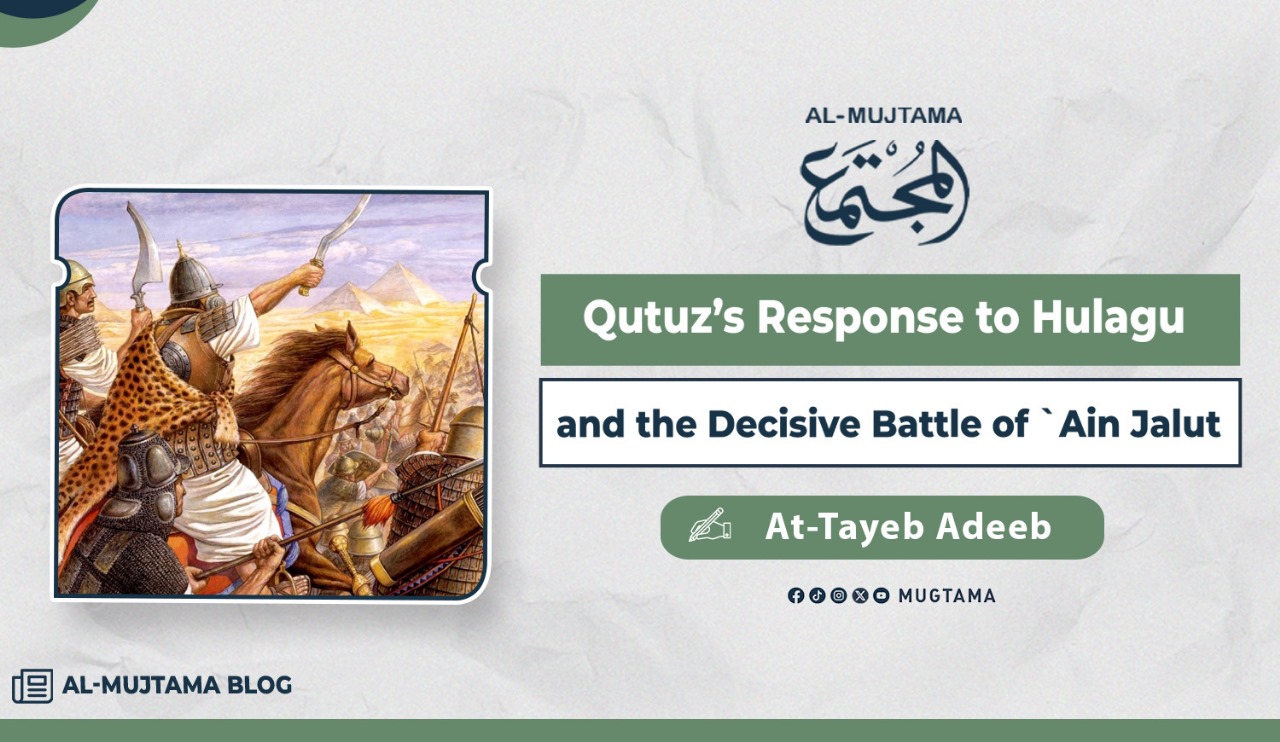
Qutuz marched at the head of the army to
meet the Tatars outside Egypt at `Ain Jalut in Palestine. He devised the decisive battle plan
with his companion, the hero Baybars. On the 25th of Ramaḍan 658 AH / 3 September 1260 CE, the decisive battle
took place. The Mamluk army, led by Sayf Ad-Din Qutuz, achieved a resounding
victory over the Tatar army, shattering their arrogance and avenging the
Muslims whose blood and property Hulagu had violated in the emirates overrun
and destroyed by the Tatar forces.
Read Also:
- Fall of the Abbasid Caliphate: A Reflection on the Causes and Consequences
- 13 Key Points Summarizing the Narrative of Crimean Tatars' Deportation
-------------------------------------------------------------