


5 Golden Benefits of Ramadan for the Muslim Family
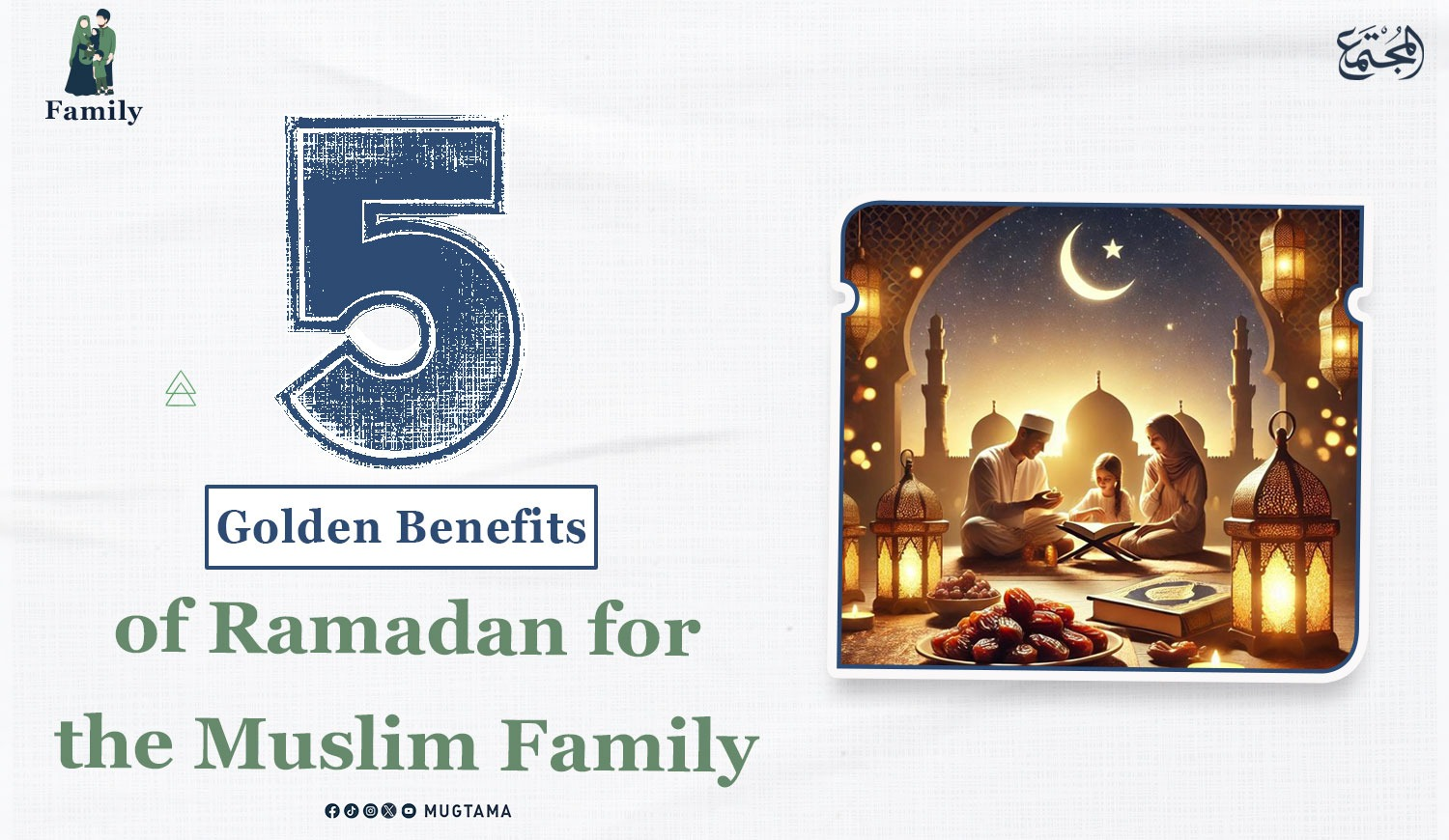
The
blessed month of Ramadan is a tremendous opportunity for the Muslim family on more
than one level—not only spiritually and faithfully, but also psychologically,
behaviorally, educationally, and socially.
The month
of fasting carries divine breezes that can transform the behavior of family
members for the better and grant them a happier life—if they succeed in
investing the month of prayer and Quran wisely. The ultimate outcome will be
attaining piety (taqwa).
Allah Says,
{O you who believe, fasting has been prescribed for
you as it was prescribed for those before you, that you may attain
righteousness.} [Al-Baqarah 2:183]
Fasting is a
school—so let us make the best use of it. It nurtures and purifies the soul,
renews faith, disciplines behavior, strengthens the heart, trains one in
patience, and cultivates awareness of Allah Almighty.
Therefore,
parents must not miss this opportunity. They should show even greater eagerness
to succeed in this divine school than the common family eagerness shown toward
academic success during the school year.
Ibn
Al-Qayyim Al-Jawziyyah said: “Whoever neglects teaching his child what benefits
him and leaves him neglected has committed the gravest wrongdoing. Most
children’s corruption stems from their parents’ neglect—failing to teach them
the obligations and Sunnahs of the religion. Thus, they led them astray in
childhood so they did not benefit from them in adulthood.”
Golden Benefits of Ramadan for the Muslim Family
This
blessed month grants the family five golden benefits:
First: Strengthening Family Bonds and
Social Connection
Fasting
improves social relationships and reunites the family around one table during
both iftar and suhoor. It is an ideal opportunity that may not be repeated
during the rest of the year due to work, studies, smartphones, and social media
distractions.
A study
issued by the University of Konstanz in Germany confirms that Ramadan enhances
the sense of belonging and identity and brings family members together through the
practice of religious rituals, thereby improving interaction among them.
Second: Increasing Happiness and Shared
Spiritual Experience for Children
Ramadan
fasting brings joy to children as they practice the religious ritual alongside
their family. Adolescents who live religious practices with their parents are
happier. More than 81% of adolescents report enjoying religious practice when
it is done with their families, according to an American study.
Third: Positive Parental Modeling and
Moral Imitation
Children
are naturally inclined to imitate their parents. This becomes especially evident during Ramadan
through fasting, night prayers, zakat, feeding the fasting person, and other
righteous deeds embraced by the family.
The
family has a profound influence on teaching children the rituals and practices
of their faith. Behavior is more impactful in children’s lives than parental
advice and words.
Fourth: Building Character and
Instilling Moral Values
The
blessed month creates a fertile and appropriate environment for learning virtues and noble morals, disciplining
behavior, and encouraging generosity, giving, and charity.
It
motivates children to empathize with the hungry and the poor, feed those in
need, maintain family ties, distribute charity and zakat, and avoid sinful
glances, lying, false testimony, idle talk, and backbiting. These moral
diseases are gradually removed from the human soul during thirty days of
fasting, placing it in a test of faith and a spiritually rehabilitative camp.
Fifth: Long-Term Behavioral and Ethical
Transformation
The
repetition of rituals—consistent fasting, night prayers, Quran recitation,
zakat, i`tikaf (spiritual retreat), feeding the fasting person, and other acts
of worship throughout this sacred month—turns them into tools of long-term
behavioral and ethical learning.
Repetition
reinforces learning. Thus, religious rituals become a means of transmitting
values and beliefs and eventually transform into a lifelong religious identity.
For Further Reading:
- 10 Divine Virtues of Ramadan
- Impact of Ramadan on Behavior
- Is Fasting Accepted Without Prayer?
-------------------------------------------------------------
