


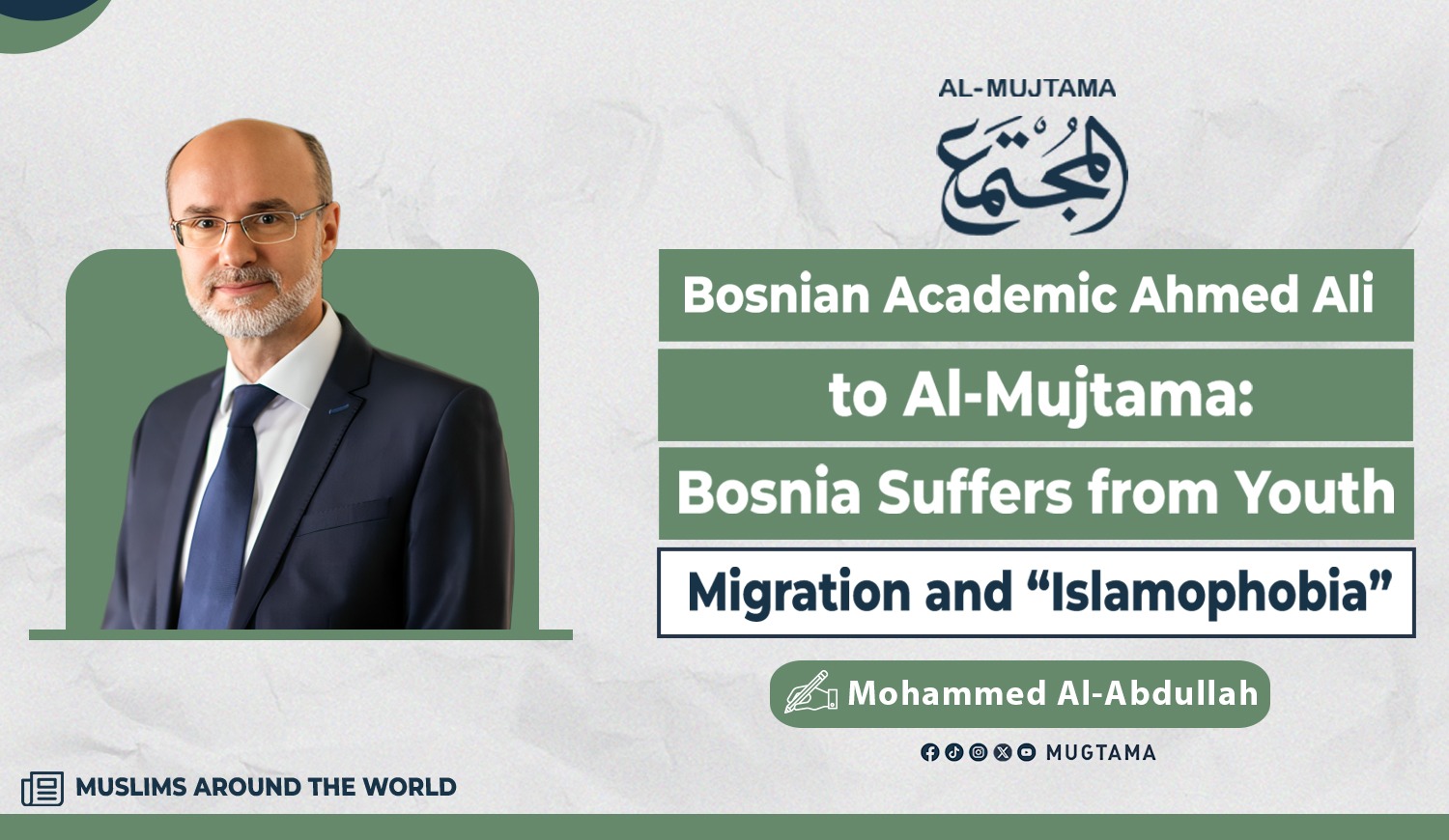
Bosnian Academic Ahmed Ali to Al-Mujtama:
Bosnia Suffers from Youth Migration and “Islamophobia”

Between rise and fall over more than five centuries, Muslims lived through all their sorrows and joys, between anxiety and reassurance, persecution and pride in their religion. The Muslimsof Bosnia and Herzegovina carved a long journey of a creed firmly rooted in hearts, becoming the gateway of Islam to Europe, standing tall against the fiercest ethnic cleansings in a world that knows only the law of the jungle.
Despite all these challenges, Bosnians
take pride in their religion and civilization, but internal challenges remain
troubling Bosnia’s Muslims, as in other Balkan countries.
Al‑Mujtama spoke with academic Ahmed Ali Bašić, Professor of Islamic
Civilization at the Faculty of Islamic Studies, University of Sarajevo, who
revealed that youth migration and the spread of “Islamophobia” are among the
most serious issues facing Muslims, in addition to the decline of the economic
situation in the country.
Bosnia as the True Gateway of Islam into Europe
“Bosnia and Herzegovina was not always
that bridge. Geographically, the route went north along the old Roman road from
Istanbul, through Belgrade, reaching Central Europe. However, after the
Ottomans withdrew from Hungary and Serbia, Bosnia’s Muslims remained faithful
to the covenant they had made. Yet bridges, despite their greatness and
usefulness, remain extremely fragile structures, and from here came the harsh
fate of Bosnia’s Muslims during the past few centuries.”
The Claim of “Islam Imposed by Force”
“The statement ‘Islam was imposed by
force on Europeans, including Bosnians’ was promoted by nationalist
historiographies in the Balkans, and is rarely taken seriously. Muslims in
Bosnia became a majority about 150 years after the arrival of Islam. If there
had been collective coercion to embrace Islam, the results would have been
different, like in regions where populations were forced to adopt the religion
of the ruling authority.”
2,800 Mosques and Nearly the Same Number of Qur’an Schools
“We want to know closely the
manifestations of Islam in Bosnia, and how Islamic culture is spread and Arabic
learning encouraged?” “The manifestations of Islam in Bosnia do not differ
essentially from Islam elsewhere. The main difference lies in the degree of
commitment and religious practice. Due to the policy of forced atheism that
prevailed between 1945 and 1990, Bosnian Muslims today are less religious than
Muslims in Lebanon and Turkey, but more religious than Muslims in Albania or
Central Asia.
In general, we have about 2,800
mosques and prayer halls (mosques without minarets), in addition to nearly the
same number of Qur’an schools. But about one‑third of the mosques do not have a
permanent imam or religious teacher.”
Religious Authority in Bosnia
“Bosnian Muslims have organized their
religious life since the departure of the Ottomans through the Islamic
Community in Bosnia and Herzegovina.
It is enough to indicate the
importance of this institution that it has existed since 1882, although Bosnia
during this period was part of multiple empires and states numbering no fewer
than five different entities. This community is led by the ‘Reis-ul-Ulema,’ or
Grand Mufti, elected by the Muslims themselves.”
The Legacy of Alija Izetbegović
“For Bosnian Muslims, the late
President Alija Izetbegović is considered above all a statesman who was able to
secure support from both East and West for Bosnia’s independence. Thanks to
this support, Bosnia today is an independent state, which is almost a miracle
considering the meager resources with which Bosnian nationalists launched this
project.
On the other hand, President
Izetbegović is remembered as a defender of freedoms and individual rights. If
there is something Bosnia can be proud of today, it is being a society that
enjoys a considerable degree of freedom.”
One‑Third of Mosques Without Imams
“What are the most prominent
challenges or obstacles facing Muslims in Bosnia and Herzegovina?” “There are
up to 2,800 mosques and prayer halls in Bosnia. Despite important achievements
in religious life, there are challenges, the most important of which are:
1. Islamophobia: We deal with it very seriously in a country that
witnessed genocide and ethnic cleansing. It is particularly evident in areas
where Muslims are a minority.
2. Migration: The migration of youth to the West makes Bosnia an aging
society with worrying demographic prospects. Nevertheless, it should be
emphasized that the youth who leave Bosnia are not necessarily lost to Islam.”
Mosque Day
“Bosnians celebrate on May 7 of each
year ‘Mosque Day.’ What is the nature of this celebration, and its role in
spreading faith and Islamic culture among Bosnians?” “This day in 1993 one of
Bosnia’s most beautiful mosques was destroyed, the Ferhat Pasha Mosque in Banja
Luka. This day serves as a reminder of the scale of destruction that befell
mosques during the aggression against Bosnia in the 1990s.
It is true that mosques had been
destroyed in previous wars in the Balkans, but never systematically as in the
1990s. In just three and a half years of war, Serbian armed forces destroyed
all the mosques they could reach.”
Economy: One of the Weakest Aspects of Life
“What is the nature of the economic
situation in the country? Are there crises weighing heavily on the country?”
“The economy is one of the weakest aspects of life in Bosnia. Unfortunately,
political instability, administrative obstacles, and corruption hinder
investment and the development of the local economy. To be fair, Bosnia is not
exceptional in this regard; we have seen the same scenario in most Eastern
European countries.”
Islamic Education
“How can Bosnian Muslims acquire
Islamic knowledge and culture?” “Teaching Islamic sciences is one of the fields
that has witnessed remarkable progress over the past thirty years. Until 1977,
Bosnian Muslims did not have any institution of higher education in Islamic
sciences.
Today, it has become possible in
Bosnia and Herzegovina to study Islamic sciences up to the doctoral level.
Scholarly works and references are widely available, and professors and
researchers from East and West frequently visit.”
-----------
Read also:
From
Bosnia to Gaza: European “hunting” trips targeting Muslims
