


Misconceptions about Palestine (16)
Did the Mamluks Care for Jerusalem?
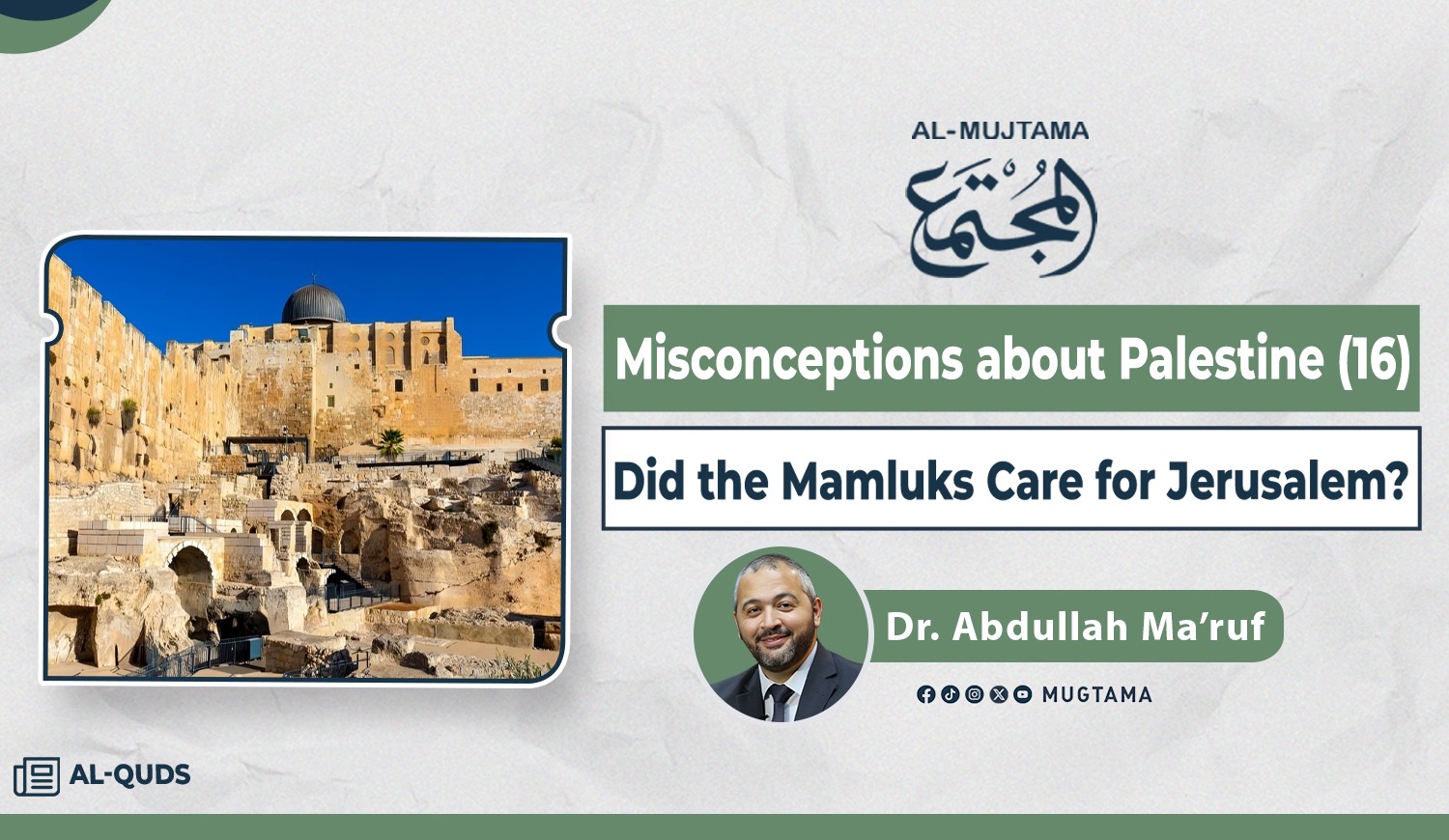
Hardly
any objective historian would dispute the exceptional attention the Mamluk
Sultanate devoted to Jerusalem. This is evidenced by the massive scale of
architectural development and the numerous monuments that populate the Holy
City, remaining to this day a vivid testament to the unique bond between the
Mamluks and Jerusalem.
Despite
this clear evidence, dissenting voices occasionally arise, seeking to distance
the Mamluks from their profound connection to Jerusalem. They argue that this
relationship was nothing more than a strategic 'exploitation' of the city,
aimed purely at gaining popular support among Muslims.
The Narrative of Marginalization
One
prominent proponent of this view is the orientalist researcher Joseph Drory
from Bar-Ilan University. In an extensive study, Drory attempts to prove that
Jerusalem lacked political importance during the Mamluk era. His argument rests
on several points: the Mamluks did not rebuild the walls destroyed by the
Ayyubid ruler Al-Mu'azzam Isa in 1219, nor did they establish the city as a
capital. Rather, by turning Jerusalem into a 'place of exile' for opponents of
the regime, Drory argues the Mamluks treated it as a secondary, marginal city.
In
reality, these allegations align perfectly with a broader narrative that many
Israeli researchers and academics seek to disseminate through their studies.
This narrative is centered on the necessity of proving Jerusalem’s marginality
within Islamic thought, while simultaneously magnifying its significance in
Jewish thought.
Mamluk Architectural Landmarks in Jerusalem
The sheer
fact that most of the monuments we see in Jerusalem today are Mamluk-built is
enough to debunk such claims. Under Mamluk rule, Jerusalem saw a surge in the
construction of grand buildings and charitable endowments that competed with
even Cairo and surpassed Damascus, the Levant’s major metropolis. This
underscores that Jerusalem was always a cornerstone of the political landscape,
where Mamluk rulers sought to cement their presence and immortalize their
legacy.
While the
Mamluks never rebuilt Jerusalem’s walls to the extent the Ottomans did, they
prioritized the preservation of its sacred landmarks. In a notable display of
devotion, the largest restoration project for the Dome of the Rock and the
Al-Qibli Mosque since the Umayyad period was carried out under Sultan Muhammad
ibn Qalawun, one of the Mamluk dynasty’s most influential and enduring rulers.
Regarding
the city wall, it was already in existence and had not been entirely razed
during the Ayyubid period. This is attested by the mentions of the wall in Al-Unsal-Jalil bi-Tarikh al-Quds wal-Khalil (The Glorious History of
Jerusalem and Hebron) by Mujir al-Din al-Ulaymi. His work remains one of the
most vital accounts describing Jerusalem during the late Mamluk era,
specifically during the reign of Sultan Al-Ashraf Qaitbay.
The
overall stability of the Mamluk State also played a crucial role. Following the
final defeat of the Crusaders by Al-Ashraf Khalil and the neutralization of the
Mongol threat, Jerusalem became a haven. Despite this relative security, the
Mamluks continued to build Ribats to house Sufis. These structures were
more than just residences; they embodied the Islamic principle of Ribat,
which represents the dedicated service of guarding and defending the sanctity
of the Holy Land.
The Centrality of Jerusalem
Moreover,
the fact that Jerusalem was never designated as a capital was never an
indicator of its political significance. Neither Mecca nor Medina served as
capitals since the end of the Rashidun era—a deliberate move to shield these
holy cities from any political strife that might compromise their sanctity.
This principle directly refutes the claim that Jerusalem was merely a 'place of
exile,' as Drory suggests; in reality, the city maintained a multifaceted
status as both a profound religious sanctuary and a strategic outpost.
Moreover,
the political and administrative weight of Jerusalem is evidenced by the direct
attachment of the Jerusalem Deputyship to the Sultanate in Cairo. This
underscores the Mamluks' dedication to the city and their commitment to
maintaining its unique religious identity; a reality that supports the Mamluk
legacy and counters the claims made by Drory and his peers.
In
conclusion, the facts on the ground and the magnificent archaeological remains
left by the Mamluks serve as the most compelling evidence refuting any
allegations regarding their relationship with Jerusalem. Indeed, such claims
are revealed to be nothing more than a form of empty sophistry.
You may
also like:
