


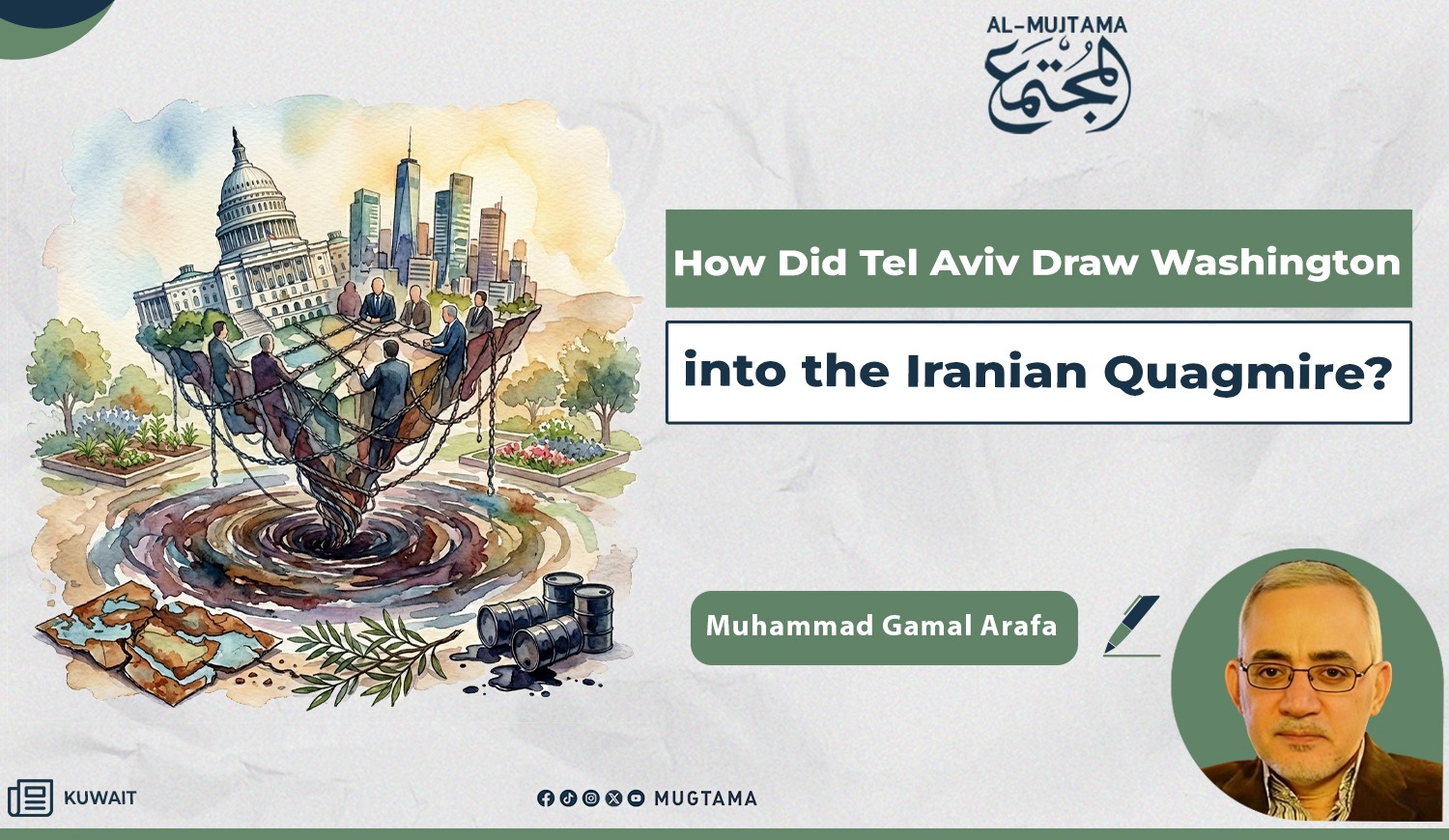
How Did Tel Aviv Draw Washington into the Iranian Quagmire?
On March
2, 2026, a journalist asked the U.S. Secretary of State: Who made the decision
to go to war against Iran — America or Israel — a decision that has harmed the
entire region? He replied that it was Israel that made the decision and
insisted upon it, leaving Washington no choice but to enter the war alongside
it, as the Iranian retaliation would have endangered American military bases.
The
following day, and before entering a session to brief members of Congress on
the war, the American Secretary of State walked back his earlier statements —
after the journalist had exposed the trap she had drawn him into.
The day
after his statement, the same journalist asked him: "You said that Israel
was the one who made the decision, yet President Trump said that he was the one
who made it." He challenged her, saying: "If you had attended my
remarks yesterday, you would have found that I said no such thing!" She
then embarrassed him by responding: "I was there — and I am the one who
asked you yesterday!
This
incident encapsulates the state of embarrassment, contradiction, and anger in
America — particularly between the Democrats and the MAGA movement that
supports Trump — stemming from Trump's preference for an "Israel
First" agenda over his own campaign slogan of "America First,"
and his entanglement of the country in precisely the kind of war he himself had
previously warned against.
In fact,
President Trump has become the most strike-happy commander-in-chief in modern
American history, having ordered military strikes spanning 7 countries —
including Iran, Nigeria, and Venezuela— according to Axios.
Trump ran
for election as an anti-war candidate, yet fell victim to Israeli influence — a
influence that prompted American analysts to question what Israeli Prime
Minister Netanyahu had done to drag him into a war that has harmed the entire
Arab region and the world at large. Some suggested that he may have been
blackmailed with files related to the scandals of his friend Jeffrey Epstein, the convicted sex trafficker of minors.
Divisions Within the Republican Party
Due to
his embroiling of America in the attack on Iran in service of Israel's agenda —
aimed at establishing Israeli dominance over the Middle East following the
elimination of the Iranian threat — many of Trump's own supporters within the
MAGA (Make America Great Again) movement turned against their leader, and
divisions within both the movement and the Republican Party continued to grow.
The
"America First" slogan, under which Trump ran his 2024 presidential
campaign, was meant to signify the prioritization of the American people's
interests over foreign entanglements and opposition to involvement in new wars.
Yet what Trump ultimately did served an "Israel First" agenda
instead.
The Quagmire of War and Elections
Due to
the relative resilience of the Iranians — despite the staggering losses in the
lives of their leaders and civilians, the destruction of their cities, the
degradation of Iran's infrastructure, and the damage inflicted on its
oil-exporting regions — and the continuation of their strikes on Tel Aviv and
what they describe as American military bases in the Gulf, which have also
struck civilian areas, Western assessments anticipate that Trump will
ultimately be compelled to bring the war to a halt.
According
to these assessments, Trump is already seeking a way out and is making
statements that pave the ground for one — such as claiming there are no more
targets left to strike. This comes particularly in the wake of publicly
acknowledged military losses, including the deaths of 11 American soldiers, the
loss of 5 aircraft (4 of which were downed accidentally by Kuwaiti air
defenses), damage to warships, and strikes on 17 bases and radar installations
across the Middle East.
One of
the reasons behind Trump's retreat — beyond the divisions within his MAGA
movement — is the approaching midterm congressional elections, which all polls
predict his party will lose.
The
Israeli-American war on Iran has so far failed to achieve a number of its
stated plans and objectives, according to political analyst Nahum Barnea of the
Israeli newspaper Yedioth Ahronoth. Moreover, Trump's eagerness to declare
victory remains out of reach — yet an exhausted Iran still holds winning cards,
according to The Washington Post. Barnea noted that two weeks into the war,
both Israel and the United States had miscalculated the response of the Iranian
regime and Hezbollah, both of which have held their ground and continue to
fight back.
Historically,
the sitting U.S. president's party loses in midterm congressional elections —
particularly in times of foreign wars, and especially when those wars are
accompanied by domestic economic pressures such as slowing growth, rising
inflation, or increasing unemployment. This is precisely what Trump and his
party are expected to face in the November elections, the early signs of which
have already appeared with their defeat in Texas.
Did the War Succeed or Fail?
The
outcomes of the war so far suggest that each party has achieved gains and
suffered losses in equal measure, making a ceasefire a dilemma in itself — as
each side awaits a decisive victory that remains out of reach. The result is
neither a winner nor a loser, but rather a protracted conflict.
America
and Israel have achieved a partial military victory, yet have suffered a moral
defeat. Iran has been battered on the ground, with multiple regions, its
military infrastructure, and civilian facilities destroyed — yet it has gained
political resilience. Meanwhile, the greatest economic loser is the world at
large, and the Gulf region in particular, which is paying the price of a war
that is not its own.
Analysts
and experts therefore anticipate an open-ended outcome rather than a clear
peace agreement — one characterized by no decisive victory for any party, a
gradual de-escalation or an undeclared ceasefire, the continuation of a
"shadow war" (limited strikes and intelligence conflict), and an Iran
that emerges more hardline than before.
According
to the Atlantic Council, this is a high-stakes war with no clear endgame. The
International Institute for Strategic Studies (IISS) acknowledges military
achievements, but notes the absence of an exit strategy for both America and
Israel from the Iranian quagmire. The Center for Strategic and International
Studies (CSIS), meanwhile, believes the conflict will persist in a
low-intensity form in the war's aftermath.
American
and Israeli assessments suggest that both have succeeded, citing as indicators
of success the slowing of Iran's nuclear program, the weakening of some of
Iran's regional proxy arms, and the temporary reinforcement of Israeli
deterrence.
However,
analysts point to numerous indicators of failure, among them: the inability to
eliminate the Iranian threat at its roots, the soaring economic and military
cost of the war, the widening of the conflict rather than its containment, and
the surge in Iran's domestic and regional popularity as a nation perceived to
be under assault.
Tactical Success and Strategic Risks
According
to the general assessment found across much of Western analysis, the war's
harvest so far amounts to short-term tactical success at the cost of long-term
strategic risks. Iran's use of cluster missiles striking deep into enemy
territory represents a strategic shift in the rules of engagement and a
penetration of air defense systems — putting the entire theory of deterrence to
a genuine test.
This
escalation does not merely target physical destruction; it aims to paralyze the
home front, undermine confidence in the entire security apparatus, and inflict
psychological damage on the Israelis. Videos have been circulating of Israelis
in shelters, crying out over the paralysis of their lives and livelihoods at
the hands of Netanyahu and Trump's gamble.
The
United States achieved gains in the form of destroying a portion of Iran's
missile and nuclear capabilities and temporarily restoring military deterrence
— yet it lost the trust of its allies in the Arab region, suffered the economic
blow of rising inflation and the hardship imposed on Americans by surging oil
prices, along with a negative impact on growth. In short, it won militarily
while losing economically, at least in part.
Israel
achieved gains through the destruction of approximately 60% of Iran's missile
platforms, the short-term reinforcement of its military superiority, and the
assassination of senior leadership figures — yet it suffered losses in the form
of missile strikes causing casualties and thousands of wounded, threats to its
home front, the closure of its airspace, the risk of prolonged attrition, and
the persistence of the threat.
Israel
has for decades been committed to entrenching what is known as its qualitative
military edge — ensuring its superiority over all regional states combined
through advanced military technology, air supremacy, intelligence capabilities,
and a nuclear umbrella. The Israelis have sought to destroy every Arab or
Islamic power they deem a threat, to the point where they are already speaking
of Turkey as a future target once they are done with Iran — with Tel Aviv
maintaining that any Iranian rise constitutes a direct threat to its status as
the region's preeminent power.
Iran, for
its part, achieved gains through the survival and cohesion of its regime, the
reinforcement of the Revolutionary Guards' grip on power, the demonstrated
ability to disrupt the Strait of Hormuz and impact the global economy, and the
transformation of the war into a protracted regional conflict. Yet it suffered
enormous losses, including widespread destruction of its military and economic
infrastructure, billions of dollars in losses to its oil sector and broader
infrastructure, and a relative degradation of its missile capabilities.
Iran is
therefore expected to emerge from the conflict with its ground, air, and naval
capabilities significantly damaged — and yet its security forces have shown no
signs of collapse or widespread defection, while the internal opposition
remains disorganized and poorly armed. Iran has also lost the sympathy of Arab
peoples, particularly those of the Gulf states, as a result of its strikes on
Gulf countries and Jordan.
Global Losses
As for
the world, its losses are the most significant of all — as economic and
political turmoil has spread globally, with the temporary loss of approximately
20% of global gas supplies, a loss of 3.2 trillion dollars from financial
markets within days, severe disruption to trade, aviation, and supply chains,
and most critically, the loss of international peace and security, the
paralysis of the United Nations, and the rise of a global culture of bullying.
A joint
report by the German outlet Merkor and the American magazine Newsweek outlined
three possible scenarios currently being discussed in the United States for how
the war with Iran might end: either a swift victory — now considered unlikely
given Iran's resilience — a diplomatic solution, or a prolonged regional
conflict.
You may
also like:
10 Facts Exposing the Falsity of the "Military Bases Pretext" in IranianRhetoric
