


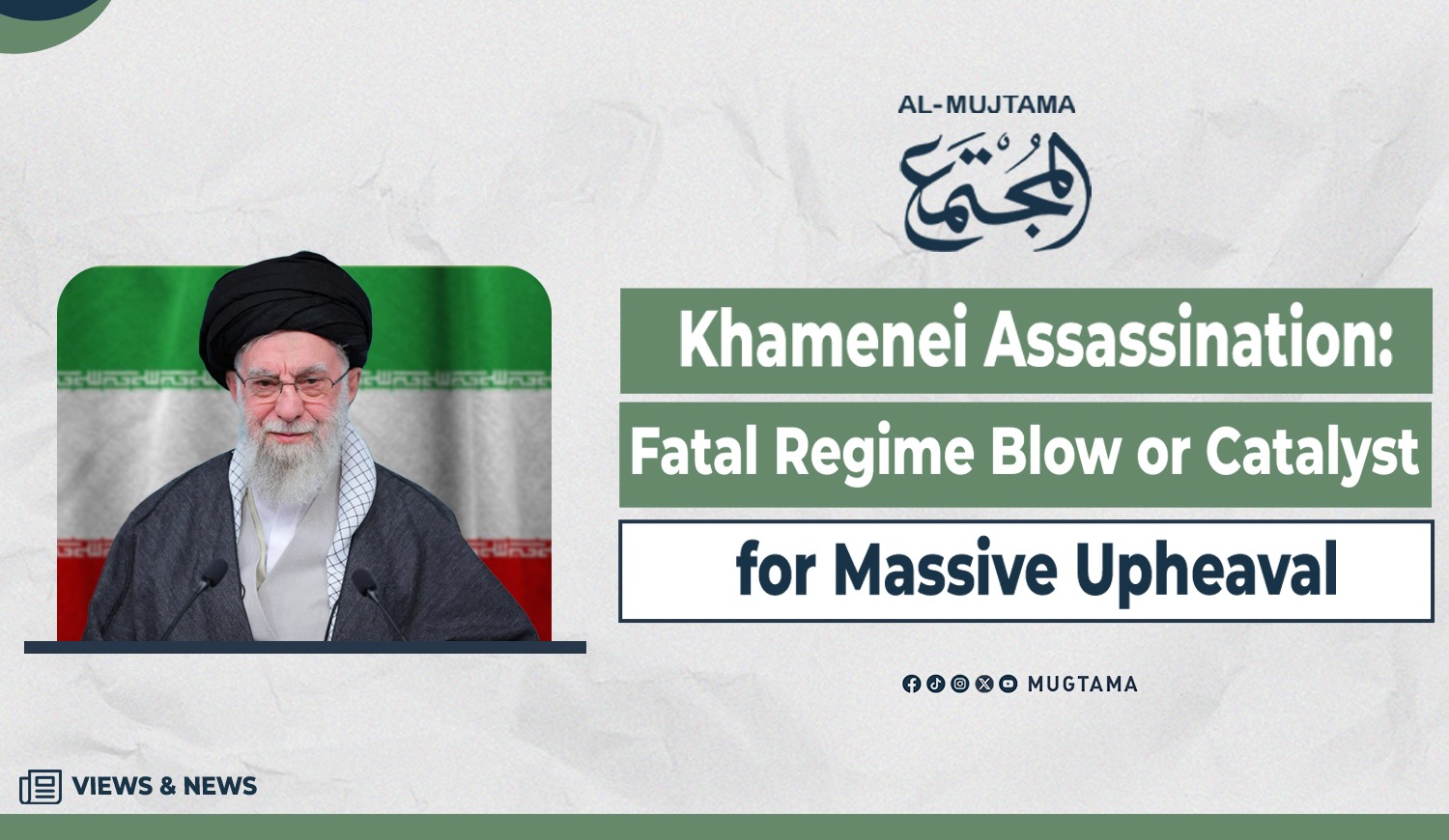
Khamenei Assassination: Fatal Regime Blow or Catalyst for Massive Upheaval
In what
is considered the most perilous escalation since the outbreak of military
confrontation between Tehran, Tel Aviv, and Washington, Iranian state media
confirmed on Sunday the death of the Islamic Republic’s Supreme Leader, Ali
Khamenei. His death resulted from joint U.S.-Israeli airstrikes that targeted
Iran early Saturday morning, coming just hours after U.S. President Donald
Trump first announced the leader's killing.
Iranian
state television reported that Ali Khamenei, the Leader of the Revolution and
the Islamic Republic of Iran, was killed in the ongoing U.S.-Israeli aggression
that began Saturday morning. For its part, the Islamic Republic News Agency
(IRNA) confirmed Khamenei's death following the airstrikes, while Fars News
Agency stated that the Supreme Leader was killed in his office while on duty
during the early hours of Saturday. Fars further added that Khamenei’s
daughter, son-in-law, and grandson were also killed in the same attack—a
development reflecting the expanding scope of targets within the inner circle
of the top leadership.
National Mourning and Vows of Retaliation
The
Iranian government has declared 40 days of national mourning, alongside a
seven-day closure of all government institutions. In an official statement, the
government asserted that this 'heinous crime' will not go unanswered, declaring
that 'a new chapter will be written in the history of the Islamic world.' It
added that the retaliation would be carried out with 'full force and firmness,'
backed by the Islamic nation and the free people of the world.
The
Iranian Presidency echoed these sentiments, emphasizing that the assassination
is a major crime that will not pass without retribution, and that Tehran will
respond decisively against the perpetrators and those behind them.
Meanwhile,
the Islamic Revolutionary Guard Corps (IRGC) vowed a 'crushing and decisive'
revenge, viewing the incident as a blatant violation of all religious, moral,
legal, and customary standards. In a statement carried by IRNA, the IRGC
affirmed that 'the hand of the Iranian people's vengeance will not falter in
delivering a severe, decisive, and regret-inducing punishment to the killers.'
It further noted that the armed forces would continue to follow their leader's
path in confronting both domestic and foreign 'conspiracies,' calling on all
segments of society to mobilize in national defense to demonstrate unity.
U.S. Announcement and Counterattack
The
Iranian confirmation came hours after Trump announced, via his 'Truth Social'
platform, the killing of Khamenei in joint U.S.-Israeli attacks on Tehran,
describing him as one of the 'most evil figures in history.'
In a
rapidly escalating development, the Revolutionary Guard (IRGC) announced the
launch of a violent offensive against Israel and U.S. bases in the region in
retaliation for the Supreme Leader's assassination—a move that opens the door
to a broad regional escalation.
Assassination of Prominent Military Leaders
Iranian
state television also confirmed the deaths of Major General Abdolrahim Mousavi,
the Chief of Staff of the Iranian Armed Forces, Brigadier General Aziz
Nasirzadeh, the Minister of Defense, and Major General Mohammad Pakpour, the
Commander-in-Chief of the IRGC.
The
report clarified that these leaders were assassinated during a joint
U.S.-Israeli strike that targeted a Defense Council meeting held yesterday.
This indicates a concentrated blow aimed at the pinnacle of both the political
and military hierarchy simultaneously.
Constitutional Arrangements for the Post-Supreme Leader Era
In a
constitutional context, the spokesperson for the Guardian Council announced
that the Assembly of Experts is responsible, according to the Iranian
Constitution, for the task of selecting the new Supreme Leader. Meanwhile, a
provisional leadership council will assume the powers of the Supreme Leader
until the selection process is completed.
Larijani: A Painful Response and Targeting of Bases
For his
part, Ali Larijani, Secretary of Iran’s Supreme National Security Council,
stated that his country will 'burn the hearts of America and Israel,' just as
'our hearts were burned for the Supreme Leader.' He contended that Trump has
fallen into an 'Israeli trap,' making Israel his priority rather than America.
Larijani emphasized that the enemy is 'delusional' to believe that
assassinating leaders will destabilize Iran, noting that the Iranian response
will be even more powerful than what was seen yesterday, and that the armed
forces are well-prepared with favorable conditions to continue operations.
He also
stressed that Tehran has no intention of attacking neighboring countries.
However, he clarified that U.S. bases in the region will be considered
'legitimate targets' if they are used to serve Washington's interests. Larijani
further revealed that Iran has notified the United States, via the Swiss
Embassy, that it will target its bases if subjected to any further aggression.
You may
also like:
On the Priority of Stance in the Conflict Between the Zionist and Iranian Projects
Israel's Tools for Penetrating Arab and Islamic Countries
