


Leaking the Code: Abu Basir and Respect for International Agreements
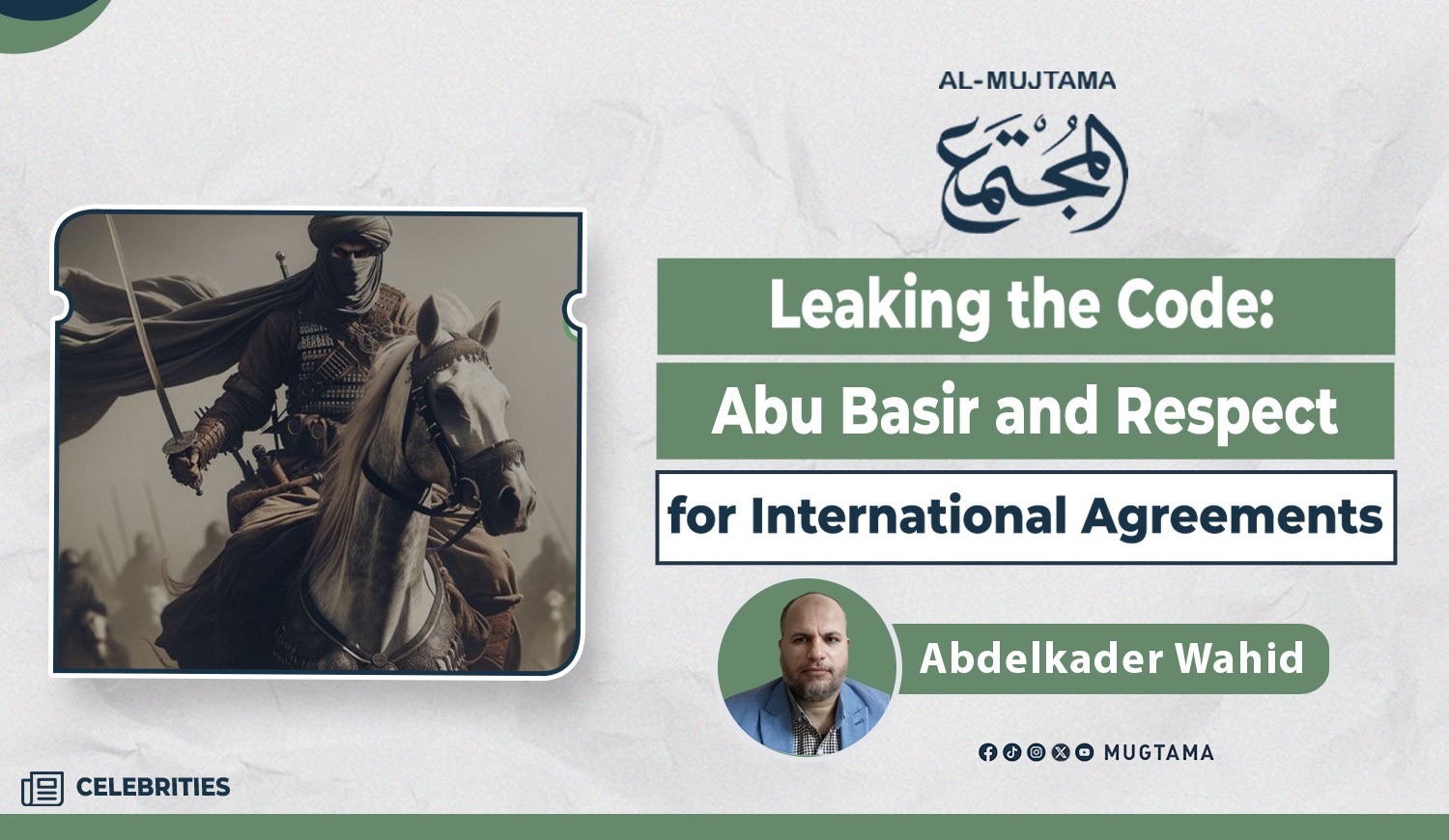
Just as
his kunya (agnomen) became more renowned than his actual name—to the point of
being known solely by it—his dynamic sense, his ability to crack codes and read
between the lines also surpassed all others, complemented by a profound acumen
in crisis management.
He is the astute and sagacious companion, Abu
Basir—born Utbah bin Asid al-Thaqafi—whose shrewdness and intellect enabled him
to secure his own freedom without compromising any pact or treaty.
The companion Abu Basir utilized his
environmental context and the resources at his disposal, in alignment with the
customs and traditions of his society, to become an inspiring model in crisis
management—all without violating international agreements, treaties, or
conventions.
Self-Control and the Forging of Treaties
We all remember, and it is no secret, what
transpired during the 'Treaty of Hudaybiyyah' and the unfairness embedded in
its terms, which seemed crafted specifically to be breached. It highlights the
Prophet’s (PBUH) immense endurance in the face of Quraysh’s arrogance and
haughtiness, manifested throughout the negotiations.
This trajectory of arrogance and disdain led a
companion of Al-Faruq Umar's stature to utter his famous words: 'I never
doubted my faith except on the day of Al-Hudaybiyyah.' This, despite the fact
that the negotiator was the Prophet (PBUH) himself—not an ordinary individual
or a person prone to flawed human judgment .
The peak of this arrogance and intransigence
reached a highly complex stage during the finalization of the treaty's terms.
Among these, as is well known, was the stipulation that the Prophet (PBUH) must
return anyone from Quraysh who came to him as a believer, whereas those who
apostatized and returned to Quraysh would not be sent back.
Coinciding with these earth-shattering
conditions, Abu Jandal—the son of the chief negotiator Suhayl bin Amr—arrived
as a migrant believer, bearing the visible marks of torture. He threw himself
into the scene while the treaty was still being drafted, causing the situation
to reach an unprecedented level of tension; it was as if a new volcano had
erupted amidst the earthquake of those oppressive terms .
The Prophet (PBUH)—holding the dual roles of
Head of State and Lawgiver—had no choice but to adhere to the terms of the
agreement; consequently, Abu Jandal was returned to Quraysh. This prompted
Al-Faruq Umar to address the son of the chief negotiator using a 'coded
message,' encouraging him to find a way to secure his own freedom.
Although
Abu Basir understood the 'code,' he did not act at that moment because his
father was the chief negotiator. He departed with them but was later able to
secure his own freedom.
Abu Basir and Social Intelligence
Following
the oppressive terms and the return to Medina, Abu Basir arrived as a Muslim,
yet the Prophet (PBUH) returned him to Quraysh. Along the way, accompanied by
two men, Abu Basir outwitted them; he managed to seize the weapon of one and
struck him to death.
As for
the other man, he was struck with terror and fled back to Medina, running so
fast that the pebbles flew from beneath his feet with Abu Basir in pursuit. He
threw himself before the Prophet (PBUH), who, upon seeing him in such a state,
remarked: 'This man has truly seen a terrifying sight' .
When Abu
Basir appeared behind the man in pursuit, the Prophet (PBUH) uttered his famous
words—a statement that appeared to be a rebuke yet carried a 'code' understood
by the astute Abu Basir. He (PBUH) said: 'Woe to his mother! What a firebrand
of war he would be, if only he had men with him!
Abu Basir realized that the Prophet (PBUH)
would eventually have to return him [to Mecca] because of his actions. However,
the Prophet (PBUH) allowed him to depart, and he headed to a location between
Mecca and Medina known as Sif al-Bahr.
On his
part, Al-Faruq Umar 'leaked the code' he had heard from the Prophet (PBUH)—'if
only he had men with him'—to all the oppressed Muslims in Mecca. Consequently,
they began to slip away one by one to join Abu Basir at the location he had
meticulously and strategically chosen. Their numbers grew into the dozens, and
they once again intercepted Quraysh's trade routes. Meanwhile, the Prophet
(PBUH), as a statesman, remained diplomatically blameless, as he had never
officially sanctioned or ordered such actions.
As a result of their own arrogance and
haughtiness, Quraysh found themselves in a predicament once again. They
hastened to the Prophet (PBUH), pleading with him to order Abu Basir and his
men to stop intercepting their trade caravans. In exchange, they offered to
waive the oppressive condition, effectively conceding that any believer who
sought refuge with the Prophet (PBUH) would no longer be returned to them.
The Conclusion
These
events reveal an exceptional sense of discernment and an unprecedented level of
self-control exhibited by the Lawgiver (PBUH) and his companions. It highlights
their mastery in deciphering and utilizing 'coded signals' without compromising
the integrity of the agreement—a treaty through which even the Quraysh had to
acknowledge the Prophet's (PBUH) profound integrity, honor, and steadfast
commitment to his word.
This saga culminated in Abu Basir’s triumph
and his eventual ability to return to Medina without being extradited to
Quraysh again. This was made possible by the arrival of the Prophet’s (PBUH)
letter, ordering him and his followers to return. However, he was then in his
final illness, and he passed away with the Prophet’s (PBUH) message resting
upon his chest. He left behind a unique model of the 'shrewd and maneuvering
resistance'—a rare breed of individuals whose presence is scarce, yet whose
actions yield immense benefit.
The noble
companion revealed a vast space where brilliant minds intersect—those capable
of reading between the lines and leveraging their resources according to their
environmental context. It began with a single individual, Abu Basir—a 'rebel'
in the eyes of the international community—and ended with dozens who imposed
their will. Together, they forged a new reality, achieving a manifest victory
and providing a path of relief and deliverance for all the oppressed and
persecuted.
We are in
dire need of this intelligent model—to extract its wisdom and lessons rather
than merely replicating them. Just as the noble companion Abu Basir did, who
managed to secure his freedom without imposing any cost on his supporters or
causing embarrassment to his state. At the same time, his crisis management was
conducted in total harmony with the customs and traditions governing his social
environment.
Abu Basir
possessed immense social intelligence, through which he leveraged all the
mechanisms of his environment. He managed his crisis with mastery, carefully
mobilizing time, place, and people to create a turning point. This resulted in
a breakthrough that alleviated the immense psychological and political burden
of the most significant treaty in the era of the Prophetic Mission.
Furthermore,
one must not overlook the profound insight of the ingenious companion Umar ibn
al-Khattab, who played a brilliant role in disseminating the 'code' after
deciphering it. His actions fostered a parallel power and generated moral and
psychological momentum for Abu Basir. As the oppressed gathered around him, Abu
Basir channeled this energy in a way that avoided international friction,
ensured the State of Medina remained uncompromised, and preserved the integrity
of its treaty.
You may
also like:
Salim Mawla Abu Hudhayfah: Qur’an Bearer and Hero of Yamama
Abu Dujanah... The Owner of the Band of Death
Anas Ibn Malik: The Faithful Servant and Esteemed Narrator
_______________________________________
