


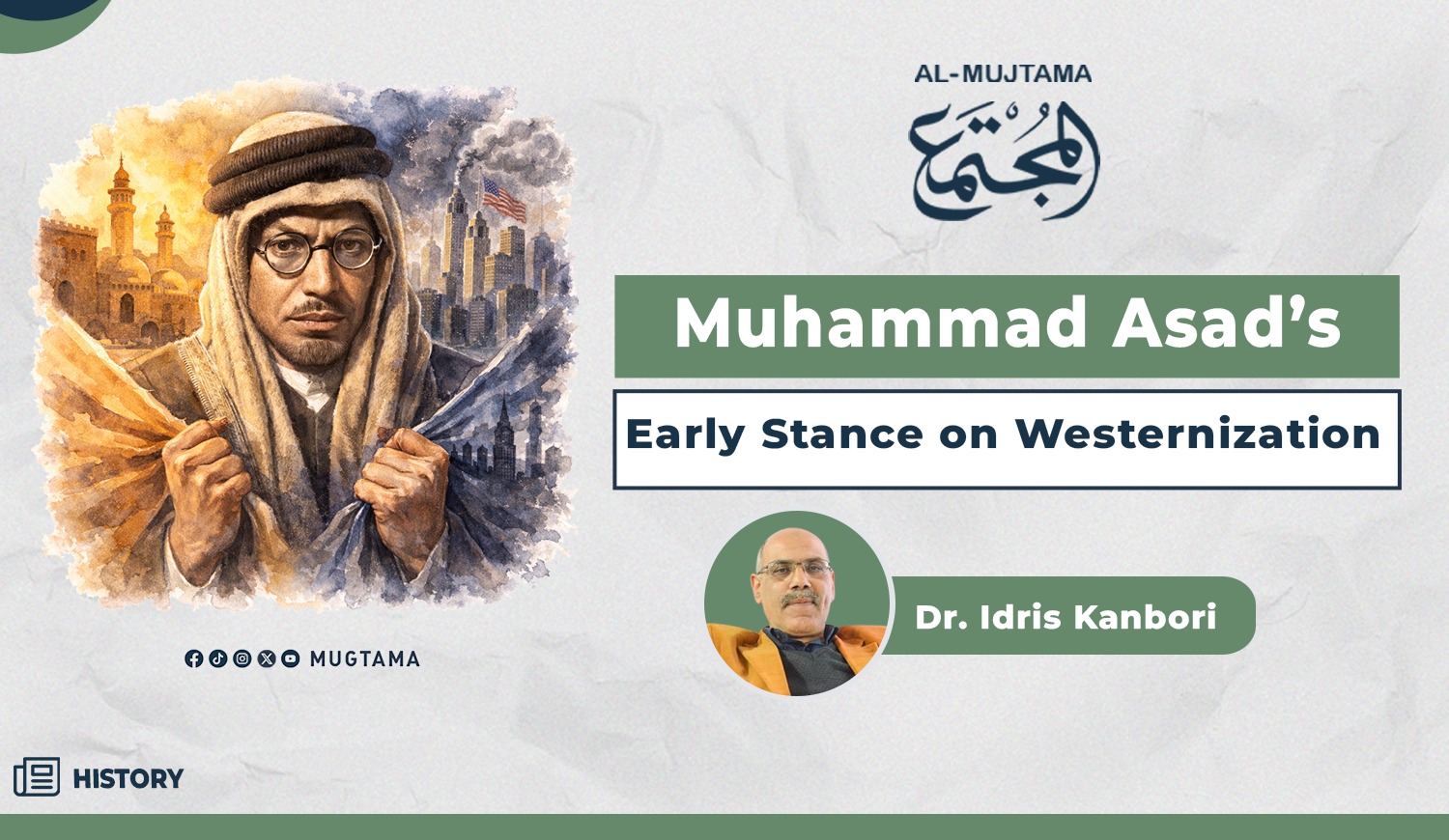
Muhammad Asad’s Early Stance on Westernization
A Journey of Faith
Muhammad Asad (1900–1992) was a preeminent
modern Muslim thinker. After converting from Judaism in 1926 and changing his
name from Leopold Weiss, he traveled extensively throughout the Islamic world,
engaging with its scholars, leaders, and intellectuals. His journey eventually
led him to Cordoba, where he lived until his passing in 1992.
The Insider’s Perspective
Having
been born and raised in Austria, Muhammad Asad emerged from the very heart of
Western culture. His lived experience allowed him to grasp the inner workings
and nuances of Western life. Upon embracing Islam, he gained a unique
analytical framework to evaluate both civilizations. This set him apart from
other Muslim thinkers who often only understood the West superficially; for a
man born to Western Jewish parents possesses an inherent perspective that
differs fundamentally from those born into Muslim families who later encounter
the West.
Consequently,
Muhammad Asad adopted a critical stance toward Western civilization early on.
He engaged in intellectual confrontations with proponents of Western imitation
at a time when Western culture was the object of widespread fascination and awe
among Muslim thinkers and intellectuals.
Observations in Lahore
During
his stay in Lahore, Asad noticed a growing tendency toward Western imitation in
culinary habits and home furnishings. He contrasted these emerging European
customs with the "rich and diverse" Mughal, Turkish, and Persian
traditions that were being abandoned. Throughout his travels across Indian
cities, he further observed the widespread adoption of European attire among
Muslims.
The Paradox of Imitation
This
marked the beginning of his awareness of the contradiction between advocating
for Islam and imitating the West. He observed that while Muslims were defending
their faith and establishing organizations to serve it, they were
simultaneously adopting European traditions and living according to Western
lifestyles.
In the
second part of his autobiography, following The Road to Mecca—a
posthumously published volume titled Homecoming of the Heart that,
unfortunately, remains untranslated into Arabic—Muhammad Asad recounts how,
during his stay in India in the 1930s, he received invitations from various
Muslim associations to deliver lectures on his conversion to Islam.
Islamic vs. Western Civilizations
During a
1933 lecture in Lahore organized by the "Society for the Protection of
Islam" (Anjuman-e-Himayat-e-Islam), Asad detailed the defining traits of
Western and Islamic civilizations. He argued that while Islamic civilization
was self-generated, Western civilization emerged from a fusion of Roman
materialism and Medieval Christianity, influenced by the dualism of light and
darkness. He concluded that Quranic teachings are fundamentally irreconcilable
with a culture that centers man as the universe's focal point, prioritizes
consumerism, and has severed its ties to spiritual values.
Muhammad
Asad continues by noting that his ideas encountered criticism from several
Indian Muslims who rejected them. The lecture sparked significant debate, which
prompted him to consider publishing a book to articulate his thesis more
clearly. This led to the birth of his book, Islam at the Crossroads,
first published in 1934.
Legacy and Modern Relevance
The book
was met with widespread acclaim across Europe and the Islamic world,
particularly in India. It earned the admiration of the philosopher-poet
Muhammad Iqbal prior to the establishment of Pakistan and was translated into
numerous languages, including Arabic.
In its
pages, Asad highlighted the distinct character of Islamic civilization and its
fundamental differences from materialistic Western culture. He called for the
adoption of Islamic values in lifestyle, thought, and conduct, warning against
the pull of Westernization. He argued that Islam stands at a
"crossroads," and Muslims must choose the path best suited to
building their own modern civilization.
Asad
crystallized this profound thesis through his extensive experience with Western
elite circles and his deep engagement with European intellectual and
philosophical movements. Furthermore, his comparative study of Judaism,
Christianity, and the Quran provided a unique depth to his work. Today, as
Westernization expands even further nearly a century later, there is a pressing
need for Muslims to rediscover and re-read his insights.
You may
also like:
On Civilizational Backwardness in the Islamic World and Its Causes
