


Recruitment in Gaza: Administrative Void or Security Readiness

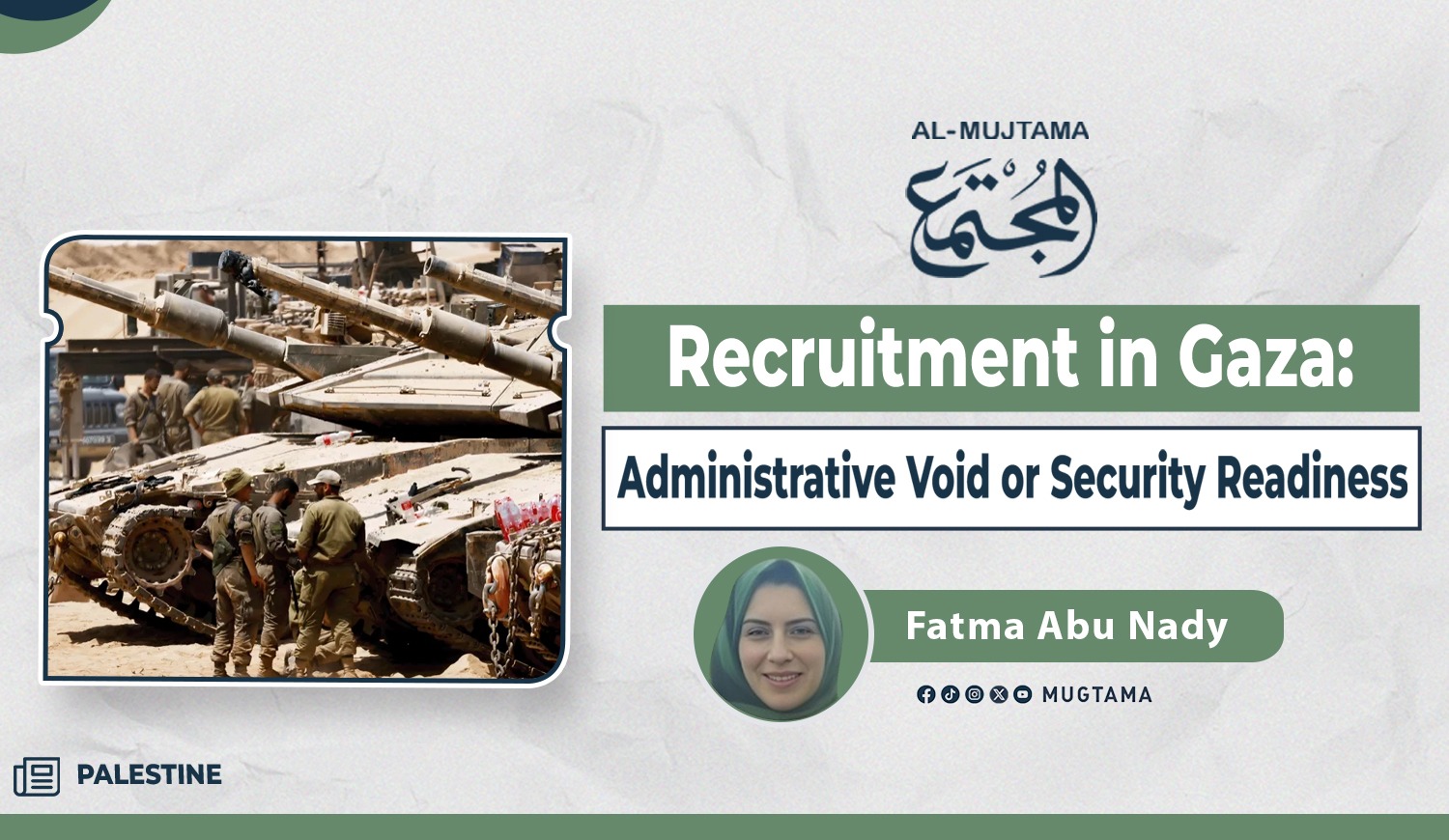
According to two parallel tracks, the United States and its "Peace Council" partners have started taking concrete steps to create new security arrangements in the Gaza Strip: first, sending a multinational international force to stabilize the area, and second, establishing a police force made up of locals. More than 2,000 people have registered to join the "Palestinian police force," which will be established in the Gaza Strip under the jurisdiction of the administrative committee in Gaza, since the announcement of the recruitment of Palestinian police from the Gaza Strip was made by Nikolai Mladenov, the head of the Executive Council of the Peace Council, from Washington during its first session. He then expressed gratitude to Egypt, Qatar, and Turkey for helping to remove the barriers. However, to start the restoration process and make the negotiating and implementation plan a reality, Hamas must fully disarm from the Gaza Strip.
With the actual absence of the
national committee established by the Peace Council with the collective
approval of the member nations, the debate regarding the recruitment file is
growing. Given the contradictions that surfaced from the moment the police
force registration link was announced, this absence calls into question the
validity of beginning the recruitment process while the person in charge of
chairing the committee is not physically present.
Economic Collapse and Youth Motivation
Motivated by an almost collapsed
economic reality, thousands of young people from a number of backgrounds rushed
to register as soon as the employment link was disclosed, particularly those
who had lost their jobs and belongings as a result of the conflict. For many,
the recruitment clause offered a glimmer of hope for escaping the void and
suffering. Social media exchanges clearly showed this, with some young
people utilizing artificially intelligent graphics to communicate scathing
sarcasm while threatening Hamas and blaming it of causing the current state of
affairs. Others, on the other hand, viewed joining the police as a chance to
rebuild themselves in a controlled, professional manner appropriate for the
uniform and its symbolic importance.
Excluded by War Disabilities
However, this scene was not inclusive
of everyone. The conflict left hundreds of young people permanently disabled,
which prevented them from taking advantage of chances. As if the curse of war
accompanies them long after the fights have ended, entrenching a double
economic and social incapacity, some of them had their limbs removed while
others suffered from chronic ailments and faced a harsh reality that deprives
them even of the dream of employment integration.
Regional Security Dimensions
If the police forces in Egypt
and Jordan are fully formed, organized, and trained, then complicated security
and political aspects will become apparent. Will this force resume its
traditional security responsibilities, or will it become central to a problem
involving resistance weapons? If things go out of hand, might it turn
into an internal conflict that recreates the 2007 division scene? Or is a
formula for resolving the weapon issue being negotiated at the regional and
international level, preventing Palestinian police forces from becoming
involved in a war that has a political and military component that is part of
the same social If Egypt's and Jordan's authorities are fully established,
organized, and trained, then complicated security and political aspects will
become apparent. Will it be at the center of a problem regarding resistance
weapons, or will this unit revert to performing only basic security duties Is
there a chance that the situation may descend into an internal conflict that
replicates the 2007 separation scene! In addition, are regional and global
agreements being formulated that incorporate a collaborative approach to the
weapon problem, avoiding Palestinian security forces from becoming embroiled in
a war that has a political and military element that is part of the same social
fabric
The Role of Security Institutions Post-War
The very concept of the supposed role
of the security institution in the post-war time and the limits of its
connection with the factions and the societal milieu from which it comes are at
the heart of the problem, which goes outside the administrative aspect of
recruiting. The police force is inevitably made up of citizens of the community
who saw the losses and horrors of war, not an alien force or an outsider to the
national context. Therefore, any strategy for its future should begin with a
sensitive comprehension of how the social and security elements are connected,
as well as careful negotiation between the demands of community stability and
peace
Hamas and the Weapons Question
In an interview appearance,
"Bashar Bahbah" responded by stating that Hamas is going to take over
its weapons and that their role has almost over. Despite their stated
willingness to turn over the weapons—but only under the terms of conversations
rather than threats—Hamas resists because there are no negotiations with
them about removing the weapons.
Institutional Control and American Influence
The most controversial topics are not
those that are formally declared but rather those that are revealed by the
reality in the Gaza Strip. These days, the recruitment file is seen as a sign
of a more profound inquiry: within what institutional framework and by whom is
the industry genuinely controlled? Given Trump's statements that he wants to
build military barracks, tunnels, and high-security monitoring equipment, is
the establishment of a technocrat administration in the Gaza Strip a
security declaration or a new stage of governance under a secret American
mandate? As if Gaza were the entire world, foreign forces control this
regulatory system within the constrained little sector.
Hamas’s Continued Control
Hamas has been in charge of the
sector's activities since 2007, and the "Izz ad-Din al- Qassam
Brigades", its military wing, serve as the foundation of the current
military organization. Recruitment is seen as part of the reasoning behind "constant
readiness" in light of the ongoing conflict with Israel. But following
this course in the absence of a thorough and publicized administrative
framework begs the question of what the phase is about: Are we dealing with an
institutional restructuring or the solidification of an already-existing
reality?
National Committee Formation and Economic Pressures
The formation of a "National
Committee for the Administration of the Gaza Strip" was recently announced
in an effort to persuade the international and domestic communities that a new
era the economic environment in Gaza is intimately connected to recruitment.
Young people are pushed into fewer options by high unemployment rates, the
breakdown of the productive framework, and the lack of a political horizon. The
security or military option becomes more prevalent when civil options wane,
sometimes as a reaction to life's stresses but not always for ideological
reasons. Here, politics and everyday necessities meet with security and the
economy. once has begun. Nonetheless, the public scene still lacks this
committee's practical aspects. There are no explicit authorities, no
well-defined structures, and no observable administrative presence in the
day-to-day operations. This absence is noticed, particularly when it involves
delicate matters such as hiring.
Confusion of Authority and International Oversight
Still, the real issue is not with the intentions of individuals, but rather with the reference's confusion. Recognizing who has decision-making authority and how it is used is a crucial first step in rebuilding domestic and global trust during any political transition. The international community, which requires specific institutional improvements before it will provide any further help for Gaza, will keep an eye on both the stated rhetoric and the real power dynamics in the region.
