

Muslims in Ethiopia
The Journey of Ethiopia’s Islamic Council From Recognition to Foundation and Vision
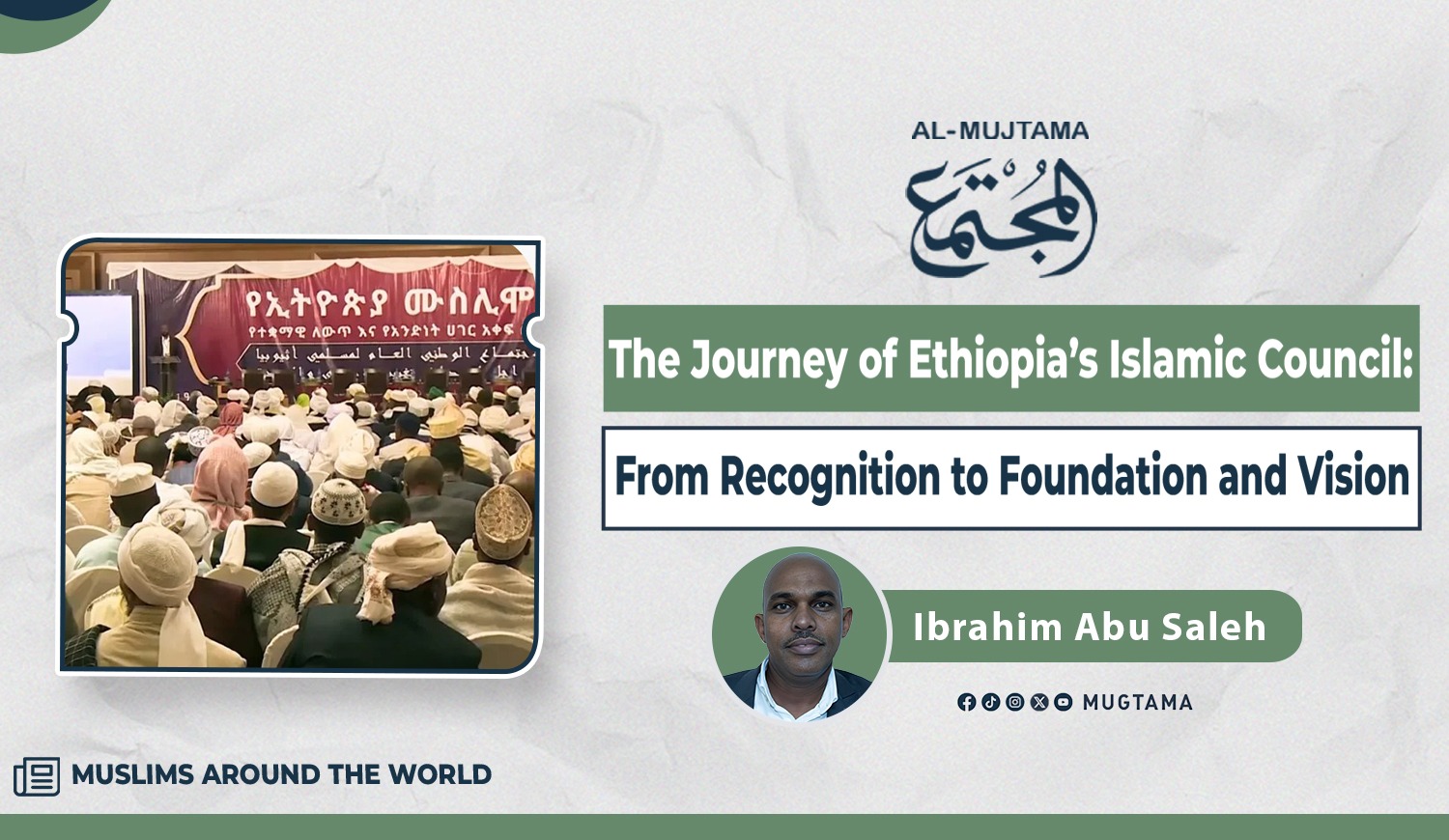
After nearly six decades, the ship of Ethiopia’s Muslims has docked at a new course for the Supreme Council of Islamic Affairs, carrying with it a forward-looking vision for nearly half of Ethiopia’s 130 million citizens. In a country often described as a “museum of peoples and nationalities,” the role of religious councils and civil society organizations is of paramount importance.
Professor Adam Kamel, Head of
External Relations at Ethiopia’s Islamic Council, told Al-Mujtama: “The journey of Ethiopia’s Muslims was marked by challenges and phases
until the council finally gained official government recognition. This came
after peaceful demonstrations in which Muslims endured repression, persecution,
and harsh imprisonment. The idea of forming a council to oversee Muslim affairs
dates back 90 years to the late Sheikh Mohammed Sadiq in the northern city of
Dessie. He had called upon Sharia courts to establish a center for discussing
Islamic affairs, but passed away before his vision materialized.”
Muslims continued their struggle with
demonstrations during Emperor Haile Selassie’s reign (1940–1974). The name “Islamic Council”
was agreed upon in 1975, though without official recognition. Under the
previous coalition government (1991–2018), Muslims staged two of the largest
peaceful demonstrations in 1995 and 2012, demanding recognition. Their demand
was finally met in 2020 under Prime Minister Abiy Ahmed, when the Ethiopian
Cabinet unanimously passed a law granting official recognition to the council
as the body overseeing Muslim affairs.
This decision responded to
long-standing Muslim demands, granting legislative legitimacy to a religious
institution that organizes their lives, ensures their right to engage with
other religious institutions, and ended decades of political and religious marginalization
in the land of Abyssinia—the first destination of Islam’s migration.
The Electoral Milestone
Kamel highlighted the significance of
the council’s recent elections: “With successful elections, the council has
become the official constitutional reference for Ethiopia’s Muslims,
strengthening its role in addressing Muslim issues, contributing to national
development, and promoting coexistence among communities.”
The elections were not merely a
democratic exercise but a qualitative leap in embedding Islamic principles of
consultation and participation. The process began at the grassroots level
through mosques across the regions, involving scholars, intellectuals, women,
and youth—reflecting the inclusive and representative nature of the new
council. Mosques were chosen as polling stations to reconnect society with its
Islamic heritage and emulate the Prophet Muhammad’s example.
In August, the council concluded its
first elections, with nearly 13 million voters casting ballots in more than
49,000 mosques turned into polling centers. The experience marked a historic
turning point, ushering Muslims into a new era of active participation in
national and developmental life. The elections produced a General Assembly of
195 members, including a 15-member executive committee. Sheikh Ibrahim Tufa was
re-elected as council president for a new five-year term, alongside three
deputies, a secretary-general, and 11 other executive members.
This transition moved Ethiopia’s
Muslims from symbolic representation to active engagement in political and
social life, in a country where Muslims are estimated to make up more than half
the population—a transformation Kamel described as a “new awakening and an
expanding role for Ethiopia’s Muslim community.”
Future Vision
Kamel outlined the council’s new
vision and implementation plan: “We are building a strong institution with a
comprehensive strategy, prioritizing Muslim unity,
serving their causes, and linking them to the wider Islamic world.” Plans
include establishing educational institutions that combine Islamic and modern
sciences, research centers, and training projects. Among the flagship
initiatives is the Najashi Center, with a budget of 5 billion Ethiopian birr
(around $40 million), and raising the council’s overall budget to 24 billion
birr (about $180 million).
Education, women, and youth are
central to the council’s agenda. Projects include universities and formal
educational centers to preserve Islamic identity and enhance learning. A
scientific committee has been formed under the supervision of the Arabic Department
at Addis Ababa University, in coordination with Arabic departments across
Ethiopian universities.
The council views poverty and
ignorance—exacerbated by systematic exclusion under previous governments—as the
greatest challenges facing Ethiopia’s Muslims. To address this, it has launched
initiatives in rights management, development, Islamic education, and Arabic
culture as a core vessel of Islamic methodology. Regional officials have been
tasked with submitting comprehensive studies on rural religious schools, where
Muslims are concentrated, to develop solutions and improve facilities. Special
focus is placed on women’s empowerment and protecting youth from extremist
ideologies.
Major projects include the Najashi
Mosque in northern Ethiopia, housing for council staff in Addis Ababa, and
upcoming Ramadan iftar programs, alongside ongoing initiatives in peace,
development, education, and training.
On financing, Kamel emphasized
self-sufficiency: “We aim to activate zakat,
endowments, and income-generating projects. Plans are underway to establish
investment endowments to achieve financial independence, moving away from
donations that have often constrained council projects.”
Unity and Cooperation
Regarding unity and external
relations, Kamel explained: “The council has a vision to strengthen peaceful
coexistence among Muslims and their various sects, as well as between Muslims
and other Ethiopian communities.
The new administration views reconciliation and unity as strategic priorities,
contributing to national security and stability. The council’s peace
initiatives have already achieved reconciliation among several ethnic groups.”
On international coordination, he
noted: “The council has clear plans to leverage Ethiopia’s historic status as
the land of the first migration, building bridges with the Islamic world, and
activating foreign relations through a dedicated executive department. We aim
to host conferences to highlight Ethiopia’s historic role in Islam and its
geographic link to the Middle East.”
Kamel stressed Ethiopia’s deep ties with the Arab world: “Ethiopia and the Arab region are connected through ten
main pathways, including shared history, the Nile, geography, the arrival of
religions via the Middle East, ancient ties between Abyssinia and Arabia,
reinforced by the Islamic migration, as well as language and Ethiopia’s culture
of respect for others, which attracted traders and tourists.”
He lamented that these factors have
not been fully utilized to strengthen relations, placing responsibility on both
Arab and Ethiopian sides. He concluded by stressing the need to move from
describing crises to formulating a clear vision with priorities and action
paths, noting the Ethiopian government’s new orientation toward restoring
Arab-Ethiopian relations.
-------------------
