


Muslims Beyond Memory (4)
The Ordeal of Rohingya Muslims in Burma... Uprooting from the Roots!
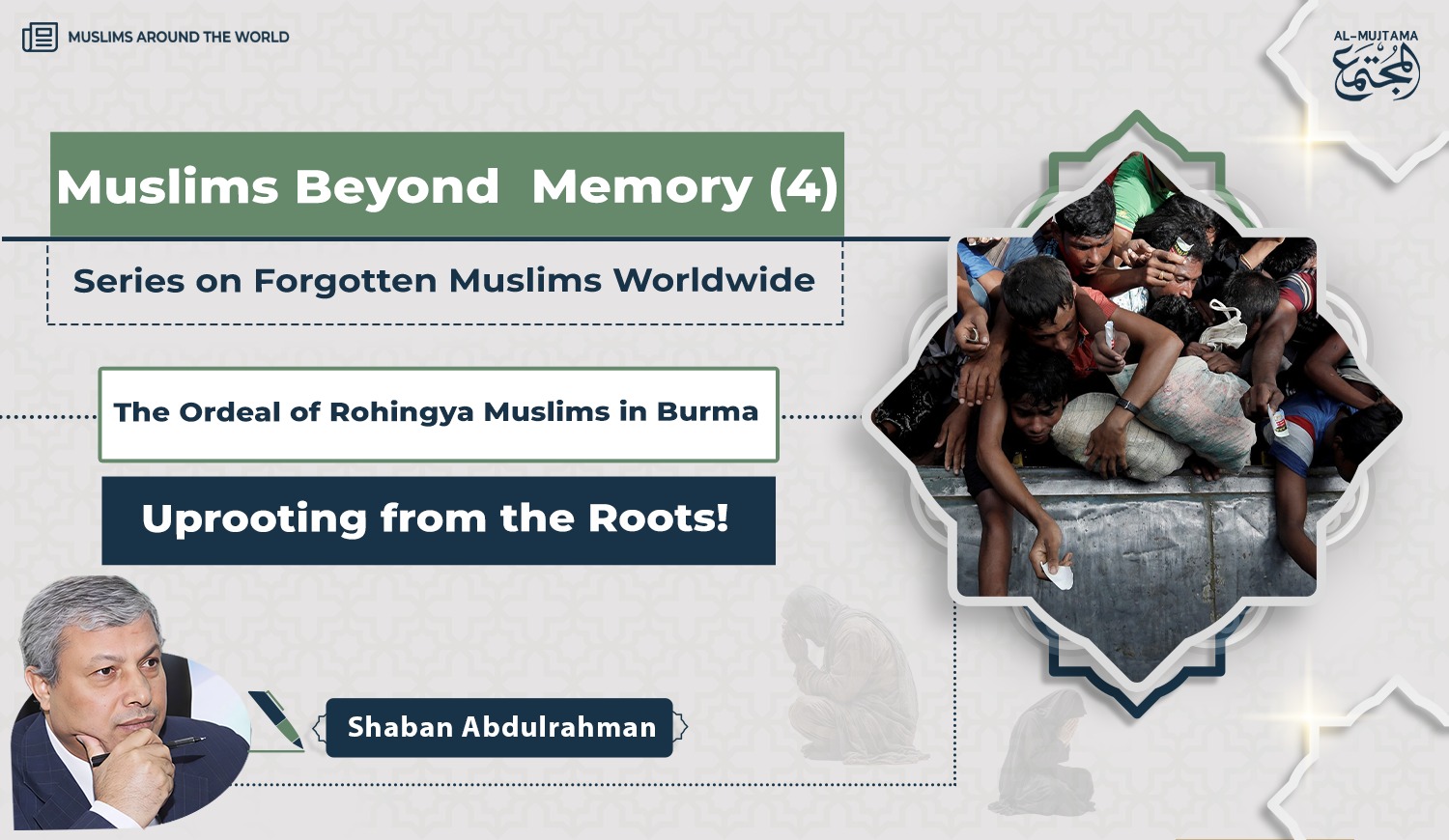
As is its custom with every holocaust against Muslims, the world stands by watching the brutal campaign of genocide practiced by Buddhists against Muslims in "Arakan," under the sight and hearing of the Burmese authorities, who sometimes turn a blind eye and at other times grant it legitimacy.
Recently, a new wave of the decades-long genocide campaign was
launched with a massacre of ten scholars, followed by other waves of killing
and the burning of living people and entire villages in the widest systematic
genocide of more than ten million Muslims. While the war of extermination
continues, the mass displacement of Muslims from Arakan continues across the
Bay of Bengal to the borders of neighboring countries. This is the ultimate
goal of the Burmese regime—expelling Muslims from their homes and
pushing them into a world of diaspora and migration, or relentless
extermination to seize their entire lands and homes in pursuit of full Buddhist
control, similar to what is happening today in Gaza.
This massacre is not the first against Muslims in
"Arakan," which was once an independent Muslim state since the 7th
century AD. However, bloody ethnic cleansing campaigns have followed its Muslim
people since the Buddhist occupation of Burma in 1748 AD. The year 1942
was a date with the commitment of the first of the most hideous and extensive
massacres by Buddhists, which claimed the lives of more than one hundred
thousand Muslims.
Subsequently, Buddhist forces began the series of emptying
Arakan of its Muslim inhabitants by displacing 1.5 million Muslims from their
lands between 1962 and 1991 to Bangladesh, the closest to its borders. Those
who remained in their country lived under the guillotine of oppression,
slaughter, and criminality as citizens deprived of citizenship rights. The
Burmese authorities—ruled by the military—have not recognized the ethnicity of
the Muslim Arakan population despite continuous international demands for this
recognition. Burma (Myanmar) insists on considering them foreigners whose
nationality belongs to neighboring Bangladesh, despite them living on
this land for centuries.
Despite the discussion of the case of the (Arakanese Rohingya)
Muslims by the United Nations, ASEAN, and the Organization of Islamic
Cooperation for two decades, nothing has changed; rather, it grows worse. In
the shadow of this helplessness, displacement campaigns continue, pushing
Muslims into the open sea on dilapidated ships without food or drink on a
journey to the unknown. Their voices and the voices of their children and women
have gone hoarse from appealing to the world, especially the Islamic world.
They have reached neighboring countries in a deplorable state between life and
death; many of them have indeed passed away, while the operations of
persecution and killing continue for everyone who remains there... and there is
no power or might except by God.
Who are they...?
The "Rohingya" are the Muslim minority in Myanmar(Burma), concentrated in "Rakhine" State, or as it was anciently
called, "Arakan." The United Nations classifies them as one of the
most persecuted groups in the world, the same description announced by the UN
spokesperson in 2009.
According to the 2014 census, they represent 4.3% of the total
population in a country with a Buddhist majority representing 87.9%. Muslims
are the most exposed to persecution under the controlling military dictatorial
regime.
Muslims have lived in Myanmar (also known as Burma) since the
11th century AD. The first documented Muslim in Burma's history, recorded in
the Hmannan Yazawin (Glass Palace Chronicle), was "Byat Wi"
during the reign of King Mon of Thaton around 1050. Byat Wi had a brother named
"Byat Ta," who fathered two sons known as the "Shwe Pyin"
brothers; they were executed as children, either because of their Islamic faith
or their refusal to perform forced labor.
The first signs of religious persecution of Muslims
appeared there when King Bayinnaung, in the mid-16th century (1550–1589 AD),
prohibited the practice of Halal slaughter for chickens and livestock. He also
prevented Muslims from celebrating Eid al-Adha and sacrificing cattle and
forced Muslims to listen to Buddhist sermons as a precursor to forcing them to
change their religion by power.
Historically, they were treated as citizens under the
government of Burmese Prime Minister U Nu (1948–1962), but this situation
changed with the military coup that occurred in 1962. A small number of them
continued in state jobs, while most of them, as well as Christians, were
excluded from their positions in the government and the army.
In 1982, the government introduced regulations depriving
anyone unable to prove their Burmese ancestry dating back to before 1823 of
obtaining citizenship. This law deprived large numbers of Muslims of their
rights, even though they had lived in the country for several generations and
over two centuries.
Since 1948, successive governments have launched 13 ethnic and
sectarian military campaigns against the Rohingya in the years (1975, 1978,
1989, 1991–1992, 2002). During these campaigns, security forces expelled the
Rohingya from their lands, burned their mosques, and committed looting and
burning of their property, accompanied by widespread rape of women before and
during their expulsion from their homes into a world of diaspora.
Obliterating Identity in the Census
Government authorities have taken strict measures to
obliterate the ethnic affiliation of the Rohingya in the population
census, insisting on forcing them to abandon this affiliation. They deleted the
term "Rohingya" from the census form, considering it against the law
and punishable by two years in prison. In fact, the appearance of the word "Muslim"
in the identity instead of "Bengali" exposes the owner to arrest or a
fine. The Rohingya News Agency reported a sample of threats from administrative
and security officials in their speeches to the residents, such as: "We
are very disturbed because you claim to be Rohingya... whoever mentions in the
census that they are Rohingya, we will punish them under the law, and we will
not give up until we make you admit your Bengali origins"!!
It goes without saying that the required recognition proves—by
their own testimonies—that the Rohingya are foreigners to the country, thus
stripping them of citizenship and granting authorities the right to expel them.
The successive waves of expulsion and displacement we are following are but a
final step after stripping citizens of their identity and placing them in the
category of foreigners required to be expelled.
Forced Labor....
Persecution has extended to all fields. Authorities impose a
strict ban on their communication with the media and prevent their practice of
Islamic rituals, even the sacrifice of animals; whoever manages to perform
their sacrifice is forced to pay bribes!
Away from military campaigns, the Rohingya are subjected to
continuous theft and extortion by security apparatuses, and many are subjected
to forced labor. In some cases, Muslim lands are confiscated and reallocated to
local Buddhists, not to mention police stopping them in the streets, only
releasing them after paying bribes or financial fines. The extortion of
Muslims' money, especially religious scholars, by security forces does not
stop, and those who refuse are threatened with imprisonment. From time to time,
Buddhist gangs launch fierce campaigns against Muslim neighborhoods.
Humanitarian aid agencies have warned that the dry season,
extending from November to May, threatens tens of thousands of internally
displaced persons (IDPs) in Rakhine State, western Myanmar, with serious
diseases. Data from the Water, Sanitation, and Hygiene (WASH) group indicates
that 40% of IDPs obtain water from ponds (stagnant water), while 28% use
treated water, at a time when 7% of camp residents suffer from a lack of
sufficient access to water. Aid and relief operations coming from the Islamic world
are being restricted.
The First Muslim in the History of Burma
Muslims have lived in Myanmar (also known as Burma) since the
11th century AD. The first documented Muslim in Burma's history and recorded in
the Hmannan Yazawin (Glass Palace Chronicle) is "Byat Wi"
during the reign of King Mon of Thaton around 1050. Byat Wi had a brother named
"Byat Ta," who fathered two sons known as the Shwe Pyin brothers, who
were executed as children, either because of their Islamic faith or their
refusal to perform forced labor.
In the 2014 census, the Rohingya represented 4.3% of
the total population with a Buddhist majority representing 87.9%. Muslims are
the most subjected to persecution under the military dictatorial regime, and
the UN classifies them as one of the most persecuted groups in the world. This
is in addition to several other minorities: Hindu (0.5%), tribal religions
(0.8%), others (0.2%), and non-religious (0.1%), but they obtain their rights
more than Muslims.
Muslims were treated as citizens under the government of Prime
Minister U Nu (1948–63), but this situation changed with the 1962 Burmese
military coup, where a few of them continued in state jobs, while most
Christians and Muslims were excluded from positions in the government and army.
In 1982, the government introduced regulations depriving anyone unable to prove
Burmese origin dating back to before 1823 of citizenship. This law deprived
many Muslims in Myanmar of their rights, despite having lived in Myanmar for
several generations.
Since 1948, successive governments have launched 13 ethnic and
sectarian military campaigns against the Rohingya in the years (1975, 1978,
1989, 1991-1992, 2002). Myanmar security forces during these campaigns expelled
the Rohingya from their lands, burned their mosques, and committed looting,
burning, and rape of Rohingya Muslims on a large scale.
Aside from these military campaigns, the Rohingya are
subjected to frequent and continuous theft and extortion by authorities, and
many are subjected to forced labor. In some cases, lands occupied by Muslims
were confiscated and reallocated to local Buddhists.
The first signs of religious persecution appeared during the
reign of King Bayinnaung (1550–1589 AD). After he seized Bago in 1559, he
banned the practice of Halal slaughter of chickens and livestock. Some subjects
were forced to listen to Buddhist sermons and were then forced to abandon Islam
by power, and Muslims were prevented from celebrating Eid al-Adha and
sacrificing cattle.
Population and Minorities....
Nine minorities live in Burma, including the Muslim minority
(Rohingya), which numbers about one million people living in the western
coastal state of Rakhine. It is one of the nine minorities living in the
country but is the most miserable and deprived of citizenship
rights—nationality, land ownership, voting in elections, and travel—and groans
under the yoke of slavery at the hands of the army that grips the country with
an iron fist.
The "Rakhine" region, where the majority of this
minority lives, has turned into mass killing fields, pushing hundreds of
thousands of Muslims to flee to neighboring countries to which they are
ethnically linked: Buddhist Thailand and Bangladesh—a Muslim country ruled by a
harsh secular dictatorial regime that knows not the meaning of Islamic or human
brotherhood. Therefore, they are usually forced—harshly—to return to where they
came from in Burma, though the police sometimes ignore government orders to prevent
their crossing into the country.
Meanwhile, the country is dominated by the largest ethnic
group, the Burmans or "Bamar" people, who constitute 40 percent of
the population of 48.7 million. This ethnicity dominates the rest of the
minorities, leading to numerous disturbances. A gradual peace process resulted
in a draft ceasefire in 2015.
As for the other minorities besides Muslims:
- The "Kayanni"
minority in the poor "Kayan" state is subjected to displacement
and attacks by the army seeking to control the region rich in natural
resources.
- The "Kachin"
minority is believed to have come from Tibet and practices Christianity.
It has an armed faction, the "Kachin Independence Front," which
reached a ceasefire agreement with the government.
- The "Chin"
minority, numbering 1.5 million people, lives in the remote Chin State
near the border with India. Most practice Christianity and suffer
persecution at the hands of the authorities and food shortages.
- The "Wa"
minority in the autonomous "Shan" state has close ties with
China, uses Mandarin Chinese as a second language, and is divided between
paganism and Christianity. They are followed by a powerful militia of
30,000 fighters, and the government has reached a ceasefire agreement with
them.
- The "Shan"
minority is the largest in Myanmar, estimated at 6 million people
distributed among Shan, Kayan, and Kachin states and the central Mandalay
region. Most are Buddhist, have their own language, and are ethnically
linked to the Thai in southwest China.
- The "Mon"
minority is believed to be one of the oldest ethnicities in Burma and
brought Buddhism to the country. They live in the south and are ethnically
linked to the Khmer in Cambodia. A military faction belonging to them, the
"New Mon State Party," reached a ceasefire with the authorities.
- The "Karen"
minority is the second largest in the country. Many practice Christianity
and live in Kayah (Karen) state. They fought alongside the British against
Japan during WWII and were promised an independent state, which never
happened. Authorities viewed them as agents, thus they faced numerous
crackdowns.
- The "Rakhine"
minority living in Rakhine (Arakan) state in the west represents the
majority of the state's population and 5 percent of Myanmar's total. Most
are Buddhists, and this minority also lives in southern Bangladesh.
The Duty of the Islamic World..
Ultimately, the Islamic world—governments and peoples—is
called upon to break its silence and helplessness and move to support these
persecuted Muslims. The Organization of Islamic Cooperation must change its
approach in dealing with Muslim ordeals; it should not suffice with issuing
appeals and statements but move to take practical and strong positions against
the state of Burma. Especially since the Islamic world possesses many
diplomatic, economic, political, and media tools in this regard, but the matter
requires political will from the countries of the Islamic world. Islamic
organizations, groups, and institutions are also required to move to expose the
persecution and massacres the Muslims are subjected to, denounce them, and
pressure their governments to act to stop them and rescue the rights of
Muslims.
It goes without saying that we cannot direct condemnation at
the United Nations and international organizations silent about this massacre
while the Islamic world appears in this weak state.
In the final analysis, supporting the Muslims of Arakan is a Sharia obligation and a human and brotherly duty for which God will hold accountable everyone who falls short in it.
----------
Writer's Mail: shaban2012 @gmail.com
Read also:
