


The Role of Women in Times of Crisis
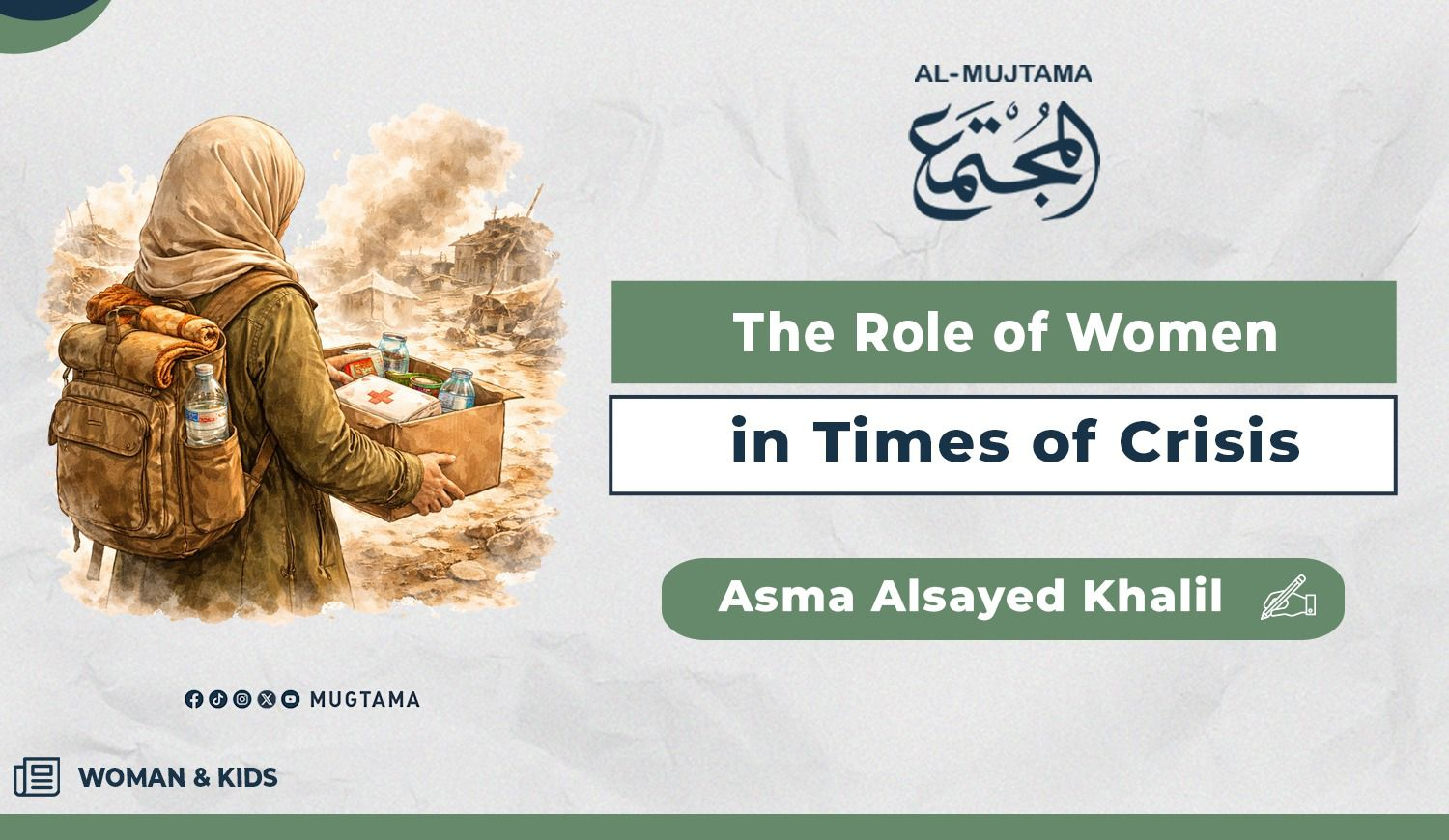
At five
in the morning, while everyone else is asleep, “A. Sh.” has already begun her
day with prayer, then preparing breakfast before waking her husband and
children. As she greets each of them with her usual smile, she hides a worry
that only Allah knows. War is not far from the family, and the general
situation is not stable. A single glance at the list of expenses, along with
the scarcity of goods and the uncertainty of the situation, is enough to
trigger tension and internal conflict within her.
Yet she
knows well that maintaining her composure in front of her family is not a
luxury, but a necessity in a time where events are accelerating and crises are
intensifying. She has been placed at the heart of the storm—something she
dislikes deeply—and she asks Allah to help her endure it.
A Mother’s Daily Battle Between the
Kitchen and Crisis
In her
home, moving quietly between the kitchen and the rooms after everyone has left,
“A. Sh.” thinks about lunch while running complex calculations in her
mind—calculations about an uncertain tomorrow. She imagines various scenarios
of war and what comes after, what remains of the family’s supplies, what is
left of the household budget, what can be postponed, and what cannot be
dispensed with.
At one
moment, she is startled by the doorbell. It is her youngest son, the first to
return home. She prepares herself once again with that familiar smile—one that
hides so much beneath it.
The Growing Pressure on Women
This
scene with is not exceptional; it has become common in many homes, in a time
where pressures on women are increasing. She understands that her breakdown is
not an option, and that her endurance of immense psychological pressure is the
safety valve that protects her family from collapse.
In such
circumstances, she is no longer just a housewife managing her home; she has
become a crisis manager, balancing limited resources with endless needs. From
this reality, she begins searching for ways to fill the gaps—responding to
mounting pressure and unavoidable responsibilities.
Some
women invest their cooking skills by preparing meals to sell to relatives and
neighbors. Others revive old projects such as sewing children’s clothes, while
some offer tutoring to students—all as temporary solutions to support the
family’s income.
In
general, anxiety is no longer tied to specific events or crises; it has become
a constant condition that colors the daily lives of many families. Rising
prices, fragile financial conditions, and a reality that feels slow and
difficult to change all contribute to this atmosphere.
Within
this environment, the housewife takes on
the role of reshaping reality. Due to her closeness to daily details—managing
children’s needs and noticing what is missing at home—she finds herself,
unwillingly, bearing the largest share in managing this anxiety.
A Woman’s Tools to Overcome Anxiety
Typically,
a housewife does not rely solely on calculations and life experience as tools
to survive anxiety. She draws upon something deeper—her natural emotional
intelligence, known as “emotion management.”
She knows
when to speak and when to remain silent, when to appear strong and when to ease
her children’s worries, absorbing tension before it reaches them. Even if she
herself is full of anxiety and lacks certainty, she does not show it—because
she believes that the reassurance she gives her children today will become
their long-term psychological stability.
Smart Strategies for Managing Household
Resources During Crisis
Just as
she manages emotions, she also skillfully manages resources by creating daily
survival plans based on her experience and adaptability. She contains the
crisis through:
1.
Changing
the way expenses are managed:
distributing the budget weekly instead of monthly to better control spending
and reduce risks.
2.
Reusing
food: what is known as “recycling
leftovers,” to reduce waste and make use of remaining food instead of throwing
it away.
3.
Postponing
non-essential purchases: reducing emotional
and unnecessary spending, and temporarily giving up luxuries to save money over
time.
4.
Searching
for lower-cost alternatives:
exploring options to find cheaper goods or services that serve the same
purpose.
5.
Changing
consumption habits: such as reducing frequent
outings, limiting subscriptions, tracking discounts, and avoiding impulsive
purchases.
Although
these solutions may seem small, their impact is cumulative—they prevent crises
from escalating and provide the family with a reasonable margin of safety
during difficult times.
The Price Women Pay for Stability
With a
tone of pain, “A. Sh.”—a woman who appears strong and resilient at all
times—tells Al-Mujtama: “When I am alone, the masks fall, my weakness
appears, and the true face of the pressure I carry becomes visible. I break
down in tears. I am not stone or iron—I am a human being with limited capacity,
not immune to breaking.”
She
affirms that behind this resilience lies a heavy, unseen cost: accumulated
psychological exhaustion, hidden anxiety, and a constant sense of
responsibility.
Sadly,
many view what women do as something natural or expected, while few recognize
it as a real and exhausting effort.
There is
no doubt that women, in such circumstances, need support—before they even ask
for it, and before the signs of psychological exhaustion appear. This support
begins with the husband’s cooperation, the children’s understanding, and
extends to society as a whole.
When
women are supported, the benefit reflects not only on them, but on the entire
family and society. In short, the safety valve itself needs protection.
For Further Reading:
- From Whole to Half Woman: War and Womanhood!
- Women’s Role in Society and Family in Islam vs. the West
- 5 Powerful Roles of Muslim Women in Shaping the Ummah’s Identity
-------------------------------------------------------------
