








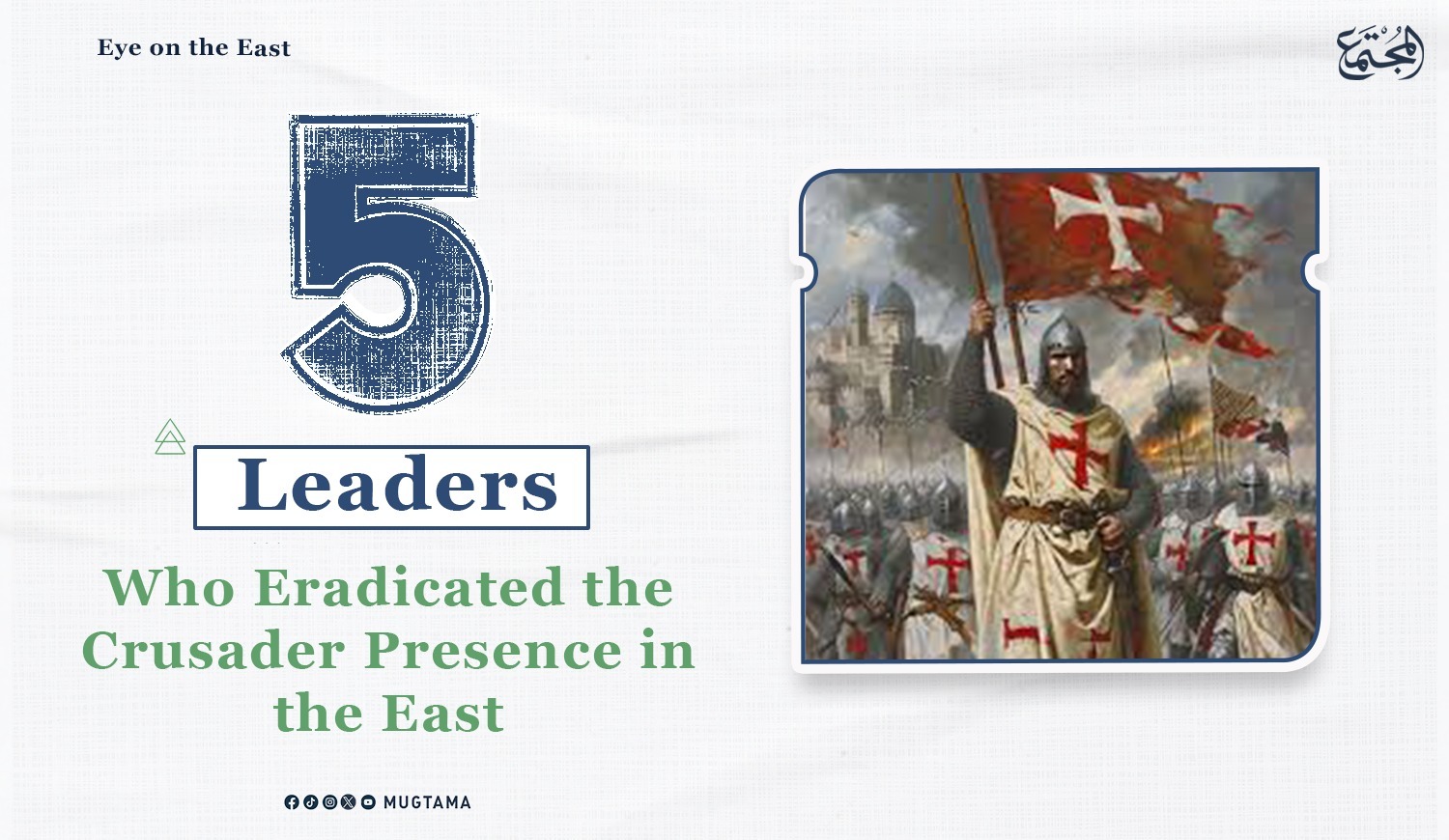
5 Leaders Who Eradicated the Crusader Presence in the East
At a critical historical turning point
in the late eleventh century, the Islamic world found itself facing a storm it
never saw coming. The military strength of the Crusaders was not the only
factor behind their success — it was the "political vacuum" and the
fragmentation among warring statelets that created the fatal gap through which
the invaders slipped, planting their kingdoms in the very heart of the region.
The "Crusades" were far more
than the religious campaigns the Church promoted at the time — they were an
explosion of Europe's internal crises, desperately seeking an outlet in the
wealthy lands of the East.
Europe was suffocating under the
weight of landless knights, while the East — with its ancient trading cities —
stood as the "Promised Land" of wealth and power.
The Church exploited religious emotion
to secure the pilgrims' route, transforming military conquest into a
"sacred duty" that justified the most heinous of crimes.
The fall of Islamic cities was not
merely a geographic loss — it was a total collapse of morale. The Islamic world
found itself trapped between an Abbasid Caliphate in Baghdad that held no real
power, and a Fatimid Caliphate in Cairo torn apart by internal strife.
Amid the rubble of political
fragmentation and the paralysis that had gripped the Islamic front between
Baghdad and Cairo, the "myth of the undefeatable Crusader" was born:
iron-clad knights, impregnable fortresses piercing the sky, and lightning victories
that led many to surrender to the notion that this invasion was an
"inevitable fate" — unstoppable and irreversible.
A prevailing sentiment took hold that
these settler kingdoms were here to stay, and that reclaiming Jerusalem was
nothing but a distant mirage.
Yet from the depths of this
suffocating despair, leaders emerged who resolved to shatter the myth —
dismantling the ambitions stone by stone. And so the epic began, as the first
thread of light pierced the darkness.
Imad ad-Din Zengi: The First Warrior of
Faith and Heir to the School of Mawdud
If we are to pinpoint the moment
history shifted on its axis, we must pause at the figure of Imad ad-Din Zengi.
He was no mere sultan in pursuit of a kingdom — he was a great warrior who
devoted his life to breaking the power of the invaders, forged in the first
school of holy war founded by the legendary Emir of Mosul, the martyr Mawdud
ibn al-Tuntakin.(1)
Under the tutelage of Emir Mawdud ibn
al-Tuntakin, Imad ad-Din learned that confronting the Crusaders required not
scattered defense, but organized offense and unity. When he assumed the Emirate
of Mosul, he did not forget his mentor's lessons — he forged them into a
comprehensive strategy that made him the ultimate nightmare haunting every
Crusader principality in the north.
Shattering the Myth — The Fall of Edessa
(1144 AD)
At a time when despair had settled
like a shroud over the Islamic world, Imad ad-Din delivered his masterstroke:
the recapture of the County of Edessa. This was no mere recovery of lost
territory — it was a shockwave that reverberated across the whole of Europe,
toppling for the very first time the towering mystique of the "invincible
Crusader knight."
Through Imad ad-Din's relentless
jihad, the compass of the Muslim world was forever reoriented — from
resignation to reality, toward an unrelenting pursuit of liberation. He laid
the cornerstone upon which his son Nur ad-Din and his protégé Saladin would
erect every victory that followed.
Nur
ad-Din Mahmud: The Pious Commander Who Shaped the Road to Liberation
If Saladin was the one who entered
Jerusalem as a conqueror, it was Nur ad-Din who paved every inch of that road —
stone by stone. Nur ad-Din was no mere military ruler; he was a complete
civilizational project, the commander who elevated Islamic action from
"reaction" to "long-term strategic planning.
With visionary genius, Nur ad-Din
understood that the Crusaders would never leave as long as Egypt and the Levant
remained divided. So he fought the "battle of unity" before the
"battle of liberation" — waiting with iron patience for years until
he succeeded in bringing Egypt into the fold, ensnaring the Crusaders in the
jaws of a pincer from which they would never escape.
Nur ad-Din believed that victory
begins from within. He established the Nurid schools and maristans — the
hospitals of their age — and built a foundation of justice among his people. In
his eyes, a strong home front was the true weapon that would ultimately bring
down the Frankish fortresses.
Perhaps no story captures the
greatness of this man more vividly than that of Nur ad-Din's Pulpit. Twenty
years before the liberation of Jerusalem, he commissioned the crafting of an
exquisitely carved wooden minbar — destined for Al-Aqsa Mosque. The Crusaders
were at the height of their power, yet Nur ad-Din was at the height of his
certainty. He built the pulpit as a message to his nation: the return was not a
possibility — it was a truth he could already see with his own eyes, long
before it came to pass.
Nur ad-Din inherited a shattered,
demoralized land — and forged it into a nation. Saladin, in turn, inherited
from Nur ad-Din a united army, a cohesive front, and a clear plan of action.
Nur ad-Din bore the title "The
Just King," and his personal austerity was so profound it left historians
in awe. Ibn al-Athir wrote of him: "I have studied the lives of kings
who came before, and after the Rightly-Guided Caliphs and Umar ibn Abd al-Aziz,
I have found none whose conduct surpassed that of the Just King, Nur ad-Din."
Saladin: The Knight Who Fulfilled His
Master's Prophecy
If Nur ad-Din was "the
Architect," then Saladin was "the Field Commander" — the one who
knew precisely how to seize the defining moment of history. Saladin never
stepped outside the legacy of the Zengid project; he was the hand that
harvested the fruits of decades of planning and unity.
In 1187 AD, Saladin led the unified
army — the very force Nur ad-Din had spent years assembling — in the epic
Battle of Hattin. There, he shattered the military backbone of the Crusader
kingdoms in a battle that was no ordinary clash — it was "Judgment
Day" for the Crusader presence in the heart of Palestine. Their kings and
commanders fell captive beneath the tent of the Victorious Sultan.
The greatness of Saladin lay not only
in his entry into Jerusalem, but in the nobility of the conqueror himself. At a
moment when all recalled the Crusader massacres of 1099, Saladin offered the
world a model of magnanimity so striking that it left Western historians —
before Muslim ones — utterly astonished.
In one of history's most sublime
moments of fulfilled promise, Saladin's entry into Al-Aqsa Mosque was no mere
display of military triumph — it was the living embodiment of a prophecy carved
in wood and certainty. In that awe-inspiring scene, the Minbar of Nur ad-Din(2)
was placed in the very spot reserved for it in the heart of Al-Aqsa — twenty
years before liberation had even arrived.
Baybars: The Mamluk Tempest and the
Crusher of Fortresses
Baybars was no sultan content to sit
upon a throne — he was the restless soul of resistance, never still, never
satisfied. A common misconception confines his legacy to the Mongol front
alone, but the truth runs far deeper: Baybars had a long and terrifying history
with the Crusaders that predated his sultanate by many years — and he never
stopped hunting them until his very last breath.
The Battle of Al-Mansurah (1250 AD)
It was at Al-Mansurah that Baybars
first blazed across the sky as a battlefield genius of the highest order.
There, his brilliance revealed itself in the way he lured the Seventh Crusade
deep into the narrow alleyways of the city — transforming them into a graveyard
for the ambitions of Louis IX and his army. It was the moment the West realized
they were facing an entirely new breed of commander: one who simply did not
know how to retreat.
The Fall of Antioch (1268 AD)
This was the crown jewel of Baybars'
military achievements. After 170 years of Crusader occupation, Baybars brought
this ancient principality to its knees in a matter of days. Antioch was no
ordinary city — it was the very symbol of Crusader presence in the north. With
its fall, the spine of their kingdoms was broken, and whatever remained of
their existence was reduced to isolated islands of stone, each one silently
awaiting its inevitable end.
Al-Ashraf Khalil ibn Qalawun: The
Liberator of Acre
The Earthquake of Acre (1291 AD)
Acre was no ordinary city — it was the
Crusaders' second capital and their last impregnable stronghold. Al-Ashraf
Khalil marshaled vast armies and erected dozens of colossal siege engines,
unleashing one of the most massive sieges the Middle Ages had ever witnessed.
And when its walls finally came down, the entire prestige of the Crusader
presence in the East came crashing down with them — completely, and without
return.
He did not stop at Acre's gates.
Al-Ashraf Khalil hunted down the fleeing remnants of the Crusader forces
through every last coastal stronghold — Tyre, Sidon, Tartus — leaving no corner
unsearched, no fugitive uncounted, until the last Crusader soldier had vanished
from the land. In doing so, he formally closed the chapter on a colonial
presence that had forced itself upon the region 192 years prior — and the
Levantine coast, scarred but unbroken, finally breathed free once more.
In his analytical reading of the
historical landscape, the renowned British historian Ernest Barker offers a
striking observation: the Crusader presence in the East succeeded in its early
stages for one reason alone — it exploited a "temporal gap" of
Islamic fragmentation. According to Barker, had the Crusaders arrived even
slightly later — or earlier — they would have found themselves facing a unified
Islamic front fully capable of hurling them back into the sea the moment they
set foot on shore.
This project began with the battle cry
of Imad ad-Din Zengi, took shape in the vision of Nur ad-Din Mahmud, blazed
forth from the sword of Saladin, was cemented in the strategy of Baybars, and
was finally brought to its close by the decisive blow of Al-Ashraf Khalil.
Five leaders who proved, across two
centuries of relentless struggle, that no land will ever truly accept strangers
— so long as its people hold the key of unity. And that history is never made
by chance, but by a vision so unshakeable it renders victory inevitable, no
matter how long the siege endures.
You may also like:
What do you know about Peter the Hermit and the People’s Crusade?!
Swords and Stories: Civilizational Exchange in the Crusades
Independent States in Islamic History and Prerequisites for Civilizational Contribution
Mamluk Shield: 4 Defeats Humiliated Mongols
=======================================
Footnotes:
1. He was Sharaf ad-Din Mawdud ibn al-Tuntakin, Emir of
Mosul (1108–1113 AD) — the man who laid the cornerstone of organized
resistance. History remembers him as the first mentor whose school forged the
Zengid leadership that would change the course of the East.
He fought ferocious
battles that shattered the myth of the "invincible Crusader knight,"
most notably the Battle of Sannabra. Yet his story did not end on the
battlefield — it ended in betrayal. In 1113 AD, he was struck down by an
Assassin's blade as he emerged from the Umayyad Mosque in Damascus, his blood
consecrating the very soil he had given his life to defend. Behind him, he left
a generation that had never learned the meaning of surrender.
2. The Minbar of Nur ad-Din — A Masterpiece in Wood and
an Unbreakable Vow
This minbar stands as one
of the greatest examples of wood carving in the entire Islamic era. Crafted in
Aleppo in 1168 AD by order of the Just King Nur ad-Din Mahmud, it was an
architectural marvel of breathtaking complexity — interlocking ebony and walnut
wood, assembled without a single nail. It was transferred to Al-Aqsa Mosque
following the liberation of Jerusalem in 1187 AD, fulfilling the vow Nur ad-Din
had made decades before his eyes ever saw the holy city freed.
For centuries it stood —
silent witness to the certainty of conquerors — until the world was struck by
an act of devastating sacrilege. On August 21, 1969, the extremist Michael
Rohan deliberately set fire to Al-Aqsa Mosque, and the original minbar — that
irreplaceable testament to faith and vision — was lost to the flames forever.
The artifact perished. But the memory it carries endures: a monument to the
unshakeable certainty of those who built for a victory they had not yet seen.