







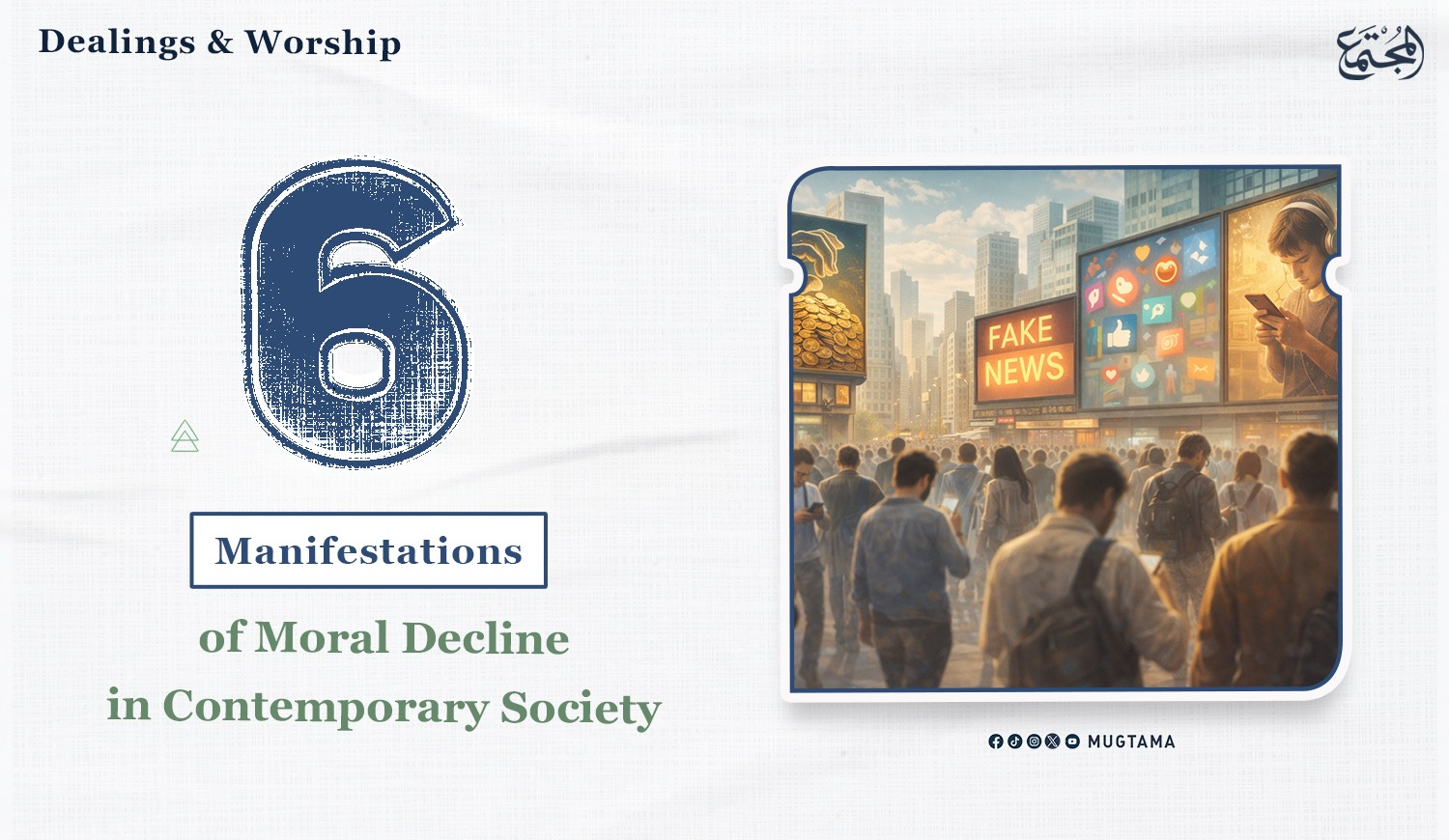
6 Manifestations of Moral Decline in Contemporary Society
Morality occupies
a lofty and central position in Islam. When one traces the Islamic texts, it
becomes clear that just as Islam came to reform people’s beliefs, it also came
to rectify and refine all corrupted morals. Allah the Exalted Describes the
character of the righteous, saying: {˹They are˺ those who donate in prosperity and
adversity, control their anger, and pardon others. And Allah loves the
good-doers.} [Ali `Imran 3:134]
And among
the purposes of the Prophet’s mission, the Prophet (peace be
upon him) said: “I
was sent to perfect good character.” (Reported by Ahmad)
Abul Darda’
(may Allah be pleased with him) narrated that the Messenger of Allah (peace be
upon him) said: “The
heaviest thing which will be put on the believer’s scale (on the Day of
Resurrection) will be good morals.” (Reported by Abu Dawud)
Yet
today, we witness a state of moral alienation within Muslim societies—as though
these texts have been entirely suspended. This poses a grave danger to the fate of the Muslim.
The Prophet (peace be upon him) warned: “And indeed, the most disliked among you to me, and
the one sitting furthest from me on the Day of Judgement are the worst among
you in conduct.” (Reported by Ahmad)
Manifestations of Moral Decline in
Contemporary Society
Bad character has
taken on numerous forms in contemporary Muslim societies. We will highlight
some of these manifestations in order to avoid a fate that does not please the
Lord of the Worlds for His believing servants.
1. Disobedience to Parents
One of
the harshest manifestations of moral corruption in our time relates to parents. It has
become common—even in public spaces—to see children addressing their parents by
their first names, arguing with them, accusing them of backwardness and lack of
modernity, and cutting off communication once they become independent, under
the pretext of being busy or lacking time.
Allah the
Exalted Says, {For your Lord has decreed that you
worship none but Him. And honour your parents. If one or both of them reach old
age in your care, never say to them ˹even˺ ‘ugh,’ nor yell at them. Rather, address them
respectfully. And be humble with them out of mercy, and pray, “My Lord! Be
merciful to them as they raised me when I was young.”} [Al-Isra’ 17:23–24]
And He Says,
{And We have commanded people to ˹honour˺ their parents. Their mothers bore them
through hardship upon hardship, and their weaning takes two years. } [Luqman 31:14]
2. The Loss of Respect for Teachers and Scholars
In our
time, the teacher has lost
much of his status and dignity for several reasons—mostly corrupt media and art
that glorify moral corruption while mocking and belittling people of knowledge.
The
Prophet (peace
be upon him) described himself as a teacher to
elevate the status of educators, saying: “God
did not send me to be harsh or cause harm, but sent me to teach and make things
easy.” (Reported by Muslim)
It is
narrated from the Commander of the Faithful, `Ali Ibn Abi Talib (may Allah be pleased with him): “Among the
rights of a scholar upon you is that when you meet him, you greet him
personally, greet the gathering generally, sit before him, do not point with
your hand, do not wink with your eyes, do not say ‘so-and-so said differently,’
do not pull his garment, and do not persistently question him.” (¹)
3. Replacing Islamic
Brotherhood with Corrupt Companionship
Among
today’s youth, companionship based on personal interest and unrestricted mixing
between genders has become widespread. One hears a girl say “my boyfriend” and
a boy say “my girlfriend,” connected through social media without shame or
Islamic boundaries.
Youth
have forgotten the principles of Islamic brotherhood
founded upon love, sincerity, and mutual counsel.
Islamic
texts strongly warned against choosing corrupt companionship. Allah Says, {And ˹beware of˺ the
Day the wrongdoer will bite his nails ˹in regret˺ and
say, “Oh! I wish I had followed the Way along
with the Messenger! Woe to me! I wish I had never taken so-and-so as a close
friend. It was he who truly made me stray from the Reminder after it had
reached me.” And Satan has always betrayed humanity.} [Al-Furqan 25:27–29]
And the
Prophet (peace
be upon him) said: “A
man follows the religion of his friend; so each one should consider whom he
makes his friend.”
(Reported by Ahmad)
4. The Breakdown of Marital Relations
In an age
of unrestricted relationships and unmonitored communication, divorce
rates—especially within the first year of marriage—have risen alarmingly. This indicates a lack of
mutual understanding, patience, and awareness of the sacrifices required for
marital life.
Allah Says,
{And one of His signs is that He created for you
spouses from among yourselves so that you may find comfort in them. And He has
placed between you compassion and mercy. Surely in this are signs for people
who reflect.} [Ar-Rum 30:21]
Islam
does not preserve the family based on love alone, for
love may fade. Among the causes of marital breakdown is the husband’s
miserliness—financial, emotional, and moral—stemming from ignorance of his
responsibilities.
Yet even
when dislike arises, separation is not immediately justified. Allah Says, {Treat them fairly. If you happen to dislike them, you
may hate something which Allah turns into a great blessing.} [An-Nisa’ 4:19]
Al-Jassas
commented that this verse encourages a man to keep his wife despite dislike,
for Allah may Place abundant good therein. (2)
5. Ethical Violations in the Marketplace
It has
become common for traders to swear falsely by Allah, claim false losses, and
deceive customers. The Prophet (peace be upon him) warned against deception, saying: “And he who treats us dishonestly does not belong to us.”
(Reported by Muslim)
Market
misconduct also includes women going out fully adorned and perfumed, forgetting
that Satan targets them when they leave their homes, contrary to the Prophet’s (peace be
upon him) warning: “Every
eye is adulterous, and when a woman perfumes herself and passes a company, she
is such and such meaning adulterous.” (Reported by Abu Dawud)
6. Loss of Modesty and
Shameless Boldness
Abu Mas`ud `Uqbah Ibn `Amr Al-Ansari Al-Badri (may Allah be pleased with him) narrated
that the Messenger of Allah (peace be upon him) said: “One of the
things people have learned from the words of the earliest prophecies is, “If
you don’t feel any shame, do whatever you like.” (Reported by Al-Bukhari)
Sadly, shamelessness and
audacity have spread widely among youth—especially among young women.
Also Read:
- 10 Ways to Obtain Good Morals
- 4 Moral Violations on Social Media and How Muslims Can Avoid Them
- Quranic Moral Rule: Speak Good to People
-------------------------------------------------------------
Footnotes:
1.
Encyclopedia of Ethics by Al-Kharraz, p. 325.
2.
Ahkam Al-Quran by Al-Jassas, vol. 2,
p. 189.