






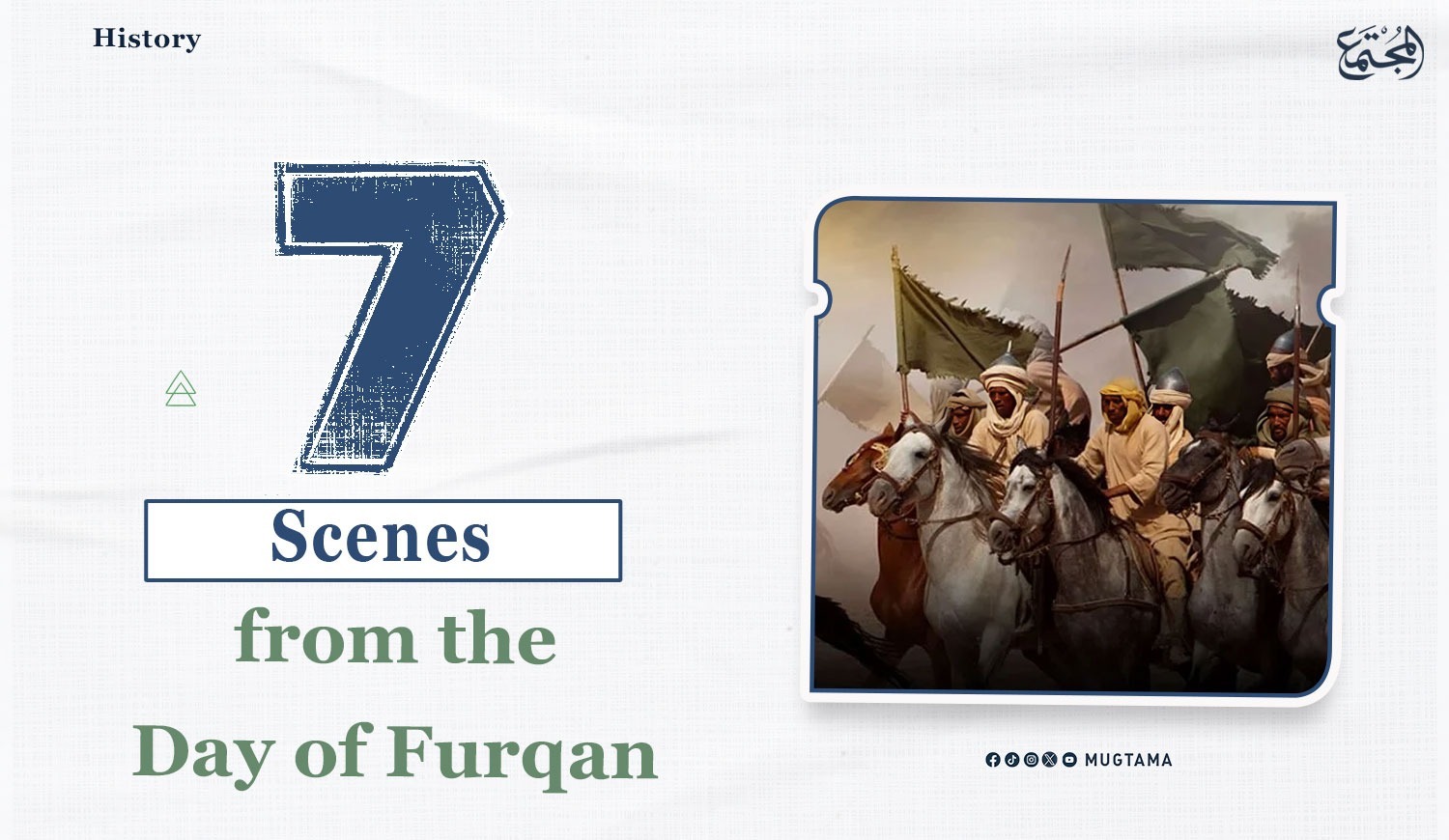
7 Scenes from the Day of Furqan
(Those who have been attacked are permitted to take up arms
because they have been wronged- God has the power to help them) (Al-Hajj:39)
With this
divine permission, the first pages of the great confrontation in the history of
Islam were opened. The Muslims had left Mecca burdened by injustice, after
Quraysh had seized their wealth and confiscated their property upon migration,
leaving them with nothing but their sincere faith and steadfast resolve. On the
seventeenth of Ramadan, nearly three hundred believers—weak in equipment and
scarce in arms—gathered to face the arrogant forces of Quraysh in the Battle of
Badr. It was not merely a military clash, but a decisive moment that altered
the balance of power and proved that victory is not measured by numbers or
weaponry, but by God’s support and the firmness of faith.
This
verse was not merely a permission to fight; it was a legal characterization of
the situation. The Muslims had not initiated aggression, but for thirteen years
in Mecca they endured torture, confiscation of wealth, and expulsion from their
homes. The verse came to grant legitimacy to reclaim their usurped
rights and to confront oppressive power with an equivalent force, while
affirming that victory is the inevitable outcome of justice and divine
authority.
7
Strategic Facts about the Battle of Badr
1. Economic Pressure (Restoring Rights)
The
beginning was not a desire for military confrontation, but rather a clever move
to paralyze Quraysh’s economic lifeline. By targeting Abu Sufyan’s caravan
returning from Syria with thousands of dinars, the Muslims placed Quraysh
before two choices: either lose its wealth and commercial prestige, or face
battle. This scene illustrates that the Muslims resorted to the weapon of economic
blockade to reclaim the financial assets that had been plundered from them
in Mecca—an action both legitimate and tactical against the aggressor.
2. Internal Unity (Military Shura)
After Abu
Sufyan successfully diverted the caravan along the coastal route, the Muslims
no longer had the luxury of time; a sharp strategic turn of 180 degrees was
imposed upon them. Their options narrowed to two bitter choices: either retreat
to Medina—an act that would be interpreted as weakness and give Quraysh a
“green light” to attack them later in their own city—or face the Meccan army
head-on, which advanced with 1,000 fighters determined to eradicate their
presence.
Here the
brilliance of participatory leadership emerged through three essential
pillars:
- Testing
the Internal Front (Building Consensus): The Prophet Muhammad (peace be
upon him) did not monopolize the decision of war despite being the leader.
Instead, he convened what could be called in modern terms an “emergency
meeting,” issuing his famous call: “Advise me, O people.” The aim
was to ensure cohesion before entering a decisive clash.
- The
Steadfastness of the Muhajirun (Principled Stance): Al-Miqdad ibn ‘Amr
stepped forward to declare the migrants’ full alignment with the Prophet’s
decision, affirming that they would not repeat the words of Moses’ people:
“Go, you and your Lord, and fight.” Rather, they were partners in
the battlefield. This statement became the first guarantee of the military
core’s solidity.
- The
Position of the Ansar (Expanding the Alliance): This was the most
sensitive point, since the Ansar had pledged at the Bay‘at al-‘Aqabah
to protect the Prophet Muhammad (peace be upon him) only within Medina.
Yet Sa‘d ibn Mu‘adh resolved the matter with his historic words,
broadening the scope of defense to wherever the Prophet deemed necessary: “Cut
the ties of whom you will, and join the ties of whom you will. By God, if
you were to march us into the sea and plunge in, we would plunge in with
you.
3. Military Intelligence (Decoding the Enemy)
The
movement of the army from Medina was neither random nor dependent on chance; it
was based on a precise intelligence system for gathering and verifying
information. In this scene, we see how “information” itself became a decisive
weapon in the hands of a numerical minority:
- Field
Reconnaissance: The Prophet Muhammad (peace be upon him)
dispatched scouts to monitor the movements of the Meccan army. He did not
rely solely on circulating reports but sought direct, on-the-ground
certainty.
- Strategic
Analytical Genius: When two young captives from Quraysh’s
camp were interrogated, they could not provide an exact number of the
army. The Prophet shifted the question: “How many camels do they
slaughter each day?” When they replied, “Nine one day and ten the
next,” he immediately deduced that the army numbered between 900 and
1,000 fighters, based on the average consumption of meat per soldier.
- Identifying
Centers of Gravity: Intelligence was not limited to
numbers; it also included identifying the names of the commanders present
in the field. This allowed the leadership to assess the political and
military “weight” of the opponent before the clash began.
4. Logistical Genius (Control of the Lifeline)
In desert
warfare, water is the “fuel.” The implementation of al-Hubab ibn al-Mundhir’s
plan to secure the wells of Badr and disable the rest was no coincidence—it was
a calculated act of logistical strangulation against the enemy. Controlling
supply resources is the first rule in breaking the backbone of a larger army
and depriving it of continuity on the battlefield.
By
securing the sources of water, the Muslims forced the Meccan army to fight
under the pressure of thirst and exhaustion. This turned Quraysh’s numerical
superiority into a burden rather than an advantage; a thirsty army quickly
loses focus and its ability to maneuver.
5. Changing the Rules of Engagement (The Battle Formation
System)
Historically,
Arab warfare relied on the hit‑and‑run style of skirmishes—unstructured
maneuvers of attack and retreat. At Badr, this method was replaced with a
disciplined formation system: fighters stood in organized, solid lines, forming
a unified block. This allowed them to absorb the shock of Quraysh’s cavalry
charge and maintain cohesion under pressure. By abandoning chaotic duels and
adopting structured ranks, the Muslims redefined the battlefield, turning
discipline into a weapon that neutralized the enemy’s initial momentum.
Through
the system of ranks, the 300 fighters were transformed into a “defensive wall”
that could not be easily penetrated. This tactic turned the Meccan army’s
numerical advantage into a liability; the larger force struggled to break
through the solid block, while the smaller, organized unit-maintained cohesion
and resilience.
6. Dismantling the Leadership Pyramid (Striking the “Head of the
Snake”)
Targeting the Elite Command: The
battle witnessed the fall of Mecca’s most prominent figures, foremost among
them Abu Jahl and Umayyah ibn Khalaf. In military terms, the death of such
leaders meant the collapse of the “command-and-control system.” Once the
masterminds were gone, the large army fragmented into scattered groups that
lost vision and purpose.
The killing of the commanders was not merely a
human loss; it was a decisive strike against the morale of Quraysh’s soldiers.
When fighters saw the very leaders who had driven them into battle falling one
after another, pride and numerical arrogance turned into panic and mass
retreat.
The fall
of these driving figures hastened the conclusion of the battle, sealing the
victory of the defending front.
7. Imposing Prestige (Geopolitical Shift)
By
enforcing a “strategic blockade,” the Muslims compelled Quraysh to reconsider
the security of its caravans and its standing among the Arabs. The victory at
Badr was not only a military triumph but also a psychological and economic
strike that reshaped regional dynamics. Quraysh’s aura of invincibility was
broken, and the balance of power shifted toward Medina, signaling the rise of a
new force that could dictate the terms of future political and economic
equations.
You may
also like:
Leakingthe Code: Abu Basir and Respect for International Agreements
5 Iconic Scenes of Young Companions in Jihad