






Consultations
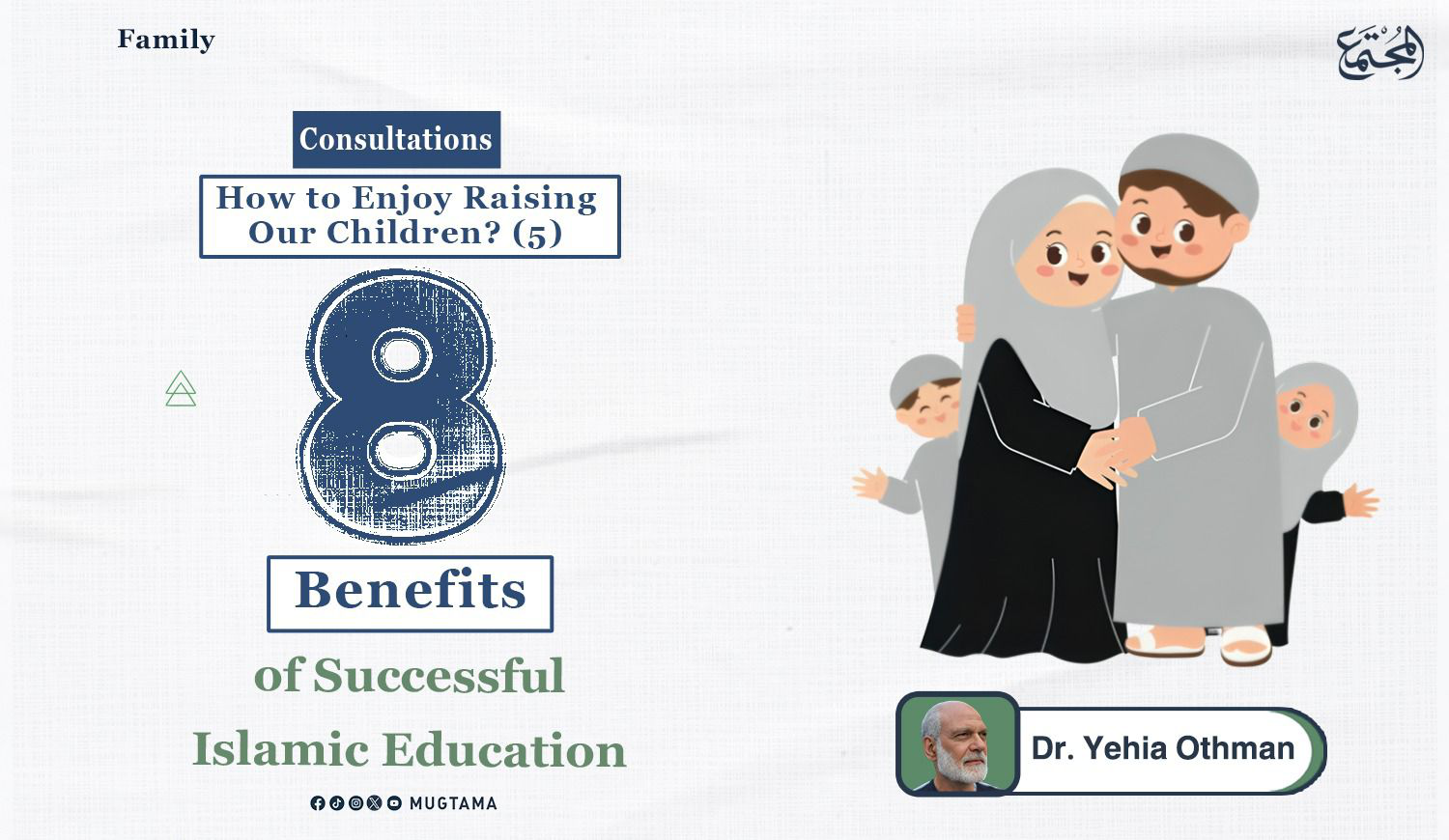
8 Benefits of Successful Islamic Education
After exploring various aspects
of this journey in previous articles of this series, we are now
in our sixth article, the very heart of the educational process, posing a
fundamental question: What is the true nature of education?
In this article, we dive deep
into the concept to uncover eight essential characteristics that make education
a unique and influential activity. Understanding these traits transforms
education from a mere collection of commands and prohibitions into a conscious
and enjoyable journey, filled with wisdom and success.
The Traits of the Educational Process
1.
Personal and Individualized
Based on the definition of
education as an interactive activity between a parent and their children or a
teacher and their students, the outcomes of an educational situation depend on
the harmony between the parent’s and child’s psychology, the educational
environment, the motive behind the educational activity, and its intended goal.
Therefore, there is no universal
pattern recommended for education—only values and general frameworks that
educators must understand and apply in a way that suits each child
individually. The most important trait of education is individuality,
and every educational situation has its own distinctiveness even for the same
child.
2.
Continuous and Lifelong
The responsibility of education
does not end at a certain age or life stage; rather, it is a continuous process
as long as one is capable. Education is one of the manifestations of enjoining what is right and forbidding what is wrong, which we have been
commanded to uphold in the Quran and Sunnah.
If this command applies to public
preaching, how much more so regarding our responsibility for our own children,
students, and all those under our care?
The Messenger of Allah (peace be
upon him) educated his daughter Fatima and called her to Allah, the One and
Only, as part of his call to his close relatives: “O
Fatima, the daughter of Muhammad ! Ask what you wish from my property, but I
cannot save you from Allah (if you disobey Him).”
Likewise, Prophet Ya`qub (peace
be upon him) while on his deathbed, fulfilled his trust of upbringing his
children: {Or did you witness when death came to
Jacob? He asked his children, “Who will you worship after my passing?” They
replied, “We will ˹continue to˺ worship your God, the God of your forefathers—Abraham,
Ishmael, and Isaac—the One God. And to Him we ˹all˺ submit.”} [Al-Baqarah 2:133]
3.
Reciprocal and Interactive
Education is an interactive
activity. If a child behaves in a certain way and the parent feels the need to
affirm a value or correct a flaw, the child, in turn, reacts to the parent’s
behavior. The parent’s response must therefore align with the child’s reaction.
Education is not a series of
orders and prohibitions dictated by the parent; it must harmonize with the
child’s emotional and behavioral responses.
In other words, just as you are
keen to raise your child as a righteous servant of Allah, understanding his reactions guides you on how to educate him effectively.
If your style is marked by
harshness and anger, and your child either becomes defiant or complies
outwardly while feeling emotionally distant, then failing to recognize these
signals means you have failed as an educator. You must understand your child’s direct
and indirect messages and adjust your methods accordingly.
4.
Holistic and Multi-Dimensional
For education to bear fruit at
both individual and societal levels, it must address all components of the
human being — spirit, heart, mind, and body.
The family bears the
responsibility for this comprehensive education. Neglecting or overemphasizing
any aspect directly affects the others; hence, balance among them is essential.
Although education is the duty of
the entire community — the teacher is an educator focusing mainly on intellect,
and the scholar focuses on spiritual growth — both are responsible for the
other dimensions as well. Therefore, it is a mistake for parents to limit their
attention to their children’s academic achievement alone.
5.
Suitable for Time and Place
Educational values in Islam
derive from the Quran and Sunnah, and the goal of education is to instill the
conviction of living by these values in all aspects of life.
However, each era and place has
its own characteristics and challenges, which Muslims must understand to live
rightly according to the law of Allah. Thus, educational methods, strategies,
tools, and stages must align with the features of the time and place to yield
results.
A parent must understand the
context, environment, and challenges their child faces in order to design
appropriate educational approaches.
For instance, the Internet has brought immense changes to educational tools and methods.
Similarly, families living in non-Islamic environments often fail when they continue applying the same
methods used in Islamic societies.
In contrast, families who adapt
their approaches to their new surroundings, while remaining grounded in Islamic
principles, succeed — by the grace of Allah — in fulfilling their educational
duty.
6.
Accumulative
Cognitive stages — and hence
educational ones — are not separate but interconnected. Each stage builds upon
the efforts and experiences of the previous one.
Education is therefore a
cumulative series of experiences, both positive and negative. Yes, earlier
mistakes can be corrected, but doing so may require great effort or even
professional help from psychologists and specialists.
The educational approach in early
childhood leaves a deeper imprint, whether good or bad, than methods applied
later in life.
7.
Evolving
A child’s mental awareness and
psychological development evolve every day; thus, educators must continually
develop their methods, strategies, and tools to keep pace.
External influences, both
positive and negative, also necessitate ongoing adaptation.
Therefore, educational sciences
are among the most rapidly evolving fields. What was considered highly
effective just a few years ago may now be obsolete.
For example, a child’s respect
for their parent was once shown by fear, silence, avoiding eye contact, or even
abstaining from declaring opinions. Today, trust is one of the foundations of
education. A parent’s success depends largely on building their child’s trust
so that the child feels free to express anything without fear or hesitation, even
their mistakes.
8. Creative
Your success as an educator is
not limited to mastering existing educational theories, tools, or techniques —
it also depends on creativity: how you apply or even innovate what suits your
child.
Hence, education is often
described as a harmony between science and art. While educators must learn
religious, psychological, and behavioral sciences, they must also master the
art of creative thinking, understanding their child’s psychology, positive dialogue,
and other interpersonal skills that open channels of communication and
receptivity in their child.
The Fruits of Righteous Education
A. In the Hereafter:
A servant will be questioned on the Day of Judgment about the trusts that Allah
Placed under his care — and among the greatest of these trusts is raising one’s
children. Allah Commands: {O you who have believed,
protect yourselves and your families from a Fire whose fuel is people and
stones, over which are [appointed] angels, harsh and severe; they do not
disobey Allah in what He commands them but do what they are commanded.}
[At-Tahrim 66:6]
B. In This World:
A righteous child is a valuable asset to the Ummah, for the worth of a nation lies in
the collective righteousness of its individuals. One of the greatest sources of
happiness for a believer is to see the blessings of Allah manifested through
the righteousness of their children — a sign that their educational efforts
were accepted and fruitful.
You Can Also Read:
- How Can we Raise Wise and Mature Children?
- 5 Ways to Raise Children to Support the Weak
- Faith Stations on the Path of Upbringing: Families in Danger!
-------------------------------------------------------------