








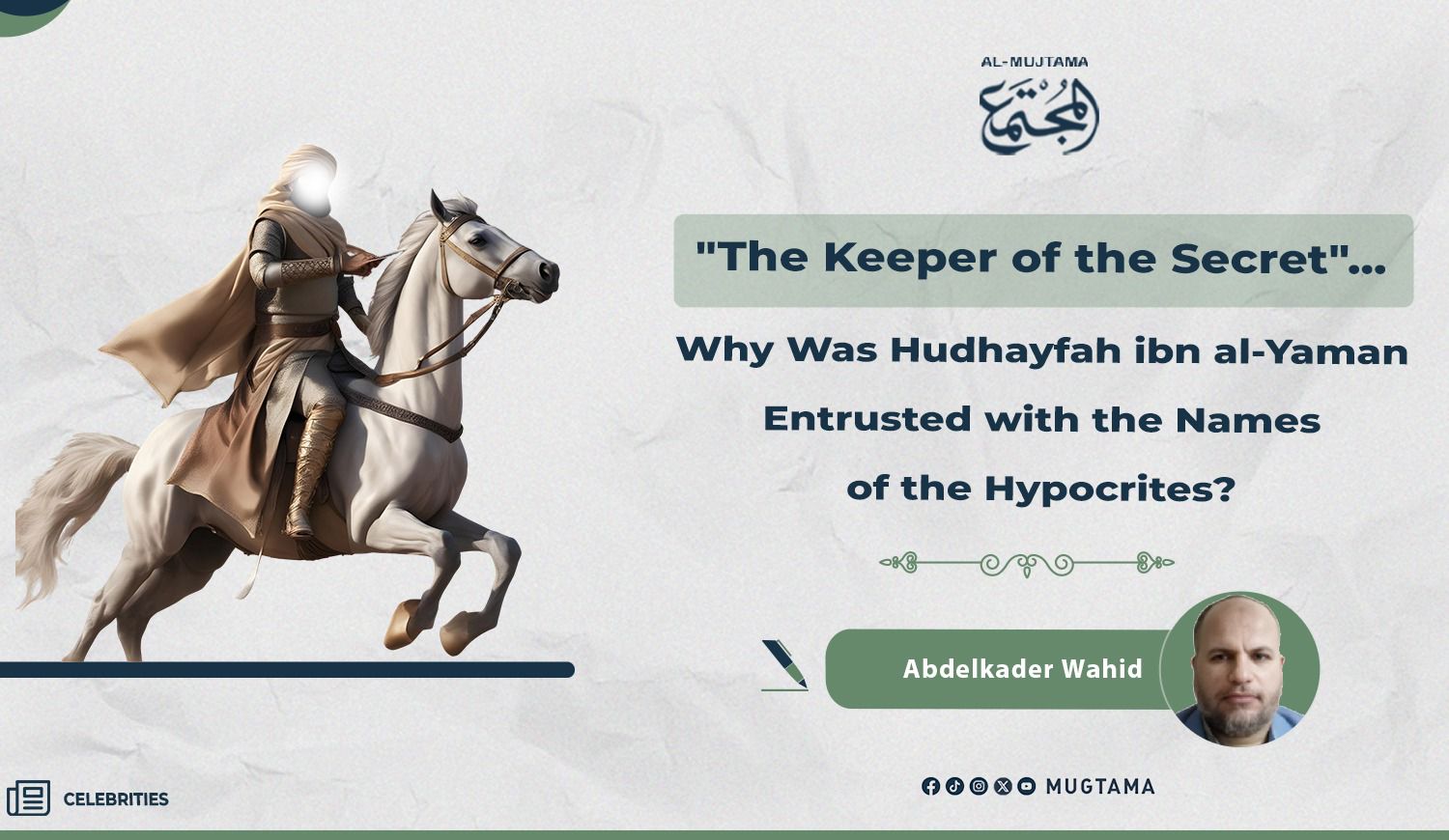
"The Keeper of the Secret"... Why Was Hudhayfah ibn al-Yaman Entrusted with the Names of the Hypocrites?
The genius of the Prophet ﷺ lay in his ability to
recognize the unique skills of all his companions and the surrounding tribes.
This brilliance was evident in how he utilized each person's talents and
qualities, assigning roles based on their distinct aptitudes. He demonstrated
that a successful society thrives on embracing diversity and that positions of
responsibility should be entrusted to those most qualified and best suited for
them.
The life of the Prophet ﷺ provides us with many
examples that merit deep reflection—examples that showcase the individuals’
capabilities, as well as their physical and psychological readiness.
The personality of the companion Ḥudhayfah ibn al-Yaman stands out as a unique example in the
history of the Prophetic era. He was entrusted by the Prophet ﷺ with the greatest secret in
the history of the Islamic state—the knowledge of the names of the hypocrites
and all the sources of unrest within the state of Madinah.
In this article, we explore the remarkable nature of
this exceptional personality, and how the Prophet ﷺ discovered his skill and
readiness, ultimately entrusting him—above all others—with his most guarded
secret.
Thinking Outside the Box
What distinguished the companion Ḥudhayfah ibn al-Yaman was his exceptional, forward-thinking mindset. His questions to the
Prophet ﷺ reflected a proactive approach and a remarkable foresight into
future events and occurrences.
He was distinguished by his anticipatory insight and
out-of-the-box thinking. While it was common for people in the presence of the
Prophet ﷺ to ask frequently about the ways to increase goodness and draw
nearer to it, the nature of Ḥudhayfah ibn al-Yaman’s
questions revealed a different pattern of thought. As narrated in the books of
tradition:
"People used to ask the Messenger of Allah ﷺ about good,
but I used to ask him about evil for fear that it might overtake me."(1)
The
essence of his character lay in his anticipatory mindset, which set him apart
from others. The Prophet ﷺ was fully aware of this unique quality and deeply understood
it—both intuitively and practically—whether on the battlefield or in public
life.
We
are well aware of what befell the companions during the Battle of Uḥud and the deep pain
the Prophet ﷺ endured over the loss of his
companions. Yet, we must not overlook the profound moral stance and supreme act
of forgiveness demonstrated by the companion Ḥudhayfah ibn al-Yamān
when his father was mistakenly killed on the battlefield of Uḥud.
This
incident revealed the purity of his soul and his ability to rise above personal
grief. In truth, when we examine the Battle of Uḥud from beginning to
end, we find that the deaths of many companions—including the father of Ḥudhayfah ibn al-Yaman—were
a direct result of the betrayal of the hypocrites, who withdrew with a third of
the army before the battle, leaving the rest to face their fate alone.
Every
loss in the battle can ultimately be traced back to that unprecedented act of
cowardice and betrayal. Yet, despite his deep personal grief, Ḥudhayfah did not
unleash his anger upon them in that moment. Instead, he displayed remarkable
composure and emotional strength—qualities that had already revealed the early
signs of his exceptional character to the Prophet ﷺ.
It is
also worth noting that at the very moment Ḥudhayfah’s father was
killed, another companion was treacherously murdered by a fellow Muslim, driven
by tribal fanaticism. This incident remained unknown until it was revealed to
the Prophet ﷺ through divine revelation.
Upon learning of it, the Prophet ﷺ ordered that the murderer be executed at the gate of Qubā’
Mosque upon the army’s return from the battle.(2)
The
Battle of Uḥud revealed that Ḥudhayfah ibn al-Yamān was a man of integrity,
unmotivated by tribal bias or worldly gain—unlike others who, when given the
opportunity, failed that moral test.
Complex
intelligence mission
The
greatest fame attained by the companion Ḥudhayfah ibn al-Yamān
came during the Battle of the Confederates (al-Aḥzāb), when the
Prophet ﷺ entrusted him with a highly
sensitive intelligence mission to gather information about the enemy. The
Prophet ﷺ firmly instructed him not to
take any action without his permission. Although Ḥudhayfah was
presented with a golden opportunity to assassinate the commander of the
Confederates’ army—Abū Sufyān—he restrained himself, recalling the Prophet’s
command:
"Had it not been for the Prophet’s instruction to me, 'Do not do
anything until you return to me,' I would have killed him."(3)
Thus,
we are looking at a personality with an extraordinary level of self-control—one
that remained composed even when faced with an equally extraordinary
opportunity.
This
incident also revealed other remarkable qualities Ḥudhayfah
possessed—chief among them his foresight, already evident in his questions
about evil. That same anticipatory instinct manifested itself on the
battlefield. As he infiltrated the enemy’s camp, he managed—through his sharp
intuition and presence of mind—to outsmart two of the most astute men of
Quraysh: ʿAmr ibn al-ʿĀṣ and Muʿāwiyah ibn Abī Sufyān, who were seated on
either side of him.
When
Abū Sufyān warned, “Beware of spies and informants—let every man ask the name
of the one beside him,” Ḥudhayfah acted first. He turned to ʿAmr on his right and
said, “Who are you?” He replied, “ʿAmr ibn al-ʿĀṣ.” Then he turned to
Muʿāwiyah on his left and
asked, “And who are you?” He answered, “Muʿāwiyah ibn Abī Sufyān.” Thus, he avoided
suspicion by asking before being asked—deceiving two of the
shrewdest minds among the enemy.
All
of these psychological traits and inner qualities made Ḥudhayfah ibn al-Yamān
the trusted keeper of the Prophet’s ﷺ secret. This trust was solidified during a critical moment
after the Battle of Tabūk, when the Prophet ﷺ survived an assassination attempt orchestrated by a group of
hypocrites.
Ḥudhayfah had taken hold of the reins of the Prophet’s camel following
the attempt. He remained by the camel until the Prophet ﷺ rose, then approached him. The Prophet ﷺ asked, “Who is this?” He replied, “It is Ḥudhayfah.” The
Prophet ﷺ then said, “I am going to
confide something to you—do not disclose it to anyone: I have been forbidden to
offer funeral prayers for so-and-so, and so-and-so, and so-and-so”—naming a
number of the hypocrites.
No
one else ever learned their names from the Prophet ﷺ except Ḥudhayfah.
After
the Prophet ﷺ passed away, during the
caliphate of ʿUmar ibn al-Khaṭṭāb
(may Allah be pleased with him), whenever a man died whom ʿUmar suspected to be
among that group (of hypocrites), he would take Ḥudhayfah’s hand and
lead him to the funeral prayer. If Ḥudhayfah walked with
him, ʿUmar would perform
the prayer. But if Ḥudhayfah withdrew his hand and refused to
proceed, ʿUmar would turn back
and refrain from offering the prayer.(4)
Final
question
But
the question remains: if the Prophet ﷺ never commanded that any of the hypocrites be killed—even
though several companions urged him to do so—why was that the case?
Indeed,
more than once, ʿUmar al-Fārūq (may Allah be
pleased with him) requested permission to strike them down, and after the attempted
assassination of the Prophet ﷺ during the return from Tabūk, the companion Usayd ibn Ḥuḍayr said:
"O Messenger of Allah, the people have gathered and settled. Command
that each tribe kill the one among them who plotted this, so that the killer is
from his own kin. And if you wish—by the One who sent you with the truth—then
inform me of their names, and I will not move from here until I bring you,
their heads.
The
Prophet ﷺ responded to Usayd ibn Ḥuḍayr with profound
wisdom, saying:
“O Usayd, I
dislike that people should say: ‘Muḥammad fought alongside a group of people, and once Allah granted him
victory through them, he turned against them and killed them.
Although
the Prophet Muhammad, peace be upon him, did not command them to be killed, he
informed Hudhayfah ibn al-Yaman of their names so that it would remain a
leverage for pressure that the adversary would be afraid to reveal one day.
It
also opens the way for him to return and join the ranks of ordinary people,
which is what the companion Hudhayfah ibn al-Yaman did. He became a keeper of
the secret of the Messenger of Allah (peace be upon him), and his presence and
involvement in this secret served as a deterrent to the discouragers and
alarmists until the state grew stronger and extended its authority through the
unique skills and competencies of those chosen by the Prophet (peace be upon
him).
____________________________
(1)
It was mentioned in the two Sahihs (Bukhari and Muslim).
(2) Al-Salihi: The Ways of Guidance and Righteousness.
(3) Muhammad ibn Umar al-Waqidi: The Expeditions of al-Waqidi.
(4) Ibn Abd al-Barr: The Comprehensive Book on the Knowledge of Companions.
(5) Al-Salihi: Previous source.