









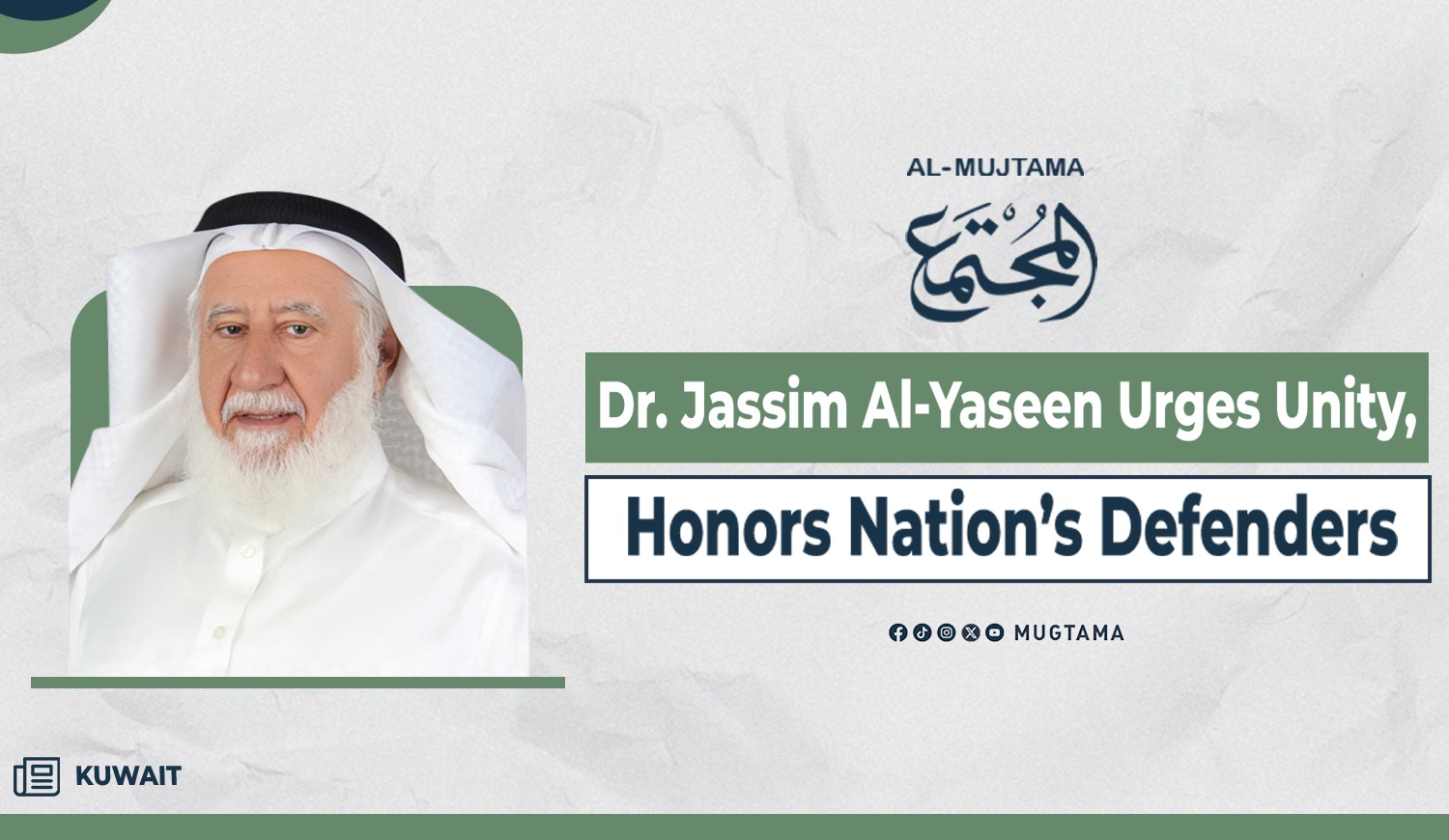
Dr. Jassim Al-Yaseen Urges Unity, Honors Nation’s Defenders
At a pivotal
moment in Kuwait’s history, voices are rising to reinforce principles and unify
ranks. Sheikh Dr. Jassim Muhalhil Al-Yaseen delivered five clear messages that
combine religious duty, national responsibility, and an emphasis on unity in
the face of challenges.
Obedience
to the Ruler is a Religious and National Duty
Sheikh
Al-Yaseen stated that obedience to the ruler and adherence to the directives of
the Council of Ministers are not optional, but rather a religious and national
obligation upon which the country’s welfare and safety depend. He added that in
times of hardship and crisis, the importance of discipline becomes evident, and
the value of commitment is revealed, as such adherence contributes to saving
lives, protecting property, and strengthening national security and stability.
He pointed out
that this commitment stems not only from national duty but also from divine
guidance. Allah has instructed believers to refer matters to those in authority
and to verify information, avoiding haste in spreading news or taking positions
without knowledge or insight: “And when there
comes to them information about public security or fear, they spread it around.
But if they had referred it to the Messenger or to those in authority among
them, then the ones who can draw correct conclusions from it would have known
about it.” (An-Nisa 4:83)
He added that
this is a clear call to consult experts, to prioritize wisdom over haste and
knowledge over assumption. The Prophet (peace be upon him) emphasized the
significance of obeying those in authority, linking it to obedience to Allah
and His Messenger: “Whoever obeys me has obeyed Allah, and whoever disobeys me
has disobeyed Allah. Whoever obeys the leader has obeyed me, and whoever
disobeys the leader has disobeyed me” (Al-Bukhari).
He explained
that this obedience is not merely administrative, but a cornerstone of societal
stability and unity. Decisions issued by official authorities are based on
careful study, accumulated expertise, and a vision that considers public
interest while balancing risks and needs.
Disavowal
of Anyone who does not Stand with Kuwait
In his second
message, Sheikh Al-Yaseen affirmed that in Kuwait—represented by its
institutions, civil society organizations, and public benefit associations of
all orientations, whether Islamic, Arab nationalist, relief-based, or
developmental—there is a unified stance: standing firmly behind the country and
its leadership against what he described as blatant aggression from Iran and
its affiliated armed groups.
He added that
they disavow any individual, figure, or institution that did not stand with
Kuwait, hesitated in supporting it, or remained silent regarding the
aggression, regardless of their name, reputation, or affiliation.
He stated that
Kuwait has faced an expansionist assault from Iran and its allied militias,
manifested in hundreds of drones and missiles—over six hundred drones and three
hundred missiles—some of which could have devastated the country, were it not
for Allah’s protection first, and the vigilance of the armed forces defending
the nation.
He noted that
these attacks targeted ports, airports, power stations, and water desalination
plants in an attempt to cripple the country’s essential infrastructure. Despite
this, Kuwait remained steadfast through the grace of Allah and the efforts of
loyal men in the military, police, and National Guard.
He cited the
verse: “Indeed, Allah defends those who have
believed.” (Al-Hajj 22:38)
He emphasized that divine protection goes hand in hand with taking the
necessary means, maintaining firm positions, and preserving unity in the face
of injustice. Kuwait, he stressed, is a red line, and anyone who fails to
support it in such times is clearly disavowed.
He added that
positions in times of crisis reveal true character. Any past aid or donations
were directed toward supporting the oppressed, fulfilling a moral and religious
duty.
Gulf
Support for Jerusalem
In his third
message, Sheikh Al-Yaseen affirmed that the issue of Jerusalem and Palestine
has always been the cause of the Arab and Muslim world, embraced and supported
by Gulf countries. He highlighted King Faisal bin Abdulaziz as a leading
example of steadfast support for the Palestinian cause.
He contrasted
this with those who merely used nationalist and socialist slogans while failing
to act meaningfully, whereas Gulf support has been rooted in faith and
principle.
He noted that
Kuwait has been a model in supporting the Palestinian cause politically and
financially, including its support for Yasser Arafat in his early years and for
Hamas since the time of its founder, Sheikh Ahmad Yassin.
However, he
pointed out that current events test true loyalty. Despite the aggression faced
by Kuwait and other Gulf states, he expressed disappointment that no clear
condemnation had been issued by Hamas or other resistance groups. He emphasized
that principles should not be selective, and those who were supported in the
past are expected to show solidarity in times of trial.
Our
Strength Lies in Unity and Cohesion
In his fourth
message, Sheikh Al-Yaseen stressed that during these difficult times, Kuwait
must rely not only on material strength but on unity, cohesion, and collective
awareness.
He urged
citizens to stand united behind their leadership, avoid division, and resist
rumors and misinformation. He cited the verse: “And
hold firmly to the rope of Allah all together and do not become divided.” (Ali-Imran 3:103)
He warned that
harmful words and malicious rumors can weaken society more than external
threats. Unity, he emphasized, is the foundation of strength and security.
A Message
of Gratitude to the Armed Forces
In his fifth
message, Sheikh Al-Yaseen expressed deep appreciation for the armed forces,
police, National Guard, firefighters, and civil defense personnel.
He praised
their sacrifices, describing them as protectors of the nation who have
demonstrated the highest levels of dedication and selflessness. He emphasized
that their work is not merely a job but a noble mission deserving of great
reward.
He cited the
saying of the Prophet (peace be upon him): “Standing guard for a day in the
cause of Allah is better than the world and all it contains.”
He concluded by
affirming that these men are the shield of the nation, the symbol of its
strength, and the reason for its continued stability. He prayed that Allah
rewards them abundantly, preserves Kuwait and its people, and maintains its
security and prosperity.
Read Also:
-
8 Key Points in Kuwait’s Letter to the United Nations on the Iranian Aggression
-
6 Effective Kuwaiti Strategies in Confronting IranianvAggression
-
Aggression Against Concepts!
-------------------------------------------------------------