






Eight Zionist Drivers of Gaza’s Selective Blockade
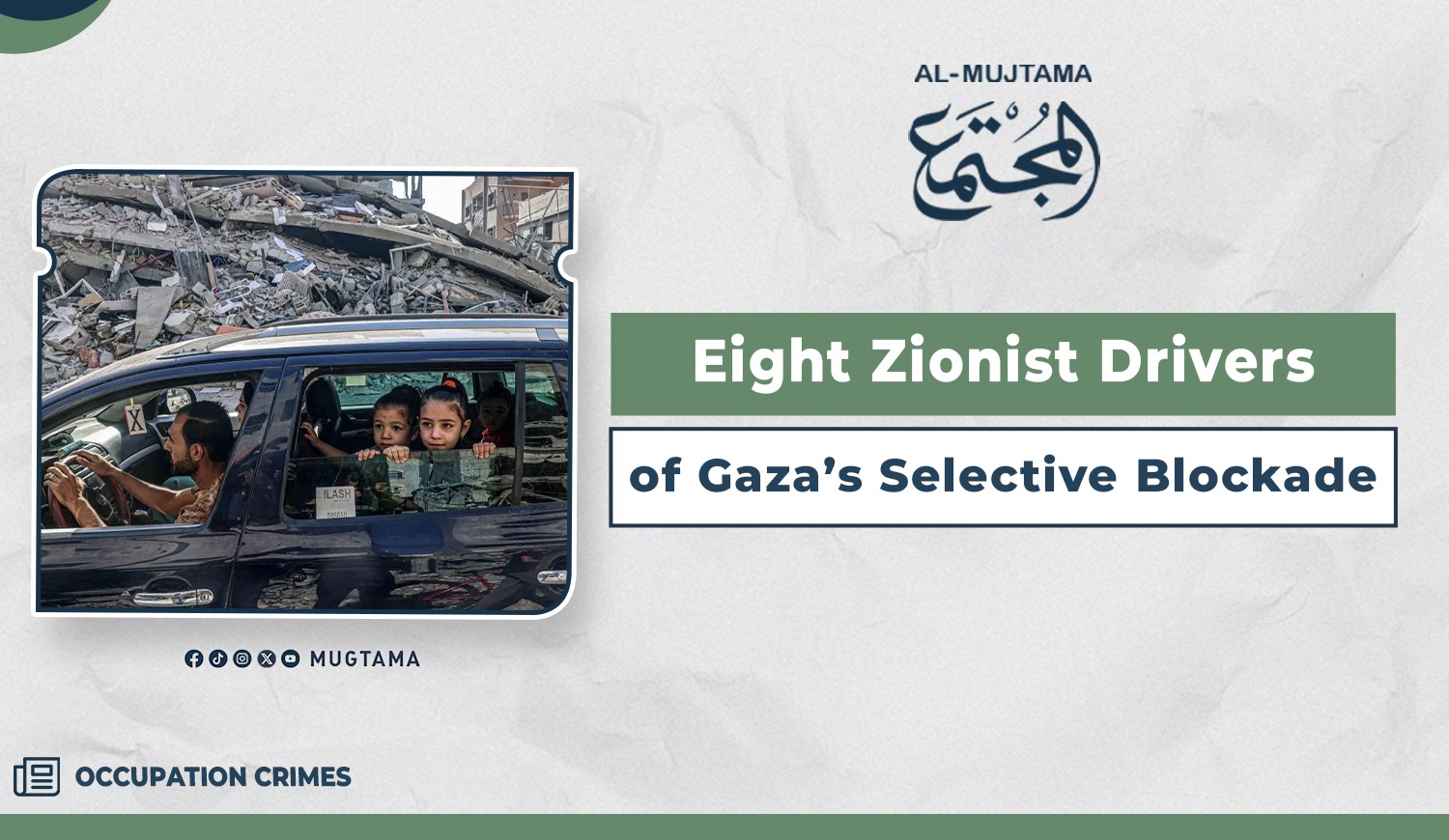
The policy of selective blockade is a central instrument in
the Israeli occupation’s strategy to control the Gaza Strip. It is based on
tightly regulating daily life necessities and controlling which materials are
allowed in or barred from entry, in service of security, political, and
economic objectives.
Reports by the United Nations Office for the Coordination of
Humanitarian Affairs (OCHA), along with Amnesty International, indicate that
the occupation applies what is known as “calculated pressure”: keeping Gaza in
a constant state of fragility without allowing a total collapse that would
undermine control.
Below are the key motives behind this policy, as documented by
UN and human rights reports and academic studies:
1. Dismantling the Social and Economic Fabric:
Reports by the United Nations Office for the Coordination of
Humanitarian Affairs (OCHA) and the World Bank on Gaza’s economy show that
restrictions on electricity, fuel, and construction materials have led to a
comprehensive deterioration of basic services, alongside soaring unemployment,
and poverty rates.
Human Rights Watch notes that this decline is not incidental,
but rather the direct result of systematic policies aimed at exhausting society
and undermining its capacity to endure and remain resilient.
2. Managing the Conflict Without Resolution:
Papers published by Israel’s Institute for National Security
Studies (INSS), along with statements by former Minister of War Moshe Ya’alon
at the Herzliya Conference, affirm that the Israeli strategy is based on
managing the conflict rather than resolving it. The selective blockade enables
the occupation to control the level of tension by deliberately opening and
closing crossings in a calibrated manner.
3. Blackmailing the Resistance and Imposing Political Realities:
Reports by the United Nations Human Rights
Council—particularly in the aftermath of the 2014 war—indicate that the
occupation uses border crossings as a tool of political pressure. Any increase
or reduction in the number of trucks or the entry of fuel is tied to issues
such as ceasefires or prisoner exchanges, turning the blockade into a strategic
instrument of blackmail that serves Israeli political and security agendas.
4. Extracting Intelligence Information:
Investigative reports published by the Hebrew newspaper Haaretz
reveal that the movement of goods and individuals through border crossings is
exploited to gather extensive intelligence on Gaza’s social and economic
structures. Permits, commercial records, and security screenings all function
as tools for building a comprehensive Israeli intelligence database on the
Strip.
5.Reshaping the Balance of Power Within
the Gaza Strip
Studies published by the School of
Oriental and African Studies in London and reports from the Al-Mezan Center for
Human Rights indicate that the blockade is being used to influence the balance
of power within Gaza. By tightening restrictions on certain areas or specific
social groups while granting concessions to others, authorities are shaping
social environments to be more vulnerable or more susceptible to pressure.
6.Deepening the Palestinian Divide
Reports by the International Crisis
Group highlight that the stark divergence between the economic and legal
realities in Gaza and the West Bank—resulting from the blockade—has entrenched
the political divide and further complicated efforts to unify Palestinian
institutions, in a manner that serves Israeli interests in perpetuating
fragmentation.
7.Undermining the Resistance’s Military
Capabilities
Amnesty International and Human Rights
Watch indicate that restrictions on so-called dual-use materials are explicitly
aimed at preventing the development of military capabilities inside Gaza. These
measures include bans on the entry of iron, cement, spare parts, and industrial
materials, thereby disrupting manufacturing processes and hindering
reconstruction after each round of hostilities.
8.Producing a State of Forced Dependency
on the Occupation
Reports by the United Nations
Conference on Trade and Development (UNCTAD) and studies from Birzeit
University affirm that Israel seeks to keep Gaza’s economy in a state of
enforced dependency by exercising full control over electricity, fuel, water,
and border crossings. This dependency grants the occupying power direct
leverage over every aspect of daily life.
You may also like:
Hamas’s Five Priorities for the Next Stage
Seven Zionist Motives Behind Prolonging the Gaza War and Stalling Phase Two
10 Steps to Sustain Public Opinion in Support of Gaza
7 Flimsy Justifications for Zionist Occupation Crimes
The Jews and the Breach of Covenants: 5 Biblical Evidences Confirming the Trait of Treachery
________________________________