






Forgotten Gaza: Missing Needs and Daily Violations
The world
thinks the war on Gaza has stopped, but the truth is we are still living
through its details every hour — sounds of bombardment, violent explosions
shaking the city, and unceasing cries of loss. Even as I write this post, the
sounds of shells are nearly tearing hearts apart. This is the life we have
grown used to — and the life the world has grown used to ignoring.
This is a
blog post by preacher Jihad Hales, recorded from the heart of Gaza as a
testament to the suffering that has never left Gaza's atmosphere — despite the
war officially halting under a ceasefire last October. Yet it has become a
truce of neither peace nor war, leaning far closer to war; the targeting of
civilians and journalists continues unabated, albeit at a lower intensity than
that of the genocide.
Adding to
Gaza's suffering is the forgetfulness that has shrouded its news, owing to the
conflicts engulfing the region — conflicts that are escalating and pulling
attention away from the Palestinian cause as a whole, and from Gaza in
particular, until its affairs have been reduced to a footnote in the news
cycle, if they appear at all.
On the Humanitarian Front
On this
front, nothing new has emerged to ease the suffering of Gaza's people after two
years of genocide. The Zionist entity has failed to honor its obligations under
the first phase of the agreement — including the entry of aid, caravans,
medicine, and the equipment needed for rubble removal — along with everything
else that would allow the people of Gaza to catch their breath.
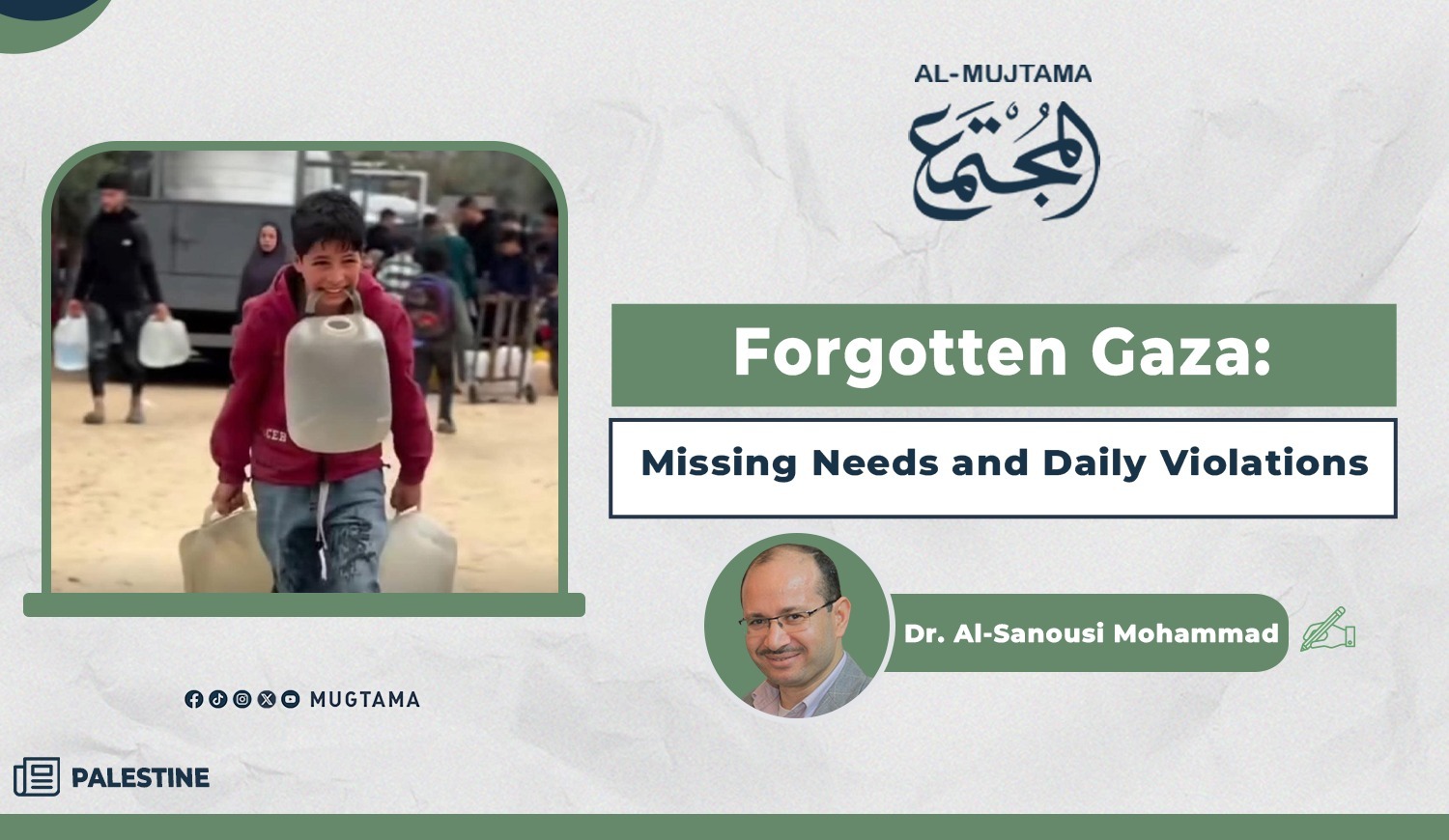
As one
example, we followed the image of a child carrying three water jugs — two in
his hands and one gripped between his teeth — a scene that reflects Gaza's dire
struggle with clean water access, and the heavy burden of early responsibility
shouldered by its children, thrust upon them by the conditions of war, the loss
of family members, and the presence of the wounded or sick in virtually every
household.
This
image reflected more than one bitter truth, and captured in a single frame much
of what needs to be said about the dignified people of Gaza and the suffering
they endure.
The
Global Campaign to Stop the Genocide in Gaza documented this on its Facebook
page, stating: "After several days of water supply disruption to
displacement centers, families across the Strip are today facing severe
difficulty accessing safe drinking water, which UNICEF had previously provided
free of charge at shelter sites.
Today,
UNICEF has halted the distribution of this water, leaving families waiting on
anyone — any individual or supporting organization — to provide it. The plight
of these families is embodied in this child, clinging with his teeth and hands
as he struggles to secure water to fill his worn-out jugs.
Also on
the humanitarian front, the dangers of tent-based living are worsening by the
day — not only during winter rains, as seen with the weather depression at the
end of last March, nor merely with the summer heat now approaching, but also
from insects, animals, and rodents that have begun posing a serious threat to
children and infants. In one case, a rat attacked a newborn baby, gnawing at
its face and leaving the child in a critical condition.
The Targeting Has Not Stopped
As noted,
it is only the war at its peak genocidal intensity that has stopped in Gaza.
The targeting of civilians — and even police officers and security personnel —
has never ceased, with martyrs falling and hospitals receiving the wounded on a
daily basis.
As one
example, on Tuesday, April 14, eleven people were killed as a result of
occupation airstrikes on Gaza City and its northern areas, including a strike
that targeted a police vehicle, killing four — among them three-year-old child
Yahya Al-Mallahi — and wounding nine bystanders. The total number of those
killed since the ceasefire began has now surpassed 750 martyrs.
Prior to
that, on Wednesday, April 8, the occupation assassinated journalist Mohammed
Wishah, a field correspondent for Al
Jazeera Mubasher, in a treacherous strike that targeted his vehicle —
reflecting the entity's deliberate policy of silencing the truth and
assassinating journalists since October 7.
Al
Jazeera stated in a press release that the assassination of Wishah constitutes
an heinous crime and a flagrant violation of international laws and norms,
affirming that the targeting is part of a systematic pattern aimed at
suppressing media coverage and preventing the truth from being reported.
The head
of Al Jazeera's bureau in Gaza, Wael Al-Dahdouh, described the incident as an
extension of a long chain of violations, noting that the number of journalists
killed in the Strip has exceeded 262 over the past period, under extremely
dangerous field conditions.
The
spokesman for the Government Media Office in Gaza, Ismail Al-Thawabta,
characterized the targeting of journalists as part of a deliberate policy aimed
at burying the truth, warning that violations continue despite international
calls for them to cease.
On the Political Front
On this
front as well, nothing new has emerged. The Administrative Committee has still
not been permitted to enter Gaza, carry out its work, or assume control of
institutions and agencies — despite Hamas having declared its readiness for
this transition. Moreover, there are persistent pressure campaigns being
exerted on the resistance by the High Commissioner for Gaza on the Peace
Council, Nikolai Mladenov, pushing toward the handover of weapons and
accelerating that process — with no regard whatsoever for the first-phase
obligations that the occupation continues to evade.
Hamas and
the Palestinian factions are preparing to finalize their response to Mladenov
regarding the disarmament plan, following consultations held in Cairo with
factions and mediators on Sunday, April 12.
Sources
close to the consultations indicated that the response will center on first
insisting upon a concrete timeline for the occupation to fulfill its
first-phase obligations — particularly those relating to the entry of relief
materials, the expansion of aid deliveries to no fewer than 600 trucks per day,
the introduction of infrastructure reconstruction materials, the cessation of
daily violations, and the immediate entry of the Gaza Administrative Committee
into the Strip to begin its work. Only after these conditions are met, the
sources said, would discussions on the second phase be entered into.
It comes
as no surprise that the Zionist entity is attempting to manipulate the terms of
the ceasefire — in both its first and second phases — seeking to evade every
obligation, while focusing solely on disarmament and linking it to
reconstruction and the fulfillment of the Strip's humanitarian needs.
Aiding it
in this is unlimited American backing, compounded by the region's absorption in
new and escalating conflicts that the entity itself ignites — what appears to
be a deliberate strategy to reduce international pressure over Gaza, and to
impose new facts on the ground, whether in Gaza and the West Bank, or in
Lebanon and Syria, not to mention Netanyahu's flight from accountability on the
domestic front within the entity itself.
And if
the policy of lighting fires has been the entity's practiced method for
decades, Gaza finds itself forgotten amid the rubble of cascading events, its
suffering compounding — especially as the entity slips free of its obligations
and intensifies pressure to extract what it failed to achieve on the
battlefield.
You may
also like:
Israel's Kill Doctrine: Genocide and Assassination
Im Tirtzu: Campus Watchdog or Ideological Enforcer?