





Homeschooling: A Psychological Safety Net for Children

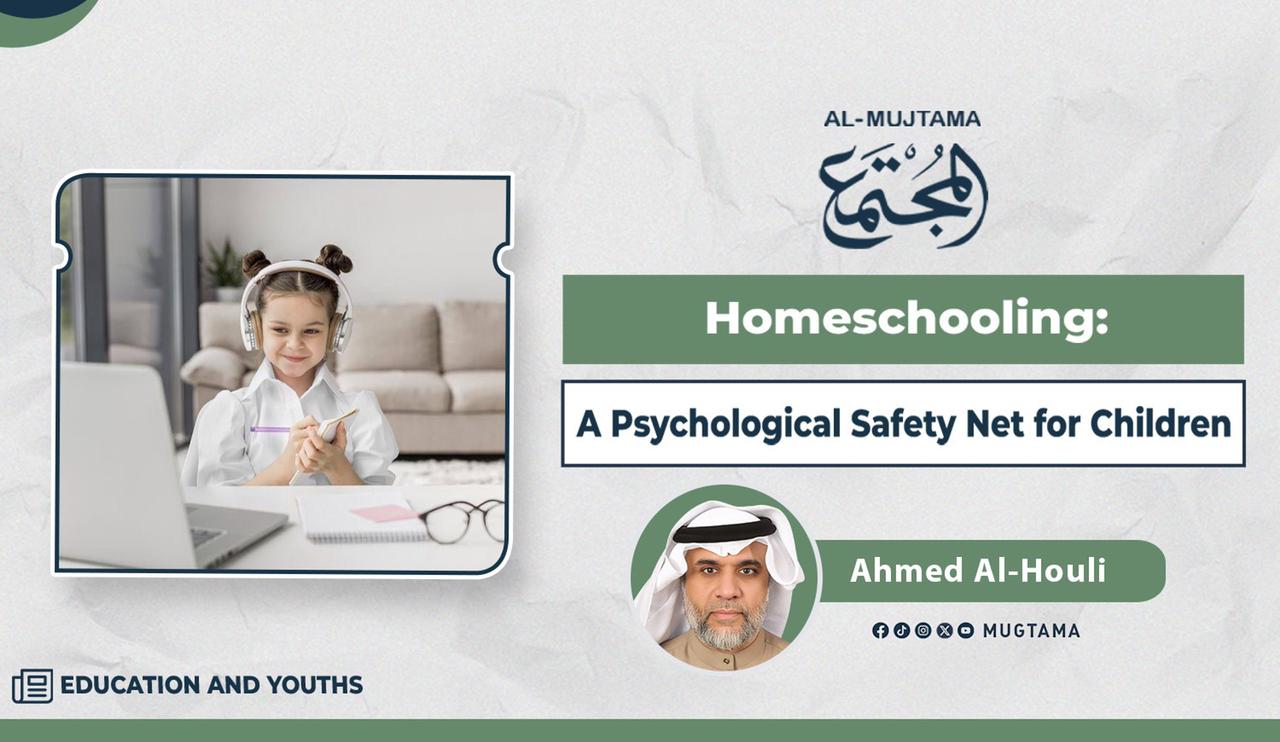
Before I discuss school bullying — which
I’ve dedicated a separate article to — I must first remind that I have
previously addressed the importance of flexible (home) education, whether at
the level of the family, the child, or even the educational system represented
by the state.
Here, I focus particularly on the child,
and on how many families and children today need the option of flexible education — a model that has
long been adopted by many advanced nations, especially in the elementary stage,
which is the age when a child’s intellectual and emotional personality begins
to take shape, and when they start interacting with environments outside their
family circle.
Challenges
of Traditional Education
With the astonishing digital development we are witnessing today — a blessing
that Allah has granted this generation — the traditional school environment is
no longer free from serious psychological and social risks. Many children are
subjected to bullying, verbal and physical harassment, or humiliation,
especially in communities characterized by tribal, familial, or marital ties in
certain regions.
When a child lacks a strong family support
system within the school — as is the case for small, expatriate, or relocated
families — they become more vulnerable to mistreatment and abuse. When such
experiences are repeated, the child’s spirit is crushed, fear and cowardice
take root, and psychological complexes may accompany them into adulthood.
A
Real-Life Example
I remember once asking one of my American colleagues — a veteran of the Vietnam
War — why he had been homeschooling his grandchildren for years. He replied,
“At home, we take better care of them. They help raise animals and poultry,
cook, farm, and manage household duties.”
I said, “Also to protect them from
bullying?”
He replied, “Yes, that’s one of the main reasons.”
School Is
Not the Only Path
There is no doubt that schools play an important role in developing certain
social and academic skills. However, today’s reality proves that a child in the
digital age can learn anywhere — at home or elsewhere — and acquire far more
knowledge than they would in a traditional classroom, in addition to gaining
practical life skills within their family environment.
Today’s child faces an overwhelming flow of
information, so much so that their mind resembles that of an elderly person
exhausted by Alzheimer’s due to mental overload. Here, flexible education
emerges as a merciful alternative that protects the child from this pressure
and strikes a balance between knowledge and practical skills.
Protecting
the Child Is a Social Responsibility
The ultimate goal remains protecting the child psychologically and socially —
and this is where flexible education derives its value. It enables families to
choose what suits their circumstances while safeguarding their children from
potentially harmful environments.
It pains me to see children being beaten or
humiliated in their schools, living in constant fear of returning there.
Education was never meant to be a gateway to humiliation — it was meant to be a
means of elevation. Today, with digital alternatives readily available, it has
become essential to reconsider the concept of flexible education and adopt it
as a realistic, modern option that aligns with the needs of our time and
safeguards our children.
-------------------------------------------------------------
Read Also:
-
Bodily Privacy: Children’s Right to Safety and Dignity