






Kuwait Humanitarian Legacy: Liberation, Charity, and Global Impact
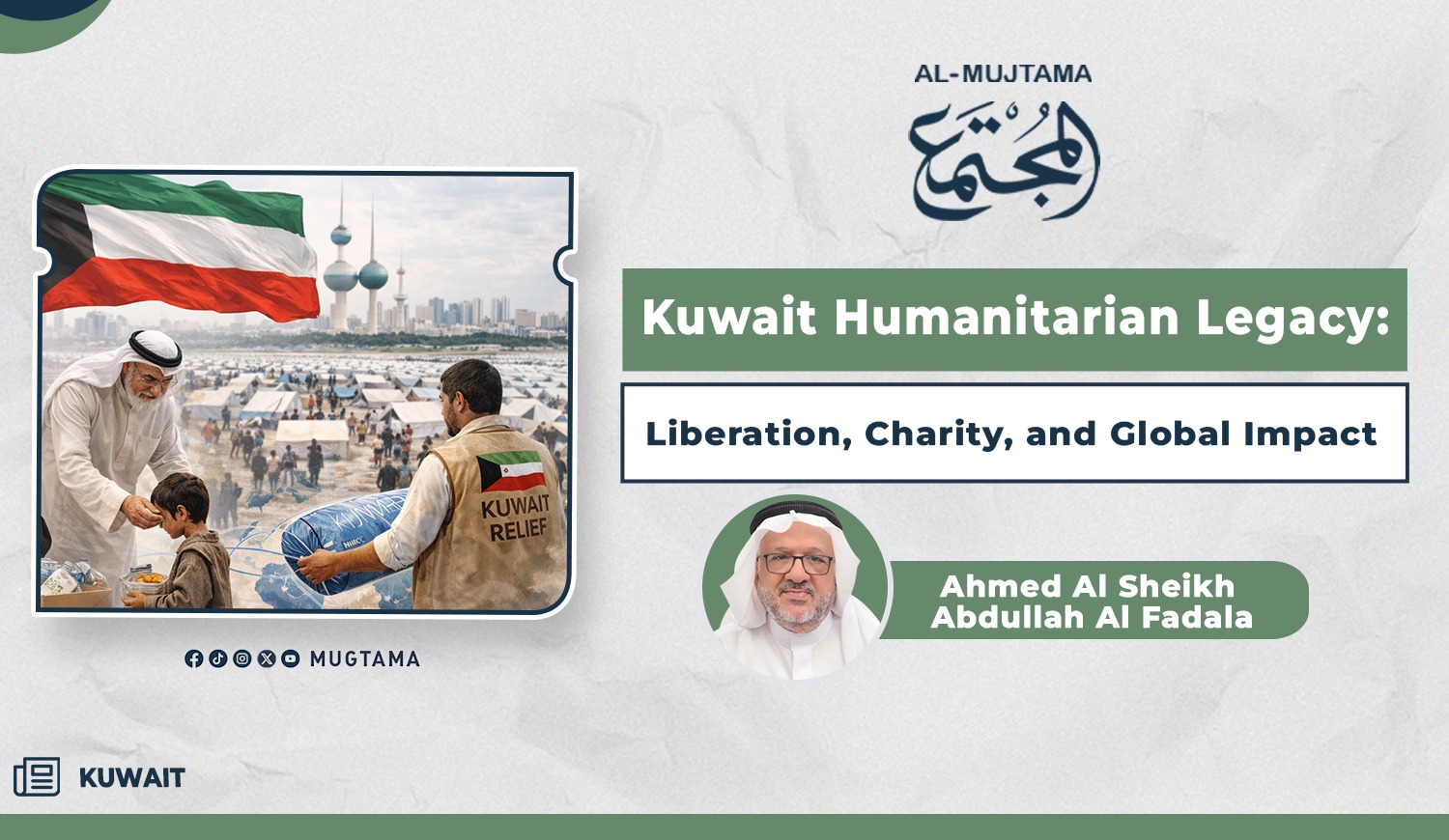
In the State of Kuwait, celebrating
National Day and Liberation Day is not merely a return to a past political
event, but a revival of the spirit of a nation that has believed that the
strength of states is not measured only by the size of their wealth or borders,
but by the good they extend to humanity, any humanity.
From the earliest beginnings, before
and after the emergence of oil, Kuwaitis carried a firm conviction that wealth
is a trust, that giving preserves values, and that what is offered for the sake
of God is never lost.
Thus, Kuwait’s description as a
“Global Humanitarian Center” did not arise from nowhere; it is the result of a long history and accumulated experience over decades, making charitable work a state policy and a people’s culture, not a passing initiative or seasonal emotion.
Leadership… When Diplomacy Becomes Humanitarian
In this context, the ruling family of
Kuwait stands out as a unique model combining politics and compassion.
Charitable work was never regarded as a gesture of courtesy but as a moral responsibility that expressed the conscience of the state. What has been achieved
is a continuation of a centuries‑long legacy of the ruling family, steadfast in
adhering to a constant path that is neither abandoned nor left to chance.
Kuwait’s name has become linked with
support, relief, building international partnerships, and honoring pioneers of
giving at home and abroad. Since its inception, the state’s message has been
clear: diplomacy is a path to a prosperous life, not a field of conflict.
The People… A Heart That Embraces All
If leadership set the framework, the
Kuwaiti people are the spirit within it. The life story of Dr. Abdulrahman Al‑Sumait,
may God have mercy on him, remains a shining example—one among many. A
physician who left behind a life of comfort, dedicating his years to serving
Africa’s poor by building schools and hospitals and launching development
projects. He believed and practiced the principle: “Give them knowledge before
you give them money,” linking charity to education, awareness, and
sustainability.
Through such examples, the truth is
clear: giving in Kuwait is part of identity, a system stretching from
individual benevolence to institutional work. Charitable work has evolved into
a comprehensive system: organized charities, development funds, grassroots and
youth initiatives, internal and external partnerships, transparency, planning,
and impact measurement. Kuwait has moved from spontaneous charity to modern
institutional work, ensuring aid reaches those who deserve it, maximizing its
impact, and transforming it into development rather than temporary assistance.
When Numbers Speak
Numbers testify to Kuwait’s humanitarian role: hundreds of millions donated to support afflicted peoples,
international relief conferences organized and sponsored, and health,
education, and development programs supported across the Arab world and beyond.
Examples include:
- In 2013, at the donors’ conference for Syria,
Kuwait pledged $300 million, with total commitments reaching $1.5 billion.
- In 2014, at the second conference, Kuwait pledged
$500 million, with total commitments reaching $2.4 billion.
- Kuwait established technical offices abroad to
implement and supervise development projects, building universities,
hospitals, health centers, housing cities, and more.
On the popular level, charities
provide education to thousands of students, distribute monthly aid to over
50,000 cases, and achieve:
- Education for more than half a million people in
Asia and Africa.
- Sponsorship of over 50,000 orphans with food,
clothing, and schooling.
- Construction of thousands of mosques and health
centers.
- Digging tens of thousands of wells in drought‑stricken
areas.
These efforts, carried out by more
than 30 charitable associations in Kuwait, confirm that giving is a strategic
moral choice, offered without discrimination of religion, race, or affiliation.
Educational Contributions
Kuwait also takes pride in its
educational contributions, notably Kuwait University, established in 1966 as
the country’s first public research university. It has played a national role
beyond education, shaping scientific elites and cultural awareness, welcoming
Arab and foreign students, and providing free education, housing, and living
support.
Since its founding, Kuwait University
has graduated about 163,000 students across 20 colleges, many of whom became
ministers, ambassadors, and senior officials in diverse fields.
Kuwait… A Nation of Freedom and Humanity Together
As Kuwait celebrates National Day and
Liberation Day, it recalls a homeland that resisted invasion and regained
freedom, and a homeland that extends its hand to others, as if to say: those
who have known pain are most entitled to ease the pain of others.
This humanitarian face is inseparable
from Kuwait’s balanced policy with its Gulf neighbors, Arab and Islamic
surroundings, and the world at large—combining steadfast principles, good
neighborliness, and respect for humanity. The result was global solidarity
during its invasion, leading to liberation and recovery in record time.
Through this balanced and wise policy,
Kuwait has believed and acted on the principle that the strength of nations is
not measured by borders alone, but by what they give to humanity.
May God have mercy on its past leaders
and benefactors, prolong the lives of its current leaders, and preserve
Kuwait—a nation whose leadership and people remain a beacon of goodness, rooted
in the land and illuminating horizons worldwide.
-------------
Read the article in Arabic