







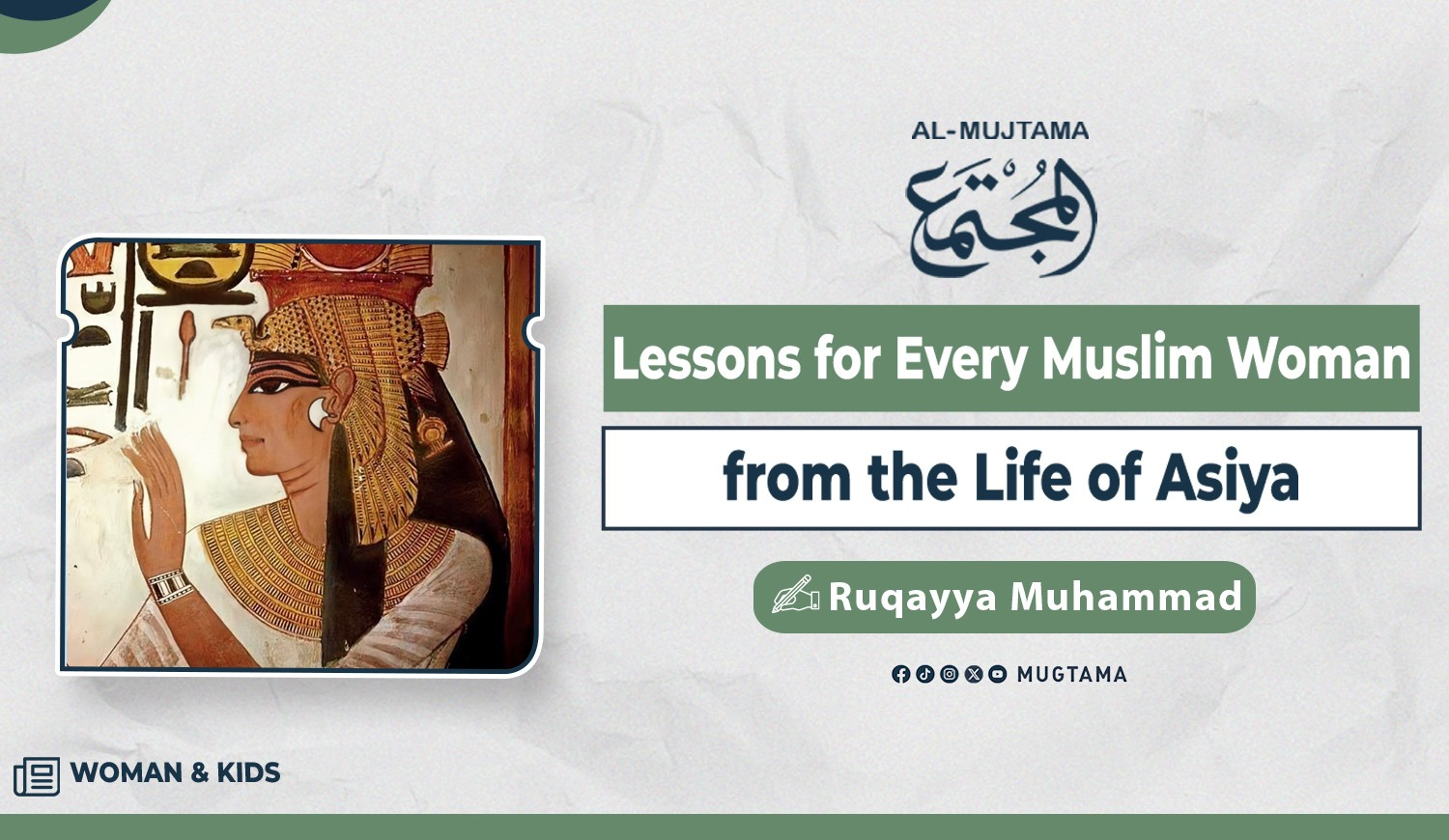
Lessons for Every Muslim Woman from the Life of Asiya
The Quran
immortalized the remembrance of Asiya, the wife of Pharaoh (peace be upon her),
making her story a light renewed in every age. Within it lie answers to deep
questions and guidance for overcoming challenges that women face in their life
journeys.
Her story
proclaims that no matter how great tyranny becomes or how severe oppression
grows, a woman can—through the power of faith—break free from the shackles of captivity into the
vastness of true freedom.
Asiya
transformed the palace of the tyrant into a ladder by which her soul ascended
to the heavens. She sold a life of luxury and fleeting splendor in exchange for
Paradise, until the Lord of the Worlds Himself set her forth as an example of
faith.
Allah the
Almighty Says, {And Allah sets forth an example for
the believers: the wife of Pharaoh, who prayed, “My Lord! Build me a house in
Paradise near You, deliver me from Pharaoh and his ˹evil˺ doing, and save me from the wrongdoing
people.”} [At-Tahrim 66:11] These are among the lessons drawn from her life.
Wisdom and Persuasion in Asiya’s Story
The verse
concerning Asiya reveals an elevated level of practical wisdom and mastery of
persuasion. Her words achieved multiple goals simultaneously: she appealed to
maternal instinct, linked the child’s welfare to Pharaoh’s personal interest—{˹This baby is˺ a source of joy for me and you.} [Al-Qasas 28:9]—and presented him as a future benefit.
All of
this was conveyed through calm, convincing speech that successfully dissuaded
Pharaoh from killing the child.
Here,
feminine wisdom emerges as a constructive force, not merely a reactive one.
Every woman should invest the insight and intelligence Allah has granted her in
managing her family’s affairs—making
dialogue her method and persuasion her path—so as to achieve balance within the
home and guide decisions toward what serves the greater good.
True
wisdom lies in transforming challenges into opportunities and using the
blessing of intellect and speech to build a stable, balanced life.
No Submission in Matters of Faith
Asiya’s
story powerfully demonstrates a woman’s independence in belief and intellectual
integrity. She was neither subordinate nor imitative—even of her husband. No
excuse exists for doctrinal deviation, regardless of how tyrannical one’s
guardian may be.
Pharaoh claimed
divinity—yet his wife defied his authority and chose, with unwavering
certainty, the worship of the One True God. Allah Requires His servants to
disavow polytheism (shirk),
regardless of how deeply it is embedded in their environment.
If such a
trial was severe even for men—as seen in the story of Prophet Ibrahim (peace be
upon him), who said: {As I distance myself from ˹all of˺ you and from whatever you invoke
besides Allah, I will ˹continue to˺ call upon my Lord ˹alone˺, trusting that I will never be
disappointed in invoking my Lord.} [Maryam 19:48]—then
it is even more demanding for a woman bound to a tyrannical husband.
Yet Asiya
overcame this test. Emotion did not
overpower her, nor did sentiment lead her astray. She stood firm in faith, supplicating Allah to
Save her from disbelief and its people—foremost among them her husband—until
she met her Lord.
Renouncing Worldly Splendor for Eternal
Life
A queen
living in a magnificent palace, with everything at her command, surrounded by
servants and luxury beyond measure—was it easy for her to abandon all this?
Worldly
grandeur became insignificant in Asiya’s eyes. She exchanged the transient life
of this world for the everlasting life of the Hereafter. She viewed fleeting pleasures with insight, neither
dazzled by their glitter nor deceived by their adornments.
Here lies
the profound contrast. While Asiya abandoned palaces and adornment for the sake
of the Hereafter, many today abandon the Hereafter for adornment and display. Modern narratives—masking the absence of the
Hereafter from people’s hearts—encourage women to exhibit beauty and adornment before non-mahrams, cloaking these calls in claims about “female innate
nature.” This is nothing but heedlessness toward the true nature of the
fleeting worldly life.
Allah the
Almighty Says, {Know that this worldly life is no
more than play, amusement, luxury, mutual boasting, and competition in wealth
and children. This is like rain that causes plants to grow, to the delight of
the planters. But later the plants dry up and you see them wither, then they
are reduced to chaff. And in the Hereafter there will be either severe
punishment or forgiveness and pleasure of Allah, whereas the life of this world
is no more than the delusion of enjoyment.} [Al-Hadid 57:20]
When the
Hereafter becomes firmly rooted in the heart, the soul awakens from the
intoxication of delusion and no longer clings to fleeting worldly pleasures.
The true choice is not between adornment and adornment—but between perishing
and permanence, between deception and an unchanging truth.
Patience: A Woman’s Spiritual Provision
Patience
in the life of a believing woman is not mere waiting—it is the provision of her
struggle, the anchor of her steadfastness amid trials. This is vividly embodied
in Asiya’s story.
Her patience was not
passive endurance, but conscious choice and unwavering commitment to truth amid
overwhelming falsehood.
She
endured the torment of a tyrant husband. She bore separation from luxury. She
stood alone against relentless oppression. She carried the burdens of faith.
Yet she never retreated—remaining steadfast until she witnessed the outcome of
her patience: a home
in Paradise.
Allah the
Almighty Says, {Indeed, the patient will be given
their reward without account.} [Az-Zumar 39:10]
Patience
grants a woman the strength to choose rightly in the harshest circumstances. It
transforms trials into gifts, weakness into resilience. Just as Asiya endured
separation from fleeting palaces to attain eternal gardens, so should every
believing woman—across time and place—arm herself with this divine provision.
Through it, she overcomes weakness, resists desire, and conquers fear.
Trusting Allah and Expecting Good from
Him
Having
good expectations of Allah—seeking His aid and turning to Him—is among the greatest acts of worship.
When
Asiya rejoiced upon seeing Musa (peace be upon him) drifting in a casket upon
the river and said: {Perhaps he may be useful to us
or we may adopt him as a son.} [Al-Qasas 28:9] Allah granted her an
eternal benefit.
That very
child became the means of her guidance and salvation. Through him, she was
honored with faith and martyrdom in the cause of Allah.
Trust in Allah is the
hidden force that transforms anxiety into tranquility and enables a woman—at
the peak of hardship—to await relief from where she least expects it.
Asiya: An Eternal Beacon for Believing
Women
Asiya
(peace be upon her) remains a lighthouse illuminating the path of truth for
every woman. She teaches that true honor and strength lie in servitude to
Allah, and in employing the intellect and heart He has Bestowed to attain the
Gardens of the Hereafter.
Worth is
not measured by what one possesses, nor by the status one inhabits—but by the
choice one makes when the worldly pleasures collide with truth.
You May Also Read:
- Women in Islam: Full Rights and Independent Personality
- How Prophet Muhammad ﷺ Pioneered Women's Rights?
- 8 Ways to Build Certainty in Muslims' Hearts
-------------------------------------------------------------