







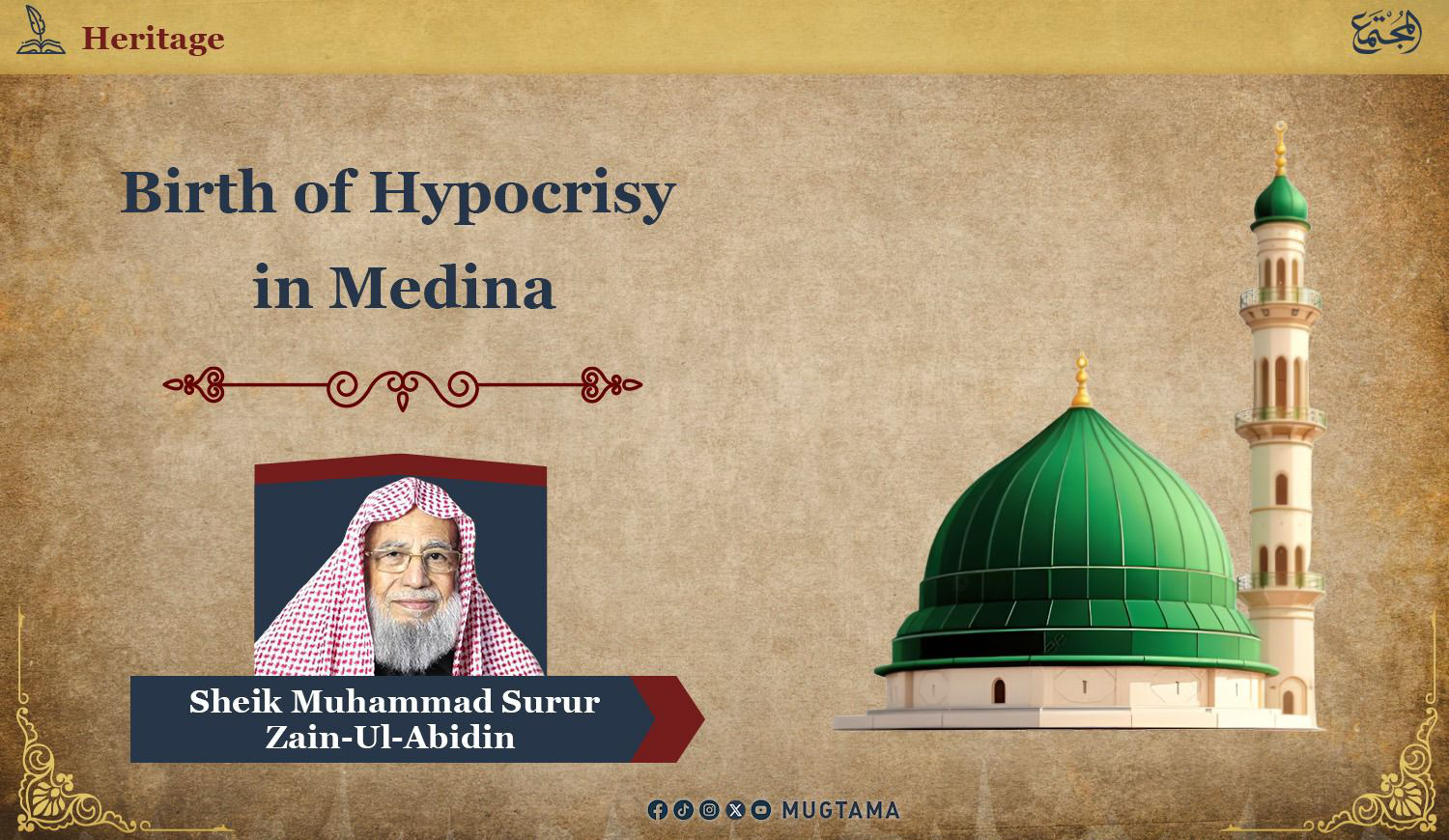
The Birth of Hypocrisy in Medina
The people of Makkah were of two
categories: those who believed in Allah and His Messenger (peace be upon him),
and those who associated partners with Allah and denied the Prophethood of
Muhammad (peace and blessings be upon him). Among the Prophet’s companions from
the emigrants (Muhajirin), there was not a single hypocrite. Hypocrisy only
began to appear among the tribes of the Ansar after the migration (Hijrah),
particularly following the Battle of Badr.
How did Hypocrisy Begin in Medina?
Ibn Kathir discussed the origin
of hypocrisy, saying: “Indeed, the descriptions of the hypocrites were
only revealed in the Medinan surahs of the
Quran, because there was no hypocrisy in Makkah. On the contrary, there were
those who outwardly displayed disbelief under compulsion, while inwardly they
were believers.
When the Messenger of Allah
(peace be upon him) migrated to Medina, the
Ansar of the Aws and Khazraj tribes were there. In their days of ignorance,
they used to worship idols following the practices of the Arab polytheists.
There were also Jews among
them—People of the Book—who followed the ways of their forefathers. They
consisted of three tribes: Banu Qaynuqa`, who were allies of the Khazraj; Banu Al-Nadir;
and Banu Quraydhah, who were allies of the Aws.
When the Messenger of Allah
(peace be upon him) arrived in Medina, many
from the Aws and Khazraj accepted Islam. Few of the Jews embraced Islam—except
for `Abdullah Ibn Salam (may Allah be pleased with him). At that time, there
was still no hypocrisy, because the Muslims did not yet have a position of
power that others would fear. Rather, the Prophet (peace be upon him) made treaties with the Jews and several Arab tribes surrounding Medina.
Then came the great Battle of Badr,
in which Allah elevated His Word and strengthened Islam and its people. At that
time, `Abdullah Ibn Ubayy ibn Salul—who was a leader in Medina and from the
Khazraj, and who had been the chief of the two tribes in the pre-Islamic
period—had nearly been crowned their king. But when the Prophet (peace be upon
him) arrived and the people embraced Islam, they turned away from Ibn Ubayy,
and that left bitterness in his heart toward Islam and the Muslims.
When the victory at Badr
occurred, he said: ‘This matter has now taken its course.’ So he outwardly
embraced Islam but inwardly concealed disbelief. Others followed him in this
hypocrisy—people who shared his mindset, along with some among the People of the
Book. Thus, hypocrisy emerged among the people of Medina and the surrounding
Bedouins. As for the Muhajirin, there was not a single hypocrite among them,
for none of them migrated under compulsion; rather, they left behind their
wealth, children, and homeland out of desire for what Allah Promised them in
the Hereafter.”
The Head of the Hypocrites
The Prophet (peace
be upon him) rode over a donkey with a saddle underneath which there was a
thick soft Fadakiya velvet sheet. Usama Bin Zaid was his companion rider, and
he was going to pay a visit to Sa`d Bin Ubada (who was sick) at the dwelling
place of Bani Al-Harith Bin Al-Khazraj, and this incident happened before the
battle of Badr. The Prophet (peace be upon him) passed by a gathering in which
there were Muslims and pagan idolators and Jews, and among them there was
`Abdullah Bin Ubayy Bin Salul, and there was `Abdullah Bin Rawaha too. When a
cloud of dust raised by the animal covered that gathering, `Abdullah Bin Ubayy
covered his nose with his Rida (sheet) and said (to the Prophet), “Don't cover
us with dust.” The Prophet (peace be upon him) greeted them and then stopped,
dismounted and invited them to Allah (i.e., to embrace Islam) and also recited
to them the Holy Quran. `Abdullah Bin Ubayy' Bin Salul said, “O man! There is
nothing better than what you say, if what you say is the truth. So do not
trouble us in our gatherings. Go back to your mount (or house,) and if anyone
of us comes to you, tell (your tales) to him.” On that `Abdullah Bin Rawaha
said, “(O Allah's Messenger (peace be upon him)!) Come to us and bring it(what
you want to say) in our gatherings, for we love that.” So the Muslims, the
pagans and the Jews started quarreling till they were about to fight and clash
with one another. The Prophet (peace be upon him) kept on quietening them (till
they all became quiet). He then rode his animal, and proceeded till he entered
upon Sa`d Bin `Ubada, he said, “O Sa`d, didn't you hear what Abu Habbab said?
(He meant `Abdullah bin Ubayy). He said so-and-so.” Sa`d bin `Ubada said, “O
Allah's Messenger (peace be upon him)! Excuse and forgive him, for by Allah,
Allah has given you what He has given you. The people of this town decided to
crown him (as their chief) and make him their king. But when Allah prevented
that with the Truth which He had given you, it choked him, and that was what
made him behave in the way you saw him behaving.” So the Prophet excused him. (Sahih
Muslim)
Imam An-Nawawi commented: “They
had agreed to make him their king, and it was their custom that when they made
someone king, they would crown him and tie the turban upon him.”
This narration was reported by `Urwah
from Usamah Ibn Zayd. In another narration reported by Muslim from Ibn Shihab,
there is the addition: “And that was before `Abdullah (Ibn Ubayy) accepted
Islam.”
An-Nawawi explained this addition
as meaning “before he outwardly declared Islam,” for inwardly he was a
disbeliever—a hypocrite displaying obvious hypocrisy.
Stages of Hypocrisy in Medina
Thus, the narration in Sahih
Muslim confirms and authenticates the account cited by Ibn Kathir in his Tafsir,
and both contain many profound lessons, the most important of which are as
follows:
1. The First Appearance of
Hypocrisy in Islam
`Abdullah Ibn Ubayy remained upon
disbelief until the great Battle of Badr, which Allah used to honor His
religion and strengthen the believers. Only then did he outwardly declared
Islam while concealing disbelief. This marked the first emergence of hypocrisy
in Islamic history.
It seems that Ibn Ubayy did not
lose all his hopes until after Badr. Before it, he still imagined he could
expel the Messenger of Allah (peace be upon him) from Medina. He could not
conceive that things would change so drastically within his own domain—that the
bond of faith would become stronger in the believers’ hearts than the bond of
land and lineage, and that his own son, `Abdullah, would become one of the
Prophet’s closest allies and, therefore, one of his father’s greatest
opponents.
2. The Spread of Hypocrisy and
Its Collaborators
Ibn Kathir said: “Groups joined
him—meaning Ibn Ubayy—those who followed his path and method, along with others
among the People of the Book.”
When the leader of the hypocrites
outwardly embraced Islam, his act was not personal but strategic. It laid the
groundwork for a coordinated scheme of deceit, conspiracy, and betrayal. Among
the conspirators were groups from the People of the Book—Jews and Christians
from outside Medina—who entered Islam following the same deceitful approach as
their leader, Ibn Ubayy. Allah the Almighty Said, {As
for the disbelievers, they are guardians of one another. And unless you ˹believers˺ act likewise, there will be great
oppression and corruption in the land.} [Al-Anfal 8:73]
3. The Hypocrites’ Lost Authority
and Hidden Resentment
The people of Medina had
previously agreed to crown `Abdullah Ibn Ubayy as their king after long,
exhausting wars between the tribes of Yathrib. But when the Messenger of Allah
(peace be upon him) arrived, he became the true leader of Medina and its
surroundings.
Ibn Ubayy and his followers—whose
hearts Islam never truly entered—believed that Muhammad (peace be upon him) had
taken power away from them, choosing instead allies from among the poor and the
weak. Under this new rule, slaves dared to speak before their masters.
The hypocrites were from the
elite whose interests, dominance, and customs had been overturned by Islam. It
should also be emphasized that most of the Prophets and Messengers of Allah
throughout history faced opposition from the elite of their people, for the
call to the Oneness of Allah and the rejection of false gods directly clashed
with their desires, wealth, and social control.
The hypocrites were, above all
else, lovers of leadership and slaves to self-interest. They would ride any
vehicle that guaranteed them power and authority. Therefore, they would believe
in the morning and disbelieve by night, speaking to every person in whatever
tone pleased him.
Allah the Exalted Said: {When they meet the believers they say, “We believe.” But
when alone with their evil associates they say, “We are definitely with you; we
were only mocking.”} [Al-Baqarah 2:14]
For Further Reading:
- From Badr to Al-Aqsa Flood... How have Muslims dealt with the POWs?
- Reflections on Urban Development in Medina: Prophethood and Rightly Guided Caliphs Era
- How to Deal with Dissuaders and Rumormongers?
- -------------------------------------------------------------